


Create Your Own AI Girlfriend 😈
Chat with AI Luvr's today or make your own! Receive images, audio messages, and much more! 🔥
4.5 stars


Think of an AI character backstory generator as your personal brainstorming partner, one that uses artificial intelligence to instantly flesh out the histories, motivations, and personalities for your fictional characters. It takes a simple concept and spins it into a complex, believable individual, saving you hours—sometimes even days—of creative heavy lifting.
Go From Blank Page to Living Character Instantly

Every truly great story, game, or role-playing adventure hinges on its characters. But let's be honest, staring at a blank page trying to invent a whole person from scratch is one of the most intimidating parts of the creative process. Building a believable past, giving them nuanced flaws, and defining their core ambitions can stop a project dead in its tracks.
This is exactly where an AI backstory generator proves its worth, becoming an essential tool in any creator's kit. It’s the ultimate cure for creative block, bridging that frustrating gap between a vague idea and a fully realized character. Whether you're a novelist hitting a wall, a game designer populating an epic RPG, or a Dungeon Master prepping for your next session, these tools can deliver that critical narrative spark.
Breathing Life into Your Ideas
Imagine you just have a simple starting point: a skeptical mage. Instead of burning hours trying to figure out the why behind their skepticism, an AI can instantly offer a dozen compelling possibilities. Maybe they were betrayed by a trusted mentor, or they witnessed magic being used for a horrific purpose. Perhaps they were raised in a community where magic was feared and its users persecuted.
Suddenly, you have immediate depth and a solid foundation to build from. The AI doesn't just hand you a flat character sheet; it gives you a person with a story that's already begging to be told. This process often unlocks narrative paths you hadn't even considered, making your world feel far more authentic and lived-in.
For creators, the advantages are clear and immediate. Here’s a quick look at how these tools can reshape your creative work.
How an AI Backstory Generator Transforms Your Workflow
| Benefit | Impact on Your Creative Process |
|---|---|
| Instant Inspiration | Overcomes writer's block by generating unique ideas you might not have considered. |
| Time Savings | Drastically reduces the hours spent on initial character brainstorming and world-building. |
| Increased Depth | Adds layers of complexity, including motivations, flaws, and personal history, with ease. |
| Enhanced Consistency | Helps maintain consistent character details and motivations across a long-form project. |
Ultimately, a good AI backstory generator handles the initial spadework, freeing you up to focus on what you do best: weaving all those threads into a compelling narrative.
An AI backstory generator excels at creating the intricate web of connections and history that makes a character feel real. It can suggest family dynamics, past traumas, and secret desires—all the elements that drive a character’s choices and make them relatable to your audience.
In the end, using AI for character creation is all about boosting your efficiency and sparking your imagination. It takes on the grunt work of foundational world-building, letting you get back to the most important part: telling a fantastic story.
Mastering the Art of the Backstory Prompt

Here’s the thing about getting a great backstory from an AI: the output is only ever as good as the input. If you toss in a lazy, one-line request like "give me a backstory for a knight," you're going to get a bland, cookie-cutter hero straight out of a fantasy starter pack. Every single time.
To create a character that feels real and has genuine depth, you have to think like a prompt architect. It's about carefully layering instructions and giving the AI the specific, juicy details it needs to work with. Think of your prompt less as a command and more as a detailed recipe. The goal is to provide enough creative fuel and clear boundaries to steer the AI away from clichés and toward something that feels like it was written with intent. Honestly, getting this right is the core skill behind using any ai character backstory generator effectively.
Building Prompts from the Ground Up
The best prompts I've ever written have been built in layers. I start with a simple foundation and then start stacking on the interesting details. This methodical approach helps ensure you don't forget anything crucial, and it prevents you from just throwing a messy wall of text at the AI.
Let's say you want a sci-fi smuggler. Instead of stopping there, start building out the concept.
- Core Trait: A charismatic but deeply indebted sci-fi smuggler.
- Defining Event: They lost a priceless cargo that belonged to a ruthless crime syndicate.
- Core Conflict: Now they have to choose between abandoning their loyal crew to save their own skin or facing the syndicate together.
- Desired Tone: Gritty, noir, with a flicker of desperate hope.
See the difference? We just turned a generic archetype into a character with immediate, high-stakes problems and a compelling internal struggle.
The Power of Negative Constraints
Sometimes, the most powerful part of a prompt is telling the AI what not to do. I think of negative constraints as my secret weapon against tired, overused tropes. By specifically telling the AI to avoid certain clichés, you force it to get more creative.
For example, you're trying to create an elf. The AI’s first instinct will be to spit out something about a wise, ancient archer who lives in a magical forest. To head that off at the pass, you can add some guardrails.
Prompt Example: "Generate a backstory for a young, impulsive elf who resents their elders' obsession with tradition. AVOID clichés like them being an archer, living in a magical forest, or being inherently wise. Instead, place them in a bustling, steampunk-inspired city where they work as a disgruntled mechanic."
This little trick completely shoves the AI off its default path. Suddenly, you get a character that subverts expectations and adds a much more interesting dynamic to your world. It's a simple move, but it puts you in the director's chair, ensuring you get something fresh and unique, not just the AI's first, easiest idea.
Keeping Your AI-Generated Characters Consistent
Alright, so you’ve used an AI to generate a fantastic backstory—a character with a genuinely complex past and clear motivations. That initial spark is thrilling, but it's just the start. The real test, and where so many stories begin to wobble, is keeping that character true to themselves across every scene, chapter, or ongoing narrative.
There's nothing that shatters a reader's immersion faster than inconsistency.
Imagine your stoic warrior, who we established has a deep-seated fear of magic from a childhood trauma, suddenly starts slinging fireballs without a second thought. The illusion is broken. The character you painstakingly crafted just becomes a hollow puppet, bent to serve the immediate needs of the plot. This is why consistency isn't just a minor detail; it's the foundation of a believable character.
Create a Character Bible
One of the most powerful tools in my arsenal for maintaining consistency is the Character Bible. Think of it as your single source of truth—a master document for your character that acts as the AI's long-term memory. It's where you lock in every critical detail. Before I start any new scene, this document is the first thing I open.
But a good bible is more than just a list of facts. It needs to be a living, breathing profile that you update as your story unfolds.
- Core Backstory: Pin down the key, defining events the AI generated. These are the non-negotiables.
- Personality Traits: List their core traits (e.g., cynical, reckless, fiercely loyal) and, most importantly, jot down why they are that way, tying it directly back to their history.
- Speech Patterns: Does your character have a unique voice? Note their vocabulary, accent, or any verbal tics. Do they use slang or speak formally?
- Relationships: Map out their connections to others—family drama, bitter rivalries, and cherished friendships.
- Key Memories: Document the specific, emotionally charged memories the AI came up with. You can reference these later to trigger authentic emotional responses.
By compiling all these details, you build a powerful reference guide that prevents you (and the AI) from accidentally contradicting your own story. Before you prompt the AI for a new scene, you can feed it key snippets from the bible to remind it of the established canon. This ensures every word and action feels earned.
Using Style Guides and Custom Instructions
Many of the more sophisticated AI platforms offer a feature for custom instructions or style guides. This is your chance to get ahead of the game and proactively shape the AI's behavior. Instead of just prompting for a backstory and hoping for the best, you’re giving the AI a permanent set of rules for how to portray your character.
This is especially valuable for platforms like Luvr AI, where you might be in a long-term role-play and need the AI to remember subtle personality quirks over time. You can explore how an AI character chat can be used to maintain that crucial consistency across countless interactions.
The demand for these kinds of believable, consistent AI characters is absolutely booming. The global AI character generator market was valued at around US$849 million and is projected to skyrocket to US$1.958 billion by 2031. This explosive growth is all being driven by our collective desire for more immersive and authentic digital experiences. It’s a clear signal that mastering the tools to keep characters believable isn't just a nice-to-have skill anymore—it's essential.
Alright, so you’ve used an AI generator to create a fantastic, detailed backstory for your character. That's a huge win, but what now? The real work—and the real fun—begins when you start weaving that history into your creative project.
A backstory isn't just a document you file away. It's the engine that drives your character. The magic happens when you let that past inform their every move, making it a living, breathing part of their story.
Turning Backstory into an Active Tool
The goal is to move beyond a static character sheet and let their history reveal itself naturally. Forget about clunky exposition dumps. Instead, let their past bleed through their actions, their dialogue, and the choices they make under pressure.
Think about it: a character who has been betrayed before will be hesitant to trust new allies. Someone who grew up with nothing might compulsively hoard supplies. These small, consistent behaviors make the backstory feel real and your character far more believable.
The trick is to constantly ask yourself, "How would their past experiences shape their reaction right now?" This simple question turns that generated backstory from a text file into a powerful guide for every single scene.
Imagine you're developing a game. A character's fear of heights—something you established in their AI-generated past—could become a core gameplay obstacle or even unlock a unique side quest. If you're writing a novel, a traumatic memory could surface in a dream, triggered by a seemingly innocent word, and completely change the direction of the plot.
This simple workflow keeps everything on track, ensuring the character you create stays consistent from start to finish.
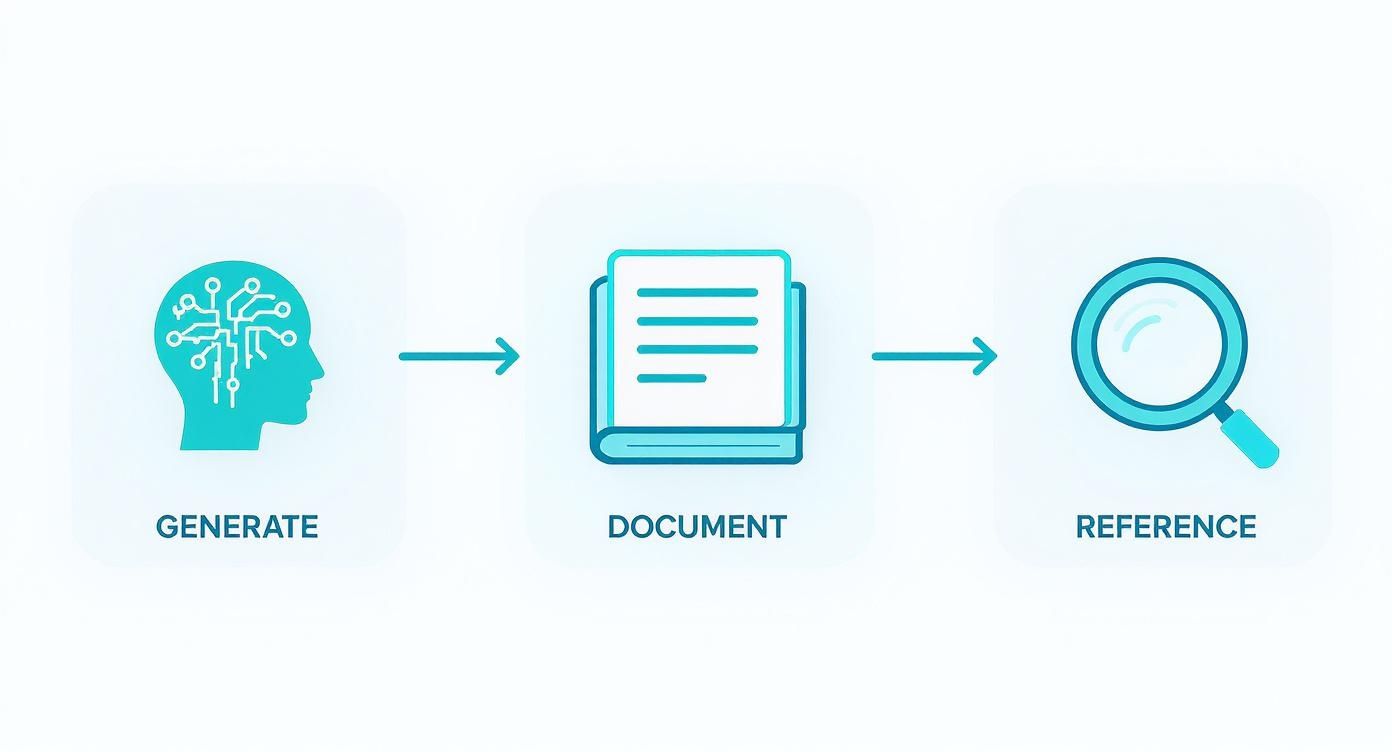
It really boils down to three simple actions: Generate, Document, and Reference. This loop ensures those brilliant details you came up with don't get lost, but instead become a foundational part of your work.
And this isn't just a niche hobby. The market for creative AI tools is booming. The AI-enhanced story plot generator market, which covers backstory creation, was valued at USD 1.47 billion and is expected to skyrocket to USD 11.84 billion by 2033. This shows just how much creators are relying on AI to build out the kind of deep, coherent character histories that captivate audiences.
Keeping Your Character Data Straight
So how do you keep all this information organized? Platforms like Luvr AI are built for exactly this. You can store the most important backstory elements directly within your character's profile. This creates a kind of persistent memory that the AI can pull from in any future interaction or scene you create.
My Advice: When you're saving character data, don't just copy and paste everything. Focus on the core memories and emotional turning points. What are the moments that truly define their personality, their fears, and their motivations? That's the stuff the AI needs to create genuinely impactful moments.
By doing this, you ensure your character’s personality and history remain rock-solid across long-term projects. You can even take it a step further by pairing their story with a distinct visual identity. Learning how to use AI character images can really bring them to life.
This level of consistency transforms your character from a one-off idea into a true creative asset you can use again and again.
Navigating Privacy and Creative Ownership
Jumping into an AI character backstory generator feels like a true creative partnership. But this exciting new frontier opens up a Pandora's box of very real questions.
Who actually owns the incredible character you just brought to life with the AI? And is your private, imaginative work secretly being fed back into the machine to train some corporation's next big model?
These aren't just philosophical questions. They're critical ethical and legal issues you need to tackle to protect your work and your privacy. The answers are almost always buried deep within a platform’s Terms of Service (ToS)—that long, dense document most of us scroll right past.
Understanding Your Rights and Data
When you're picking an AI tool, you have to put on your detective hat for a few minutes. Your mission is to find clear, simple language that confirms two very important things: you retain full ownership of your creations, and your private inputs are not used to train their AI models.
Scan for headings like "Intellectual Property," "User Content," or "Data Usage Policy." If a service’s terms are vague or mention they can use your content for "improving their services," treat that as a giant red flag.
Platforms that actually respect creators will state, without any confusing jargon, that your work remains yours. Full stop. This kind of clarity is non-negotiable, especially if you ever plan to use these characters in commercial projects or just want basic peace of mind.
The explosive growth of these tools makes this kind of scrutiny more important than ever. Character.ai, for example, reported a staggering 20 million monthly active users and saw its revenue more than double from $15.2 million to $32.2 million in a single year. With that much data changing hands, you absolutely need to know where you stand.
Your creative ideas are valuable. Choose an AI partner that treats them that way by offering clear, creator-friendly terms that prioritize your ownership and privacy above all else. Don't settle for anything less.
For instance, platforms like Luvr AI are built with user privacy as a core principle, which is essential given the personal nature of the characters people create. These concerns become even more critical when you're exploring sensitive or mature themes, a topic we cover in our guide to NSFW AI.
Ultimately, using these powerful tools with confidence means doing your homework first. A few minutes of reading can save you a world of headaches down the road.
Your Questions About AI Character Generation Answered
Jumping into AI-powered creativity brings up a lot of questions. It’s a powerful tool, and like any tool, it’s smart to understand its strengths, its limits, and how to really make it work for you. Let's cut through the noise and get straight to the practical answers you're actually looking for.
Can an AI Generator Create a Truly Unique Character?
It absolutely can, but with one big catch: it all comes down to your guidance. If you feed an AI character backstory generator a generic prompt, you'll get a generic character back. It’s just spitting out a mashup of the most common tropes it was trained on.
The real magic happens when you give it unique, specific details to work with. That's how you get a character that feels genuinely original.
Don't just ask for a "tough mercenary." Instead, try something like: "a tough mercenary who secretly volunteers at an animal shelter and has an irrational fear of butterflies." See the difference? That kind of prompt forces the AI off its well-worn path. Feed it weird little snippets from your own life or obscure historical facts you find interesting.
The more you treat the AI as a brainstorming partner instead of a vending machine for ideas, the more unique and memorable your results will be.
Think of it this way: AI is an incredible mimic. It can only connect ideas it has already seen. Your job is to give it new, unexpected combinations that push it to create a backstory that feels completely fresh, because the ingredients were uniquely yours.
How to Fix a Backstory That Misses the Mark
It's going to happen. You'll get a backstory that's 80% brilliant, but one part just feels… off. It clashes with your story's tone or a key plot point. Your first instinct might be to scrap the whole thing and start over, but that's rarely the best move.
Instead, think of it as a first draft and start a conversation with the AI. Isolate the part you don't like and tell it exactly how to fix it. This approach is way faster and lets you keep all the good stuff you already have.
Here are a few ways I do this all the time:
- Ask for an alternative: "I like this, but can you rewrite the section about their time in the military? Instead of a decorated soldier, make them a disillusioned deserter."
- Shift the focus: "Good start, but let's dig deeper into their childhood rivalry with their sibling. Make that the central conflict of their early life."
- Explore a 'what if': "Generate an alternate timeline where they never left their hometown. How would that have changed their personality and goals?"
This kind of back-and-forth turns the AI into a dynamic editing partner, letting you fine-tune the narrative with precision until it’s perfect.
Finding Free AI Character Backstory Generators
Yes, there are plenty of free tools out there that can produce excellent results. But "free" doesn't always mean "good," and you need to know what to look for so you don't waste your time.
When you're checking out a free generator, I'd suggest prioritizing these three things above everything else:
- Customization and Control: Does it let you type in detailed prompts, or are you stuck with a few dropdown menus? The best free tools give you a ton of control.
- A Clear Privacy Policy: You need to know what's happening with your ideas. Look for a clear statement that your inputs aren't being used to train their models and that you own what you create.
- Export and Save Options: A great backstory is useless if it's trapped on their website. Make sure you can easily copy, download, or save your work.
If you focus on those practical features, you can find a solid free AI character backstory generator that respects your creativity and gives you the quality you need without costing a dime.
Ready to create characters with truly deep and consistent backstories? Luvr AI gives you the tools to not only generate compelling histories but also store them directly in your character's profile, ensuring they remember every detail of their past in every conversation. Start building your unforgettable character on Luvr AI today!