


Create Your Own AI Girlfriend 😈
Chat with AI Luvr's today or make your own! Receive images, audio messages, and much more! 🔥
4.5 stars

An AI character voice is more than just a synthesized sound; it's the unique vocal identity that brings a virtual persona to life. We're moving far beyond those old robotic tones. This is about creating a voice that can express genuine personality and emotion, making every interaction feel human, believable, and truly engaging. It's the auditory soul of a digital being.
Defining the Soul of Your AI Character Voice
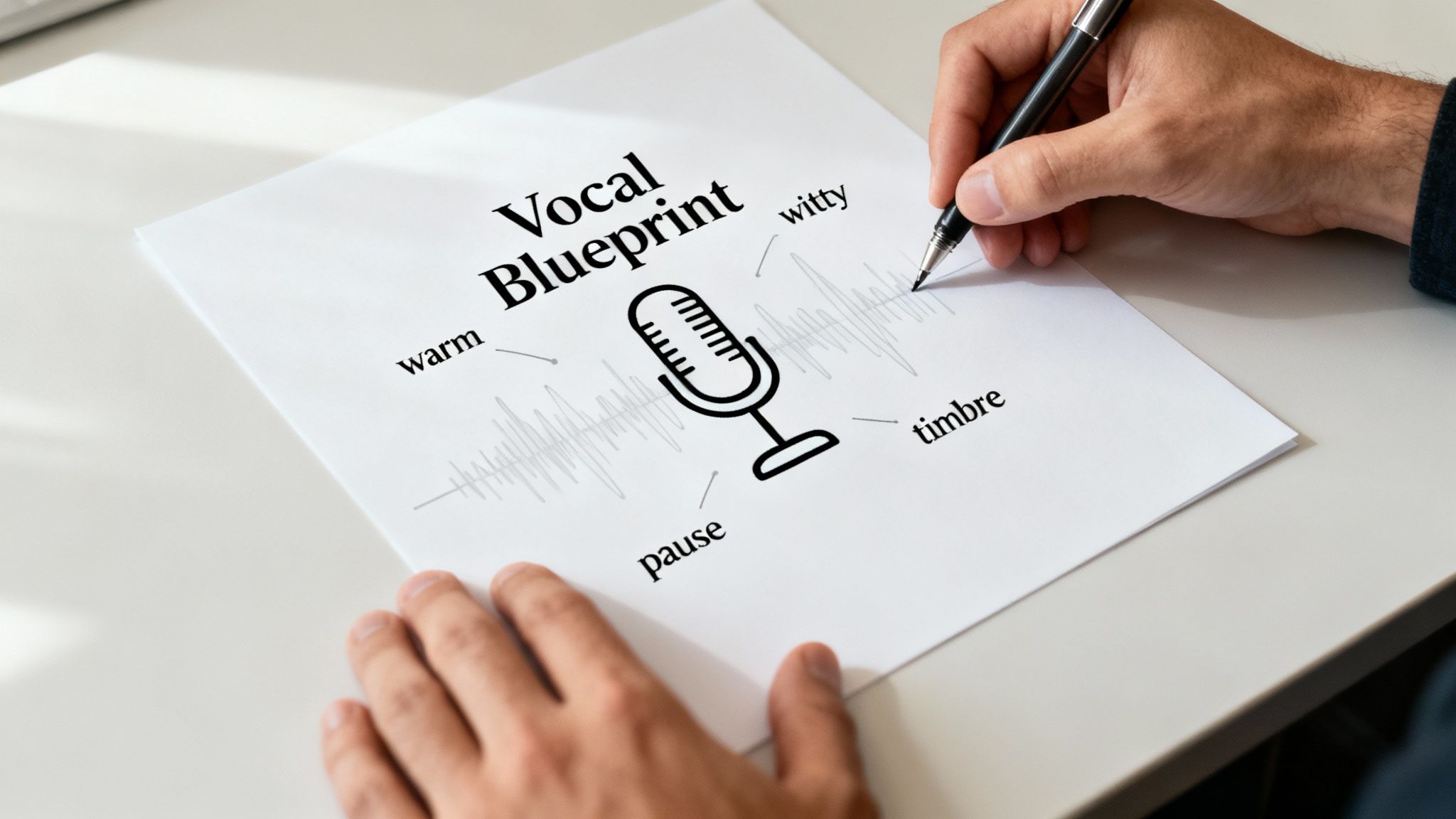
Before you even think about APIs, text-to-speech engines, or audio settings, you have to nail the essence of your AI character. This is the most critical step. A compelling voice isn’t just a pleasant sound; it's about the story it tells and the connection it forges with the user.
Skipping this foundational work is like trying to build a house without a blueprint. Sure, you might end up with four walls and a roof, but the final result will feel hollow and lack purpose.
The real goal here is to create a detailed "Vocal Blueprint," a document that maps out every single facet of your character's vocal identity. This needs to go way beyond simple descriptors like "friendly" or "deep." It's a deep dive into the nuances that make a voice unforgettable.
Think about it. If you're designing a reassuring guide for a mental health app, her voice should probably have a lower pitch, a slower pace, and a gentle, almost breathy quality. This is what inspires calm. But a witty sidekick in a video game? That demands a completely different approach. Their voice would need to be sharp and quick, full of upward inflections and dynamic tonal shifts to land every sarcastic remark with energy.
Crafting a Rich Personality Profile
To build a voice that feels authentic, you first need to understand the character behind it. I like to think of this as developing a full backstory for an actor. A character's history, their core motivations, and their personality traits all directly influence how they speak.
Start by asking yourself some key questions:
- What's their core archetype? Are they a wise mentor, a rebellious rogue, a nurturing caregiver, or a playful trickster?
- What are their emotional tendencies? Are they naturally optimistic, cynical, anxious, or stoic? This will directly shape their default intonation.
- What are their unique quirks? Do they have a slight laugh in their voice when they get excited? Do they pause thoughtfully before answering a tough question?
These are the tiny details that separate a generic AI from a character that feels real. And remember, the voice must align with the entire persona, including their visual style. If you're working on that too, our guide on creating compelling AI character images can help you ensure that what users see matches what they hear.
Key Takeaway: A truly memorable AI character voice is born from a deep understanding of personality, not just technical settings. Invest the time in defining who your character is before you decide how they should sound.
Translating Persona into Vocal Attributes
Once you have a crystal-clear picture of the personality, you can start translating those traits into specific, actionable vocal attributes. This is where you bridge the gap between your creative vision and the technical execution. Mapping out these specifics will guide everything from which tool you choose to how you engineer your prompts later.
Let's take a "confident and authoritative" CEO character, for example. We can translate that persona into a concrete vocal profile:
- Pitch: Consistently in the lower-mid range, avoiding any high-pitched sounds that might suggest uncertainty.
- Pace: Deliberate and measured, speaking at a steady clip of around 140-160 words per minute.
- Volume: Firm and steady. The voice should command attention without ever shouting.
- Intonation: A downward inflection at the end of sentences to convey a sense of finality and conviction.
This Vocal Blueprint becomes your north star. It ensures every decision you make—from choosing a TTS engine to fine-tuning the prosody—serves the character's core identity. It turns the technical process from frustrating guesswork into the focused execution of a fully-formed vision.
Alright, you've got your Vocal Blueprint nailed down. You know who your character is, what they sound like in your head, and the energy they bring to a conversation. Now comes the exciting part: bringing that voice to life with the right tech.
This is where you hit a fork in the road. On one side, you have powerful and flexible Text-to-Speech (TTS) engines. On the other, you have the incredible realism of Voice Cloning. This isn't just about picking a tool; it's a strategic choice that impacts everything from your workflow to the final feel of your character.
Think of it like casting for a movie. You could go with a versatile character actor who can convincingly play a dozen different roles—that's your TTS. Or, you could hire a specific star for that one iconic, unforgettable performance—that's Voice Cloning. Both are great options, but they serve very different purposes.
The New Age of Neural TTS
Let's be clear: this isn't the robotic, monotone speech from a decade ago. Modern neural TTS has completely changed the game.
Engines from providers like Google, Microsoft Azure, and Amazon Polly use deep learning to generate speech that has a genuinely human-like rhythm and intonation. It's a fantastic middle-ground, offering a blend of high quality, scalability, and fine-tuned control.
You get a whole library of pre-built voices you can tweak with pitch, rate, and emotional emphasis. For most projects, especially if you need a reliable and budget-friendly ai character voice, a top-tier neural TTS is more than enough to create something truly compelling.
The progress here has been wild. We've seen major players like Siri and Alexa switch entirely to neural TTS, making their voices almost indistinguishable from a real person. Then came breakthroughs like Microsoft Research's VALL-E, a model that can mimic a voice from just a three-second audio clip. It’s a glimpse into a future where custom voice creation becomes even easier.
Crafting a Signature Sound with Voice Cloning
If TTS is like casting a great actor, voice cloning is like creating your own. This process builds a completely unique AI voice model from recordings of a real human. You aren't picking from a list; you're crafting a one-of-a-kind vocal identity that belongs entirely to you.
This is the high-end route. It often means a bigger investment in studio time, hiring a voice actor, and processing the data. So, when does it make sense to go all-in?
- A Truly Unique Brand Identity: You need a voice that is exclusively tied to your brand or a flagship character.
- Deep Emotional Range: Your character needs to convey subtle, nuanced emotions that a generic TTS might not quite capture.
- Total Exclusivity: You want to create a persona that literally no one else can copy.
A cloned voice captures all the little imperfections, the unique cadence, and the subtle breathing patterns of the original speaker. It’s that layer of raw authenticity that’s so hard to get with standard TTS. It feels less like a performance and more like a presence.
Choosing the right technology is a big decision, but it's not set in stone. The table below breaks down the practical differences to help you weigh your options.
TTS vs Voice Cloning A Practical Comparison
| Feature | Text-to-Speech (TTS) | Voice Cloning |
|---|---|---|
| Uniqueness | Low to Medium. You're using a pre-built voice from a library that others can also use. | High. The voice is completely proprietary and exclusive to your project. |
| Cost | Generally lower. Often a pay-as-you-go model or a flat subscription fee. | Higher upfront investment for actor fees, studio time, and model training. |
| Speed | Instant. You can generate audio immediately after typing your text. | Slower to start. Requires recording sessions and data processing before you can use the voice. |
| Control | Good. You can control pitch, speed, and volume, with some emotional control via SSML tags. | Excellent. The model is trained on specific emotional deliveries for much finer control. |
| Best For | Prototyping, scalable content, projects with diverse character needs, and budget-conscious creators. | Flagship characters, brand-specific voices, and projects requiring maximum realism and emotional depth. |
Ultimately, both paths lead to amazing results. The best choice really depends on your project's goals for uniqueness, emotional fidelity, your budget, and how quickly you need to get moving.
For creators using platforms like Luvr AI, you have the freedom to experiment. You might start with a great TTS voice to get a feel for your character and later decide to invest in a custom-cloned voice. You can start bringing your ideas to life right now in our AI character builder.
3. Directing the Performance: Prompts and Prosody
Picking a voice engine is just the first step. The real art of creating an AI character that feels truly alive is in the performance—all those subtle inflections, emotional beats, and pacing that make speech human. This is where you stop being a technician and become a director, using prompts and prosody to shape every single line.
Think of it this way: your text is the script, but the AI is an actor waiting for direction. If you just hand it the lines, you'll get a flat, lifeless table read. Your job is to be the director in the booth, guiding the AI to understand the feeling behind the words, not just the words themselves.
This isn't about just tossing an exclamation mark at the end of a sentence to show excitement. It's a hands-on loop: write, listen, tweak, and repeat. You’ll craft prompts that suggest emotion, hear how the AI interprets them, and then refine your approach until the delivery is spot on for your character.
Crafting a Better Prompt
The text you feed the AI is what sets the stage for its entire performance. A simple sentence like "I can't believe you did that" could mean a dozen different things. Your prompt needs to give the AI the context it's missing.
A great trick is to frame the line with emotional or action-based cues, often in brackets. Many models are trained to interpret these as stage directions.
- For pure anger:
[shouting, frustrated] I can't believe you did that! - For quiet disbelief:
[whispering, astonished] I can't believe you did that. - For a sarcastic jab:
[laughing] I can't believe you did that.
This decision point—whether to use a flexible TTS engine or a specific cloned voice—is the first fork in the road for your prompting strategy.
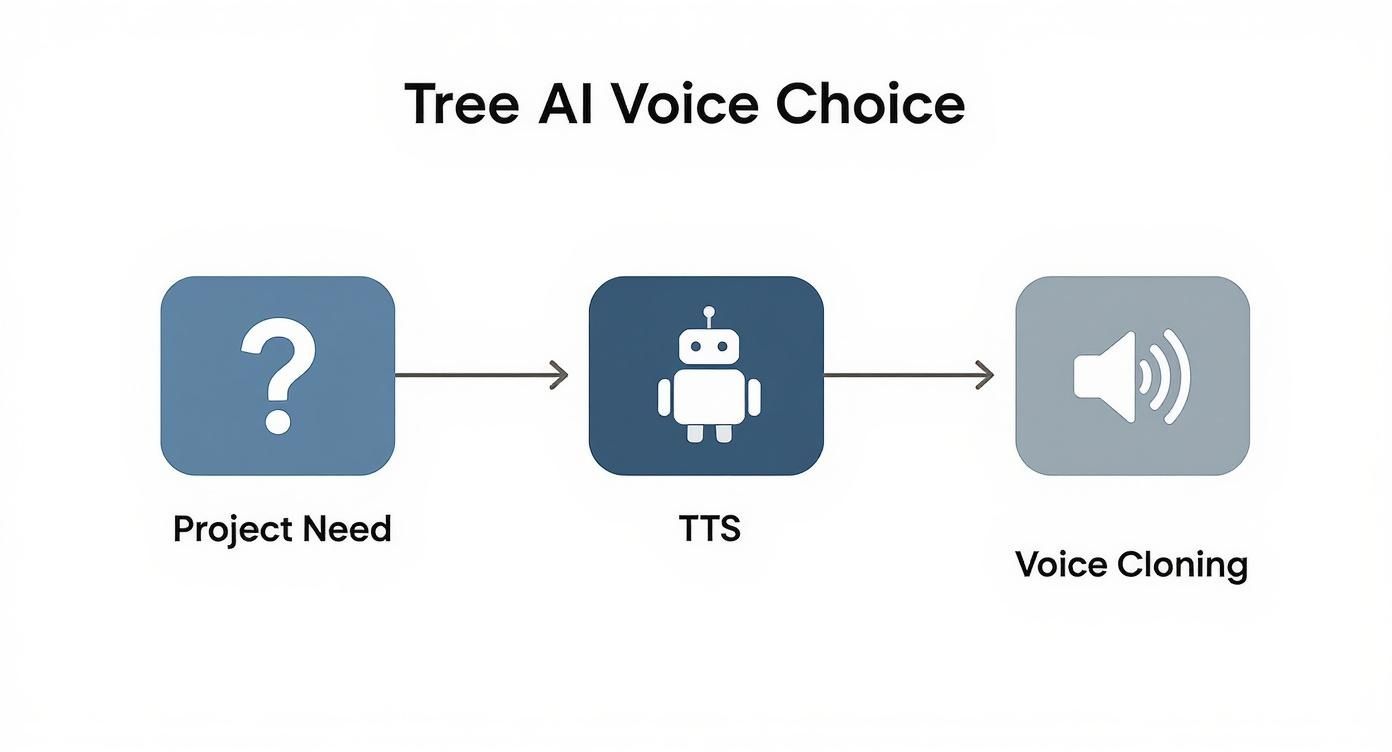
As the chart shows, your project's needs will push you toward either the broader control offered by general TTS or the pinpoint realism of a cloned voice, each requiring a different directorial touch.
Getting Granular Control with SSML
Sometimes, simple prompts aren't enough. When you need surgical precision over the delivery, it’s time to bring in Speech Synthesis Markup Language (SSML). Think of SSML as the industry-standard toolkit that lets you fine-tune the vocal performance right inside your text.
SSML is your secret weapon. It gives you director-level control over the AI's performance. Learning just a few basic tags can take a robotic delivery and turn it into something with real nuance and emotion.
With SSML, you can control the nitty-gritty details:
- Rate: Speed things up for a panicked character or slow them down for someone deep in thought.
- Pitch: Nudge the pitch higher to convey excitement or lower it for a more serious, somber tone.
- Pauses: We don't talk in a continuous stream. Inserting strategic pauses (a half-second here, a full second there) for dramatic effect or to mimic a natural breath makes a world of difference.
Believe it or not, the dream of synthetic speech started over 250 years ago with clunky mechanical talking machines. The real breakthrough came in 1939 with Bell Labs' VODER, the first electronic speech synthesizer, which laid the groundwork for the AI voices we have today. You can dive deeper into the fascinating history of text-to-speech to see just how far we've come.
By blending evocative prompts with the precision of SSML tags, you build a powerful workflow for directing your AI character. This cycle—prompt, listen, tune, and repeat—is what elevates an AI voice from just "good" to truly captivating.
Integrating Your Voice for a Seamless Experience
https://www.youtube.com/embed/qq13yG32rUk
You’ve done the hard work of crafting a unique persona and dialing in the perfect vocal performance. But all that effort goes to waste if the delivery is clunky. This is the final, critical step: making sure your AI character voice reaches the user without a hitch.
The goal here is a completely seamless interaction. We want it to feel instantaneous, like a real conversation. Any delay, even a slight one, shatters the illusion of presence. It all comes down to the technical plumbing, specifically a smart API integration.
Beating Latency for Real-Time Conversations
Latency is the absolute enemy of immersion. When a user has to wait even a half-second for a reply, the magic is gone. The entire conversation feels stilted and robotic. Your mission, should you choose to accept it, is to crush that delay.
In my experience, the biggest bottleneck is waiting for the AI’s full text response before you even start generating the audio. That's a rookie mistake. A much smarter way to work is to use streaming.
- Embrace Streaming APIs: Look for a voice provider that offers streaming. This is a game-changer. It lets you start playing the audio for the first few words of a sentence while the rest is still being generated in the background.
- Pre-Bake Common Phrases: You know your character will say things like "Hello!" or "How are you?" thousands of times. Don't generate that audio on the fly. Pre-generate these common responses and have them ready to go.
- Get Close to Your Users: Network lag is real. If your users are mostly in Europe, don’t use a voice API server based in California. Choose a provider with servers located geographically close to your audience.
These tactics, when used together, make the conversation feel snappy and responsive, keeping your users completely engaged.
Building a Resilient Voice System
So, what happens when your character goes viral and you get a massive traffic spike? Or when your voice provider’s API has a hiccup? If you haven't planned for this, your system will crumble, and the user experience will fall apart. You have to design for both success and failure.
Your integration isn't just about making things work; it's about making sure they don't break. Smart caching and graceful error handling are the invisible pillars that support a truly seamless and professional user experience.
Caching is your best friend for building a robust system. Instead of hitting an API to generate the same audio for a common phrase over and over, you generate it once, store it, and serve it directly. This move alone will slash your API costs, cut down on latency, and make your whole platform feel faster.
You also need a solid backup plan for when things go wrong. If your primary voice API fails, don't just throw up an error. Fail gracefully. You could automatically switch to a more basic, secondary TTS provider. Or, at the very least, have the character send a text-only response explaining the situation, like, "My voice seems to be having a little trouble, but I can still chat."
This is how you build a reliable AI character—one that keeps the conversation going no matter what.
Navigating the Ethical and Legal Maze

As your AI character’s voice gets more realistic, your responsibility as a creator shoots through the roof. This is the one part of the process you absolutely cannot afford to gloss over. Building with integrity means laying down a solid ethical foundation right from the very beginning.
When you get into voice cloning, consent isn't just a good idea—it’s everything. A person’s voice is a core part of their identity. Cloning it without their explicit, informed, and written permission is a massive ethical overstep and can land you in serious legal trouble for violating their right of publicity.
This isn’t about a quick signature on a form, either. You need a rock-solid agreement that clearly lays out compensation, usage rights, and strict boundaries on how the cloned voice will be used. This is what protects the voice actor from misuse and gives your project the legal ground it needs to stand on.
Safeguarding Against Misuse
Let's be honest: with this kind of powerful tech comes the real risk of misuse. A hyper-realistic AI voice could be weaponized to create fake endorsements or spread disinformation. As the creator, it’s on you to build in safeguards.
A great place to start is with transparent watermarking or disclaimers, especially in sensitive contexts. Make it crystal clear that users are interacting with an AI. It's also vital to have ironclad terms of service that explicitly forbid malicious use. For platforms like Luvr AI, user trust is our currency, and our own legal framework is built to protect everyone involved.
Building ethically isn't about stifling your creativity; it's about steering it in the right direction. A strong ethical framework doesn't just keep you out of court—it builds the deep user trust your creation needs to actually succeed.
The technology itself has come an incredibly long way. We've gone from early systems like Bell Labs' Audrey, which could recognize single digits back in 1952, and IBM’s Shoebox, which understood just 16 words, to the incredibly sophisticated tools we have today. The launch of Dragon NaturallySpeaking in 1997 was a huge leap, but it’s all built on that foundational work. If you're interested, the full history and evolution of voice recognition technology is a fascinating read.
Upholding User Privacy and Transparency
Finally, always play it straight with your audience. Data privacy is a non-negotiable part of ethical AI.
- Disclose the AI: Users should never be tricked into thinking they're talking to a real person.
- Secure Conversation Data: All user interactions must be encrypted and stored securely. You need clear, public policies on how you handle that data.
- Give Users Control: Let users manage their own data, including the option to wipe their conversation history clean.
Weaving these principles into your project from the start is how you build an experience that’s not just immersive, but also safe and respectful. It’s this proactive stance on ethics that separates a flash-in-the-pan project from a brand that people trust for the long haul.
Got Questions About AI Character Voices? Let's Talk.
As you start bringing an AI character to life, questions are bound to pop up. It’s one thing to have a concept, but it's another to get into the nitty-gritty of making it real. I get asked about this stuff all the time, so let's clear up a few of the most common sticking points.
This isn't about drowning in technical specs. It's about getting straight answers so you can make the right calls for your project, whether you’re crafting a supportive friend or a bold adventurer.
So, What's This Going to Cost Me?
The price for an AI character voice can be all over the map, honestly. If you're just starting out or working with a tight budget, your best move is to use a high-quality, pre-built neural voice from one of the big TTS providers. You usually pay per million characters of audio you generate, so it’s a super flexible and affordable way to get going.
But if you need a voice that’s completely unique to your character, you're looking at a much bigger investment. A custom-built neural voice or a professional voice cloning project is a serious piece of work. The costs can easily climb into the thousands of dollars when you account for:
- Hiring a Voice Actor: You need to pay a professional for their talent and time in the booth.
- Studio Time: Clean, high-quality audio is the foundation of a good voice model, and that means professional recording.
- Training the Model: This involves significant computing power and the expertise to process all that audio data and build the final voice.
Ultimately, the final price really depends on how exclusive and polished you want the voice to be.
What’s the Hardest Part of Making an AI Voice Sound Human?
Without a doubt, the biggest challenge is nailing the prosody—that natural rhythm, a T-shirt, and the unique intonation that makes speech feel real. Today’s AI is incredibly good at pronouncing words correctly, but capturing the musicality and emotional undertones of a real conversation? That's still the final boss.
A flat delivery or a weirdly emphasized word can shatter the illusion in a heartbeat.
The real magic is in the imperfections. It’s the tiny pauses, the soft breath before a sentence, or the way someone’s voice trails off when they're thinking. High-end voice cloning is all about capturing these little details that turn a synthetic voice into a soul.
You can get 90% of the way there with clever prompting and fine-tuning with SSML. But that last 10%—conveying subtle emotions like sarcasm or genuine warmth—requires a human touch and a director's ear. It's that final polish that makes an AI voice feel truly present and alive.
Can I Just Clone Any Voice I Like?
Let me be crystal clear: No, absolutely not. This is a massive legal and ethical line you cannot cross.
Cloning someone's voice without their direct, informed, and written permission is a serious violation of their personal rights. A person's voice is part of their identity, and it's protected by law. Don't even think about it.
Any project that involves voice cloning must be built on solid legal ground. That means a formal contract that spells out everything: payment, exactly how the voice can be used, and clear limits on its application. This is non-negotiable for protecting the voice actor, your project, and yourself.
Ready to create an AI character that you can truly connect with? At Luvr AI, we give you the tools to design unique, immersive companions with personalities and voices that feel real. Explore what's possible and start building your ideal AI today.