


Create Your Own AI Girlfriend 😈
Chat with AI Luvr's today or make your own! Receive images, audio messages, and much more! 🔥
4.5 stars


An AI chat character isn't just a bot. It's a personality, a digital actor you bring to life to engage users in real, human-like conversations. Think of it less as lines of code and more as your brand's voice, a customer's personal guide, or a user's trusted friend. The goal is to build genuine connections that foster loyalty and drive results.
Why Your Next Big Thing Should Be an AI Chat Character
Welcome to the new frontier of digital connection. A well-designed AI chat character is a powerful asset, moving far beyond generic, automated replies to create persuasive and unforgettable experiences. The secret to standing out isn't just having a bot—it's crafting a character that resonates with people on a human level.
This isn't just a fleeting trend; it's a fundamental shift in how we interact online. The global AI chatbot market, which is the engine behind every AI character, is absolutely exploding. It’s already valued between $10-15 billion and is on track to hit nearly $47 billion by 2029.
This growth isn't just about investment—it's about adoption. A staggering 70% of all customer interactions are expected to involve AI technologies like these very soon. People aren't just getting used to them; they're starting to expect them.
The Heart of Character Creation
Building a memorable AI character is about much more than just programming responses. It's about crafting a personality. The best characters have a defined backstory, a unique voice, and consistent traits that make them feel authentic and believable.
The process boils down to three key phases: defining your character's purpose, building out its personality and conversational skills, and finally, connecting it with your audience.
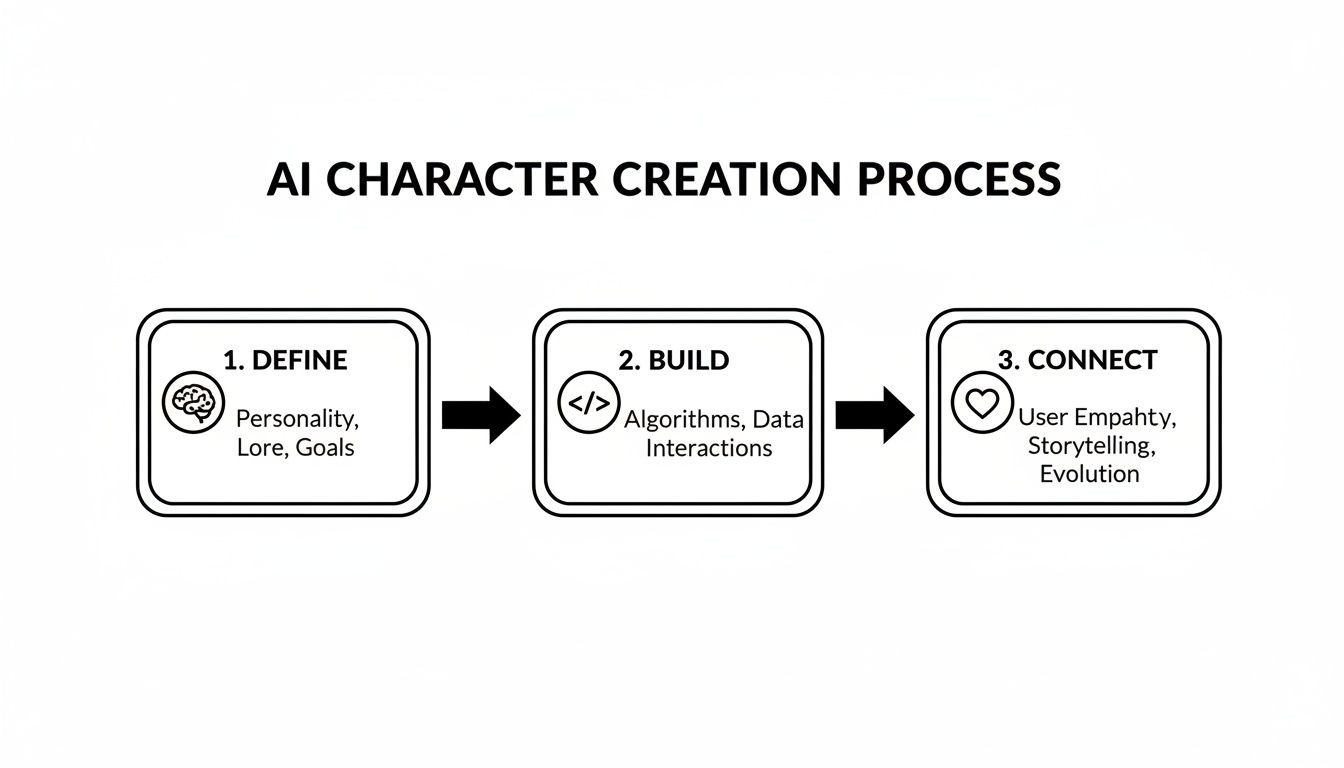
This workflow shows that the initial strategic thinking is every bit as important as the technical execution. When you get all these elements working in harmony, you end up with an AI that feels less like a tool and more like a real personality.
To build a character that truly connects, you need to focus on a few core pillars. These elements are the foundation of any compelling AI persona, ensuring consistency, depth, and believability in every interaction.
Core Pillars of AI Character Design
| Pillar | Key Objective | Example Application |
|---|---|---|
| Persona | Define the character’s core identity, including their backstory, personality traits, and motivations. | "Anya is a 25-year-old adventurous historian from Cairo, witty, curious, and a bit sarcastic." |
| Voice & Tone | Establish a consistent and unique communication style. | Anya speaks informally, uses modern slang, and often makes historical puns. |
| Knowledge Base | Provide the character with the specific information it needs to be an expert in its domain. | Anya's knowledge base includes detailed facts about ancient civilizations, mythology, and archaeology. |
| Interaction Logic | Design how the character responds to different user inputs, moods, and conversational paths. | If a user asks a basic question, Anya gives a fun fact. If they seem frustrated, her tone becomes more empathetic and direct. |
These pillars ensure that your character isn't just answering questions but is engaging users in a way that feels natural and true to who they are.
By focusing on persona from the very beginning, you create an emotional connection that transforms a simple interaction into a lasting relationship. This is the difference between a bot that users tolerate and a character they genuinely want to talk to.
This guide is your complete roadmap for the entire process. We’ll walk through everything from designing your character's core identity to launching it effectively. For those ready to dive in, you can explore the powerful tools for building an AI character chat right on our features page. Our mission is to help you build a character that doesn't just reply, but truly connects.
Making Your Character Someone People Want to Talk To

Let's be honest: the difference between a bot that just spits out answers and an unforgettable AI chat character is its persona. This is where the magic happens. We're talking about the soul of your creation—the unique blend of traits, memories, and little quirks that make it feel real. A solid persona is what turns a simple Q&A into a genuine connection.
Think of yourself as a novelist. You wouldn't just create "a detective." You'd create a grizzled, coffee-addicted detective haunted by a past case, right? That’s the level of depth we’re aiming for here.
First, Figure Out Who Your Character Is
Before you even think about prompts, you need a crystal-clear picture of who this character is. This goes way beyond just listing a few adjectives. It’s about building a believable individual from the ground up.
Start by digging into these core areas to give your character some real substance:
- Backstory: Where did they come from? What key moments in their past define them now? A good backstory is the foundation for everything they say and do.
- Motivations: What gets them out of bed in the morning? Are they looking for adventure, knowledge, or maybe just a good friend? Their goals will shape the entire conversation.
- Personality Traits: Don't just settle for "friendly." Are they sarcastic but with a heart of gold? Deeply empathetic? Endearingly awkward? Pinpoint their most dominant traits.
- Flaws and Quirks: Nobody's perfect, and that's what makes us interesting. A character who is a bit too curious or hilariously forgetful feels far more human and relatable.
So, instead of a generic "helpful assistant," you might create "Orion." He's a disgraced galactic archivist, exiled to Earth's internet. He uses his incredible (though sometimes unreliable) memory to help people, all while wistfully talking about the nebula he misses. See the difference? Now you have a character.
The AI characters that truly stick with you are the ones with a real point of view. They don’t just serve up facts; they have opinions, they get surprised, and they show a little vulnerability. That’s what makes a user feel like they’re chatting with a personality, not just a program.
Keep It All Straight with a "Character Bible"
Once you’ve got the core ideas down, put them all into a "Character Bible." This becomes your ultimate guide, your single source of truth for everything about the persona. It’s the secret to keeping your character consistent, whether you're five minutes or five hours into a conversation.
Your Character Bible is a living document and should be your go-to reference. It needs to include:
- Key personality traits and concrete examples of how they show up in dialogue.
- A detailed backstory with the most important life events.
- Specific speech patterns, like common phrases, slang, or even a unique laugh.
- Their core values and the hills they’re willing to die on.
- Hard rules, like topics they’ll always avoid or opinions they’ll defend to the end.
This bible is an absolute game-changer when you get to prompt engineering. It tells the AI how to think and act, ensuring Orion always sounds like Orion. The AI chat market is huge, and standing out is everything. Just look at ChatGPT, which dominates a staggering 81.85% of the global market. You can dig into more of these stats about the dominant players in AI chat on Statcounter.
In a world crowded with generic bots, a well-defined persona helps you carve out your own space. By focusing on a unique and consistent AI chat character, you give people a compelling reason to keep coming back to your creation instead of the countless others out there.
Mastering the Art of Prompt Engineering

So, you’ve dreamt up a brilliant persona. You've got the backstory, the quirks, the whole nine yards. Now for the hard part: getting all of that out of your head and into a living, breathing character that people can actually talk to. This is where prompt engineering comes in.
It’s less about writing code and more about teaching your AI how to be itself. Think of your main prompt as the character’s inner voice or its core philosophy. A lazy, generic prompt will get you a forgettable bot. But a really well-crafted one? That’s how you create a character that feels real.
Your mission is to give the AI a clear roadmap for every conversation. Don't just tell it to "be friendly." You need to get specific and give it actionable guidance that makes your ai chat character come alive.
Building the Core Prompt
Everything starts with the core or "system" prompt. This is the foundation—the set of instructions the AI constantly refers back to, a North Star for its personality. It should be a tight, comprehensive summary of the Character Bible you've already created. A solid core prompt is the secret ingredient for keeping your character consistent, even after hours of conversation.
A truly effective prompt has a few essential ingredients:
- Role and Identity: Be crystal clear about who they are. "You are Anya, a witty 25-year-old historian from Cairo. You have a sarcastic sense of humor but a deep passion for ancient mysteries."
- Speech Patterns: Nail down how they talk. "You speak informally, use modern slang, and love making clever history puns. You avoid overly formal language at all costs."
- Behavioral Rules: Set clear guardrails. "You’re confident and a bit of a flirt, but you always stay respectful. If a user seems sad, your tone immediately softens to become more empathetic and supportive."
This level of detail is what separates a basic bot from a character with a soul. It's not just answering questions; it's answering them as Anya would.
Your prompt is the DNA of your AI chat character. Every word you write shapes its personality, from its grand motivations down to its tiniest verbal tic. The more specific you are, the more believable and engaging the final result will be.
Ready to put these ideas into action? A platform with powerful creation tools is a must. You can start bringing your own characters to life by visiting the Luvr AI character builder and experimenting with these principles firsthand.
Advanced Prompting Techniques
Once you've locked in the core prompt, it's time to layer in some advanced techniques. This is how you prepare your character for the wild, unpredictable ride of human conversation and add real depth to their personality.
Think about adding instructions for more nuanced situations:
- Handling Ambiguity: "If a user asks a vague question, don't just guess. Instead, ask a playful, clarifying question of your own to get more detail."
- Emotional Responses: "When a user shares exciting news, mirror their energy with enthusiastic language and exclamation points! If they share bad news, respond with soft, comforting words and offer to listen."
- Maintaining Boundaries: Define topics the character absolutely must avoid. This isn't just good practice; it's becoming an industry standard. Platforms like Character.AI are continuously improving their safety features, especially for younger users, showing how critical responsible design is.
For instance, don't just say your character is "funny." What kind of funny? Are they sarcastic and dry, or do they have a soft spot for terrible dad jokes? Giving the AI these specific stylistic cues is what elevates it from a simple chatbot to a truly compelling ai chat character that users will come back to again and again.
How to Test and Refine Your AI Character

So you've designed a compelling persona. That's a huge step, but honestly, it's only half the battle. Before you even think about launching, your creation needs to survive the gauntlet of rigorous testing. This isn't just about squashing bugs; it’s about pressure-testing the personality you’ve so carefully built. This is the stage that turns a good AI into a great one, ensuring a polished, engaging experience right from the first chat.
We're going way beyond simple functionality checks here. The real goal is persona-based testing. Does your character stay true to its backstory when a user tries to trip it up? How does your witty, sarcastic historian handle someone who only gives one-word replies? Answering these questions is how you discover the true strength of your ai chat character.
Pushing the Boundaries with Persona Testing
Your first job is to try and break your character. Seriously. Intentionally steer conversations in weird, unexpected directions to see where the guardrails of your prompt engineering give way. You have to be certain its core personality remains intact, no matter what a user throws at it.
I've found a few focused testing methods that reveal weaknesses almost immediately:
- Ambiguity Tests: Toss it some vague or super open-ended questions. A well-designed character won't just guess or give a generic answer; it will seek clarification in a way that feels true to its personality.
- Emotional Stress Tests: Hit your character with a range of emotional scenarios. Share some amazing news, vent about a bad day, or confide a secret. A great AI won't just acknowledge the emotion—it will react in a way that’s completely consistent with its defined traits.
- Consistency Probes: Keep the conversation going for a while, then subtly reintroduce topics you discussed earlier. Does it remember key details? This is how you test its ability to maintain context and build a believable, ongoing rapport.
The ultimate test of a well-crafted AI chat character is its resilience. Can it maintain its unique voice and personality when faced with chaos, confusion, or emotional complexity? A character that can is one that users will trust and form a genuine connection with.
The Power of Red-Teaming and User Feedback
Beyond keeping the persona consistent, safety and the user's experience are everything. This is where red-teaming comes in. It's a proactive process where you deliberately try to provoke unwanted responses to find and patch potential safety issues before a real user does. This is absolutely critical, especially for platforms with age restrictions. Just look at companies like Character.AI, which have made huge strides in refining their experience based on these kinds of safety deep-dives.
A solid testing plan is your best friend here. I always recommend using a checklist to keep things organized across different phases.
Character Testing Checklist
Here's a simple framework to guide your testing, from internal checks to real-world feedback. Each phase builds on the last, ensuring you cover all your bases.
| Testing Phase | Focus Area | Success Metric |
|---|---|---|
| Alpha Testing | Internal team checks for core persona consistency and major bugs. | The character consistently adheres to its "Character Bible" rules without breaking. |
| Beta Testing | A small group of external users provides qualitative feedback. | Testers report feeling a genuine connection and find the dialogue believable and engaging. |
| Safety Audit | Red-teaming to find and eliminate conversational vulnerabilities. | The character successfully deflects or safely handles inappropriate or off-limit topics. |
Getting this kind of qualitative feedback is priceless. Don't just ask beta testers what the character said; ask them how its responses made them feel. Use those insights to fine-tune dialogue, adjust emotional reactions, and close any conversational dead-ends you find.
This back-and-forth cycle of testing and refining is what separates an amateur bot from a professional-grade ai chat character. It takes work, but the payoff is an experience users will come back to again and again.
Bringing Your AI Character to Life: Launch and Monetization
You’ve done the hard work—designing, testing, and refining. Now it’s time for the payoff. Launching your AI character is more than just flipping a switch; it's about making a splash and turning your creation into a real, profitable part of your platform.
This is the moment your AI chat character stops being a project and starts becoming an asset.
The key to a great launch is building anticipation. Don't just drop your character unannounced. Start teasing its personality on social media or in your community forums. Share intriguing snippets of dialogue, hints about its backstory, or even some behind-the-scenes peeks at the development process. You want your audience to feel invested before they’ve even typed "hello."
When it’s time to go live, make sure the integration feels seamless. Your character shouldn't be a jarring popup that interrupts the user. Instead, position it as a helpful guide, a fun companion, or an exclusive feature that genuinely enhances their experience.
Finding the Right Way to Monetize
Once your character is charming users and driving engagement, you can start thinking about monetization. There’s no single magic bullet here—the best approach really depends on your audience and what they value.
Here are a few models that have worked well for others:
- Subscription Tiers: This is a classic for a reason. Offer a basic version for free to get people hooked. Then, reserve the really cool stuff—like longer memory, exclusive storylines, or priority access—for paying subscribers.
- One-Time Purchases: Think of these as "DLC" for your character. Let users buy unique content packs or special interactive scenarios, like a "haunted mansion mystery" or a "tropical island getaway." It gives them more of what they love without a recurring commitment.
- Freemium with Limits: This model gives everyone a taste of the premium experience. You could set a daily message limit for free users or restrict access to certain advanced personality traits. Once they see what they're missing, the upgrade becomes a no-brainer.
The most effective monetization doesn't feel like a paywall; it feels like an upgrade to a better experience. Your goal is to offer premium features that make the user's connection with the character even deeper, making the decision to pay feel easy and worthwhile.
Don't Just Build a Feature, Build a Community
The most successful AI characters don't just exist on a platform; they become the center of a vibrant community. You should actively encourage your users to share their wildest conversations, create fan art, or even write their own stories starring your AI.
This kind of user-generated content is gold. It's authentic social proof and it keeps people coming back for more.
The demand for these kinds of personalized digital experiences is exploding. The chatbot market, which hit $7.76 billion, is on a trajectory to reach an incredible $27.29 billion by 2030. This growth isn't just about technology; it's about people craving more meaningful digital interactions. For more on this trend, check out these fascinating chatbot market statistics on Fullview.io.
For developers ready to build these engaging and profitable experiences, the right tools are everything. An AI girlfriend API can give you the technical foundation to create and scale your own monetizable characters. When you pair a magnetic personality with a smart business strategy, you’re not just building an AI—you're creating an experience that people will love and happily support.
Got Questions About Creating AI Characters? We’ve Got Answers.
As you dive into creating your first AI chat character, you're bound to run into a few questions. It's totally normal. Juggling the creative vision with the technical nuts and bolts can feel like a lot at first, but don't worry. We're going to walk through some of the most common challenges creators hit and how to solve them.
How Do I Keep My AI Character Safe for Everyone?
Making sure your character provides a safe and positive experience is job number one. This isn't just about adding a filter at the end; it’s a strategy you need to build from the ground up, starting with a rock-solid system prompt. Think of this as your character's constitution—it needs to clearly outlaw things like hate speech, explicit content, and any kind of personal attack.
That prompt is your first line of defense. From there, you'll want to layer on content moderation filters that can catch and block inappropriate language in real-time, both from the user and the AI.
Safety isn't a one-and-done task. It's a living part of your character that needs constant attention. You have to actively monitor, test, and tweak the guardrails to keep your users protected.
Before you launch, you absolutely have to "red team" your character. That's a fancy way of saying you should actively try to break its safety rules. Find the weak spots before your users do. And finally, give your users an easy way to report anything that feels off. This feedback is pure gold for making your safety systems smarter over time.
What’s the #1 Mistake People Make When Building an AI Character?
Hands down, the biggest mistake is obsessing over what the character does and completely forgetting who it is. A bot that just spits out information is a tool. An AI chat character with a personality, a history, and a unique way of speaking? That’s an experience. This usually happens when a creator gets excited and rushes straight to the technical stuff.
They skip the deep work of defining a backstory, giving the character quirks, or establishing a consistent voice. The result is a bland, generic bot that feels hollow. Users sniff this out in a heartbeat, and they just won't form a connection.
The fix? Spend real time building out a "Character Bible" before you write a single prompt. This is your master document for every personality trait, memory, and mannerism, ensuring your AI feels like a real, consistent being.
How Do I Know if My Character Is Actually Successful?
Success is a mix of cold, hard data and genuine human feedback. You need to look at both to get the full picture.
For the numbers side of things, keep an eye on these key metrics:
- Daily Active Users: Are people showing up to chat every day?
- Average Conversation Length: Are the conversations short and transactional, or are users settling in for long, meaningful chats?
- User Retention Rate: This is a big one. Are people coming back for more, day after day?
But numbers only tell half the story. You have to listen to what your users are saying. Use surveys and ratings, sure, but the real insights are buried in the conversation logs. Look for patterns. Where are users getting frustrated? What topics get them excited? A truly successful AI chat character doesn't just hit engagement targets; it builds a real emotional bond with the people who talk to it.
Ready to build an AI character that truly captivates and connects? With Luvr AI, you have everything you need to design, launch, and grow an unforgettable personality. Start creating your perfect AI companion today.