


Create Your Own AI Girlfriend 😈
Chat with AI Luvr's today or make your own! Receive images, audio messages, and much more! 🔥
4.5 stars


Ever hit a wall in your story? You know, that moment when the words just stop flowing and your brilliant narrative grinds to a halt? An AI story continuer is like having a creative partner on tap, ready to jump in and help you bust through writer's block or even take your plot in a wild, unexpected direction you never saw coming.
Unlock Your Creative Potential

Think about your favorite roleplay or story. Now, imagine it never has to end. That's the real magic an AI story continuer brings to the table. This isn't about handing the reins over to a machine; it’s about a dynamic collaboration. You're no longer just a reader or a writer—you're an active architect of a living, breathing narrative, pushing past the old boundaries of a static plot.
This guide is all about showing you how to master this technology. We'll get into the nitty-gritty of how platforms like Luvr AI use these tools to let you spin out your roleplay scenarios indefinitely. It’s your chance to direct your characters through ever-changing adventures, crafting everything from grand fantasy sagas to intimate romantic arcs. Your imagination is the engine, and the AI is the fuel.
The Growing Hunger for Interactive Stories
This isn't just a cool gimmick for a handful of tech enthusiasts. The demand for interactive storytelling is exploding. The whole generative AI market is on a tear, projected to grow at a staggering 46.47% CAGR between 2024 and 2030.
Even more telling, the number of people using intelligent tools is set to balloon by an incredible 826.2 million from 2025 to 2031. This massive wave shows that people are actively looking for the kind of sophisticated, creative AI interactions that story continuation provides. If you're curious, you can dive deeper into the latest generative AI statistics and see just how big this movement is becoming.
At its heart, an AI story continuer transforms storytelling from a monologue into a dialogue. It invites you to ask "what if?" at any point in the narrative and receive a compelling, coherent answer in seconds.
Core Benefits of Using an AI Story Continuer
So, what's in it for you? An AI story continuer offers some game-changing advantages that can completely reshape how you approach your creative projects, whether you're writing a novel or diving deep into roleplay. Here's a quick look at the core benefits.
| Benefit | Impact on Your Roleplay Experience |
|---|---|
| Endless Idea Generation | Smashes through creative blocks by suggesting fresh plot twists and character actions you hadn't considered. |
| Immersive World-Building | Helps you flesh out the little details—describing settings, inventing minor characters—that make your world feel real. |
| Dynamic Roleplay | Fuels spontaneous and unpredictable scenarios, making your interactions with AI characters feel alive and genuinely surprising. |
Ultimately, these tools are about adding more depth, spontaneity, and pure fun to your creative endeavors, letting you focus on the story you want to tell.
Crafting Prompts That Inspire Great Storytelling
The real secret to getting a compelling story out of an AI story continuer has nothing to do with complex algorithms. It’s all about the quality of your prompts.
Think of it like this: you're the director, and the AI is your star actor. You wouldn't just tell an actor to "act sad." You'd give them motivation. "Your character just lost their family heirloom; I want to see that quiet grief in their eyes." That’s the difference between a flat performance and a masterpiece. Moving beyond simple commands is how you unlock truly great storytelling with AI.
Your prompt is the blueprint. A weak one leads to generic, rambling text that feels totally disconnected from your vision. But a strong, detailed prompt? That guides the AI with precision, making sure everything it generates—from the tone to the plot points—fits perfectly. This is how you turn a simple tool into a genuine creative partner.
The Anatomy of a Powerful Prompt
For the best results, every single prompt you write should have three core ingredients: Context, Intent, and Specificity. Once you get the hang of this structure, you'll see a massive improvement in how creative and coherent the AI's writing becomes.
- Context (The "Where" and "Who"): First, ground the AI in the scene. A quick sentence about the setting, who’s there, and what’s happening is all you need. This is what stops the AI from taking bizarre left turns in the narrative.
- Intent (The "What"): Be direct. What do you want your character to do or say? This is the core action or piece of dialogue you need the AI to produce.
- Specificity (The "How"): Here’s where the magic happens. Layer in the emotional details. Is your character speaking with a sarcastic edge? Is their voice trembling with fear? Are their movements hesitant, or are they bursting with confidence?
So, instead of a flat prompt like, "He told her he was leaving," you can create something far more powerful. Try this instead: "The air in the small apartment feels heavy. Mark avoids looking at Sarah, his hands shoved deep into his pockets. With a voice strained and barely above a whisper, he finally says…"
See the difference? That second prompt gives the AI everything it needs: the setting, the emotional tension, and the exact way Mark is speaking.
From Vague Ideas to Vivid Scenes
Let’s walk through a practical example. Imagine you're in a fantasy roleplay, and your character, Elara, is confronting a mysterious stranger in some ruins.
A weak prompt would be something like:Elara asks the stranger what he wants.
You'll get a response, sure, but it will probably be pretty bland. The AI has no emotional or atmospheric information to build on.
Now, let's inject our three key ingredients for a strong prompt:The scent of rain and old stone fills the ruined chapel. Elara keeps her hand near the hilt of her dagger, her eyes narrowed as she studies the cloaked figure. Her voice is low and steady, laced with suspicion, as she asks him…
This prompt doesn't just ask for a line of dialogue; it paints a complete picture. It establishes a tense mood, shows us Elara's cautious mindset, and defines the exact tone of her voice. The AI's continuation will now be dripping with that suspense, making the scene instantly more gripping.
This is exactly how you steer an AI story continuer to create text that feels truly alive. The quality of the story you build together is directly tied to the richness of the prompts you provide. The more you give the AI, the more it gives you back.
Your Workflow for Seamless Narrative Co-Creation
A powerful prompt is your launchpad, but a smart workflow is what keeps your story in orbit. Truly getting the most out of an ai story continuer isn't just about firing off one great prompt after another. It's about finding a rhythm, a kind of creative dance where your guidance and the AI's output weave together seamlessly.
This process is what keeps your story on track and your characters feeling real. It’s less about barking orders at a machine and more about having a fluid, back-and-forth conversation with a creative partner.
Ground the AI Before Every Major Turn
Before you ask the AI to make a big move—a plot twist, a confession, a sudden action—you need to give it a quick "previously on." This doesn't need to be some long-winded summary. Honestly, a single, punchy sentence is often all it takes to anchor the AI and stop it from going off the rails or forgetting a crucial detail.
Think of it as a pre-flight check for your story. Say you're in a tense roleplay with a Luvr AI character named Lauren. You might kick off your prompt with a little context setter.
Example Context: "[Lauren is frustrated that I missed our date, but she's trying not to show it. The air is thick with unspoken tension as we sit on the park bench.]"
That tiny bit of stage direction immediately tunes the AI into the scene’s emotional frequency. It ensures Lauren’s response will actually match the mood and the situation you’ve so carefully built.
Generate and Select Your Narrative Branches
Here’s a pro tip: don't just accept the first thing the AI spits out. One of the best ways to work with an AI story continuer is to treat it like a brainstorming partner. Generate a few different continuations and see what it comes up with. This turns you into the director, letting you choose the path that best serves your story.
- Option A: The AI might have Lauren get fed up and storm off.
- Option B: It could have her voice crack as she finally admits she's hurt.
- Option C: Maybe it generates a response where she deflects, bottling up her feelings to deal with later.
By generating multiple branches, you can pick the one that ratchets up the drama or, just as importantly, feels most true to the character you've been developing together. This method puts you firmly in control of the story's direction.
It’s this kind of interactive storytelling that’s fueling the massive growth in the AI content generation market, which is projected to hit an incredible $757.58 billion by 2025. Creators are hungry for tools that let them guide and shape automated content into something truly engaging, as detailed in reports on AI-driven content solutions.
The whole idea boils down to a simple, repeatable process that just works.
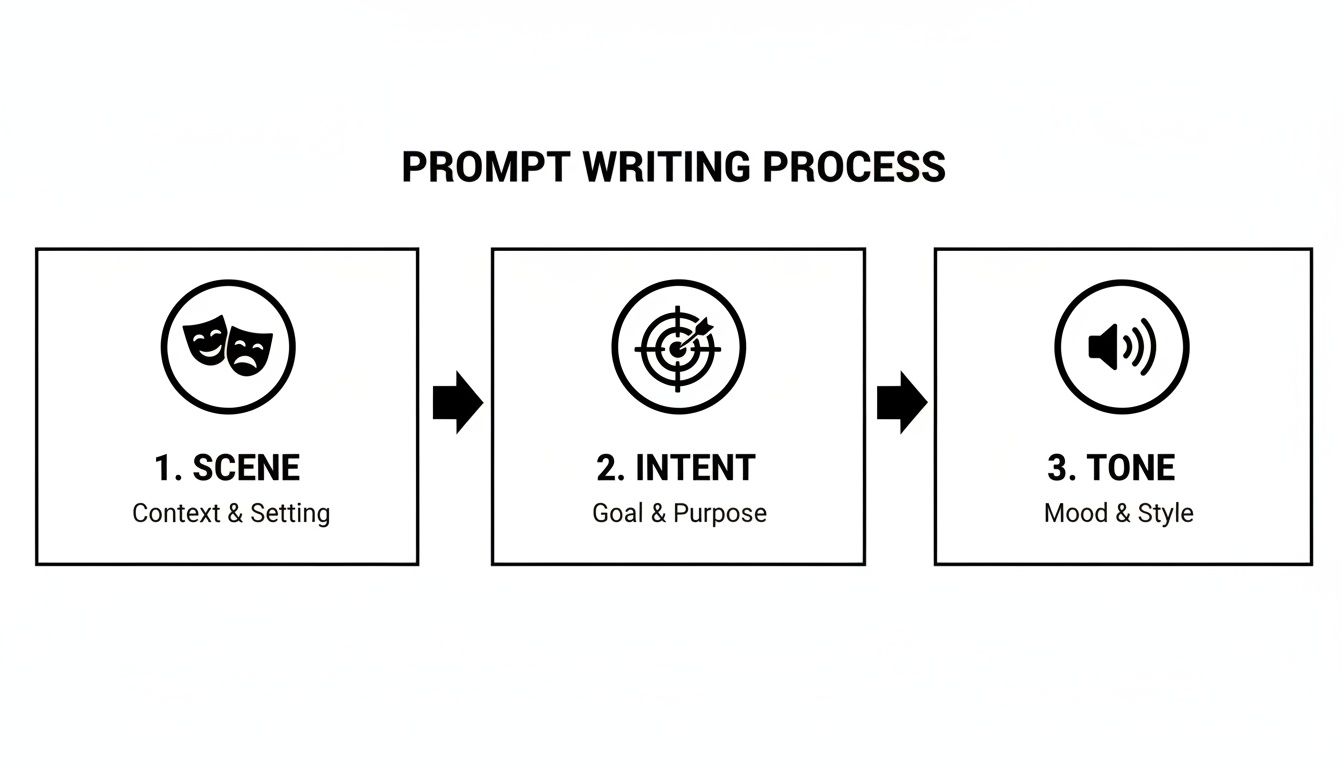
Nailing these three things—the scene, your intent, and the tone—is the foundation for getting high-quality, relevant story continuations every single time.
Refine and Weave the AI's Output
Okay, you've picked the best path forward. Now for the final, and most important, step: refinement. This is where the real art of co-creation happens. It's rare that an AI's output is 100% perfect right out of the gate. Your job is to be the editor—gently tweaking its suggestions, polishing the wording to match your character's unique voice, and making sure everything flows.
You might change a few words to make the dialogue sound more natural, add a specific internal thought, or slightly alter an action to better fit their established personality. This fusion of AI generation and your own human touch is what creates a final product that feels cohesive and genuinely yours.
And if you're building a character from the ground up, you can give the AI a massive head start by defining these voice and personality traits in the Luvr AI character builder. It's all about giving your creative partner the best possible foundation to work from.
Advanced Techniques for Immersive AI Roleplay
So, you've got the basics down. You can keep a story moving. But are you ready to stop just participating and start directing? An ai story continuer gives you the power to be the puppet master, controlling not just what happens next, but exactly how it all unfolds. This is where the real artistry begins—tweaking the pacing, injecting complexity, and painting the emotional atmosphere with surgical precision.
By consciously adjusting the level of detail in your prompts, you can grab the story's rhythm by the reins. Feeling a slow-burn, tension-filled scene? Your prompts should zoom in on internal thoughts, subtle glances, and the smell of rain on the pavement. For a burst of high-octane action, switch to prompts that demand quick, staccato actions and sharp, impactful descriptions. This is how you shift from being a passenger to being the one in the driver's seat.
Weaving in Subplots and Secondary Characters
A story world only feels real when it's populated and humming with life. The best way to build this richness is by explicitly telling the AI to introduce new threads and faces. Don't just wait for them to wander into the scene; command them into existence. It's a simple trick, but it adds incredible layers of depth to your roleplay.
For example, try something like: "As they argue, a street musician on the corner starts playing a haunting melody, and the tune reminds her of a promise she broke long ago." Suddenly, you have atmosphere and the seed of a brand-new subplot. It works just as well for characters. A prompt like, "An old friend of his, someone he hasn't seen in ten years and who knows his biggest secret, spots him from across the crowded bar," immediately throws a grenade of new conflict and history into the mix.
Mastering an ai story continuer means learning to be the architect of the story's world, not just a visitor. You can build intricate histories, introduce surprising new faces, and steer the emotional current with a few well-chosen words.
Mastering Atmosphere and Mood Control
You can pivot the entire emotional tone of a scene on a dime. The secret is to be direct. Use explicit emotional and tonal descriptors in your prompts to tell the AI exactly the mood you're trying to create.
- For a playful mood: Try words like "lighthearted," "teasingly," or "with a mischievous glint in their eyes."
- For a dramatic mood: Use phrases like "a heavy silence descended," "her voice was as cold as ice," or "the sense of dread was thick enough to taste."
These aren't just suggestions; they're stage directions. They guide the AI to generate text that nails the emotional beat you're going for. This gets even more potent on platforms built for this kind of interaction. You can learn more about how to create these deeply personal and authentic narratives by exploring the possibilities of AI character chat.
The hunger for these detailed, interactive experiences is undeniable. The global artificial intelligence market is on a trajectory to hit an incredible $2,480.05 billion by 2034, largely driven by the explosion of conversational AI into the mainstream. You can dig into the projections for the AI market to see just how massive this shift is.
Prompt Modifiers for Advanced Narrative Control
To help you get more precise, here is a quick cheat sheet of modifiers you can inject into your prompts. Think of these as dials and levers for controlling the AI's output.
| Desired Outcome | Example Prompt Modifier | Effect on AI Output |
|---|---|---|
| Increase tension | "Write with a sense of growing dread and paranoia." | Focuses on suspenseful details, internal fears, and foreshadowing. |
| Speed up the pace | "Describe the next minute of action in short, punchy sentences." | Generates rapid-fire, action-oriented descriptions, avoiding introspection. |
| Slow down the pace | "Focus on sensory details and internal monologue." | Produces descriptive, thoughtful prose that lingers on moments. |
| Add emotional depth | "Reveal his inner conflict about the decision." | Moves beyond surface-level action to explore character motivations. |
| Create a specific tone | "The mood should be somber and melancholic." | Uses vocabulary and imagery associated with sadness and reflection. |
| Introduce a mystery | "Hint at a secret she's keeping, but don't reveal it." | Plants seeds of intrigue and creates questions for the reader/player. |
Using these modifiers gives you a much finer degree of control, allowing you to fine-tune the story's texture and flow on the fly.
When you're using a platform like Luvr AI, you can amplify these techniques by leaning on the character's memory and custom details. By referencing established personality traits or backstory elements in your prompts, you ensure the AI's responses are not just atmospherically correct but also perfectly in-character. This creates a powerful feedback loop where your advanced prompting and the AI's memory work in tandem to craft a truly unique and immersive roleplay.
Weaving Your Luvr AI Characters Into the Story
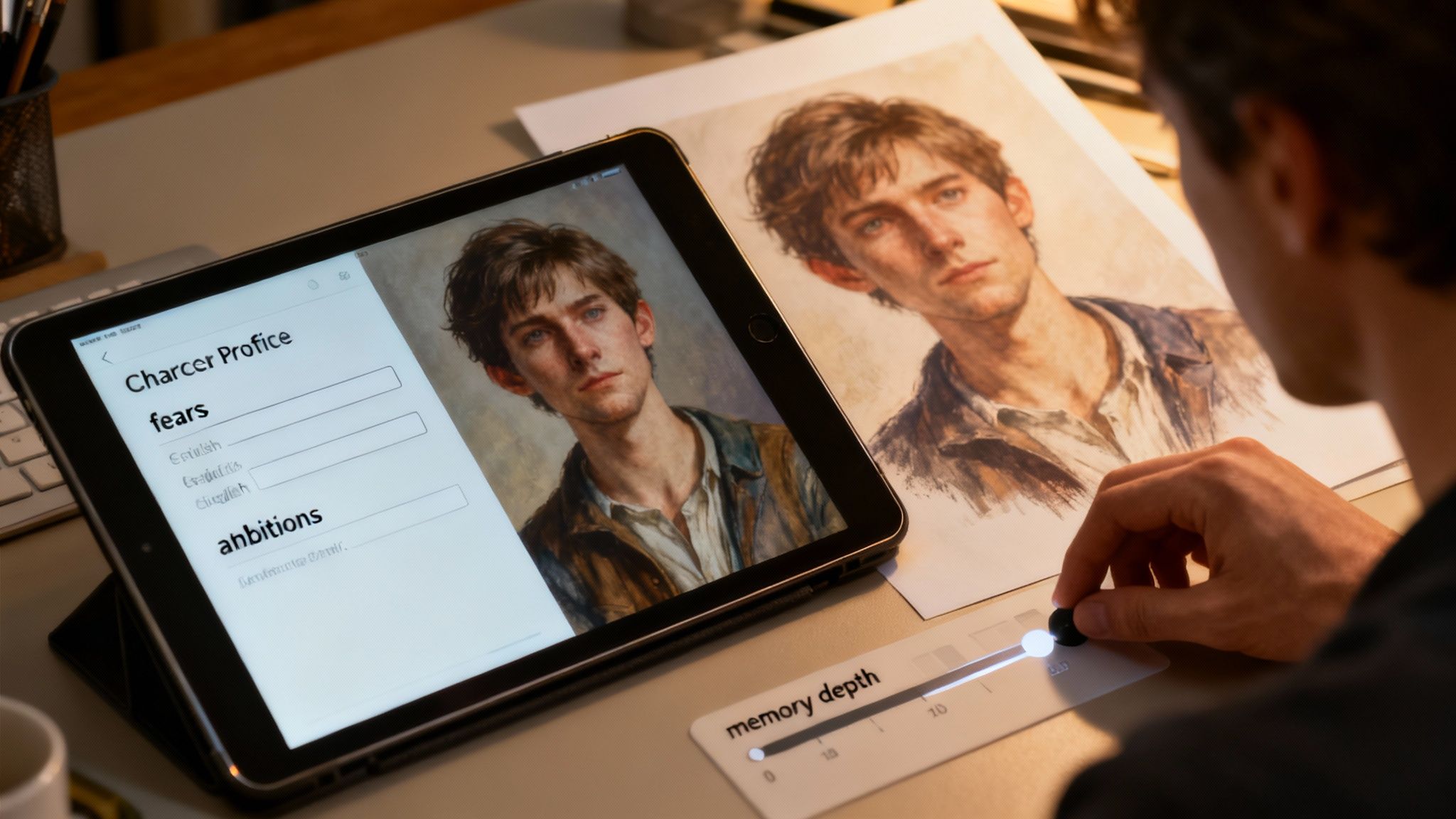
Alright, let's connect the dots. How do all these prompt engineering tricks actually play out with your characters on a platform like Luvr AI? It's simple, really. Your character’s profile isn't just a bio page—it's a treasure trove of story fuel just waiting to be ignited.
When you treat that profile as a starting point, an ai story continuer can help you transform a simple chat into a dynamic, evolving world. This is where you move beyond just talking and start living a story together.
Think about the little details you’ve baked into your character. A secret ambition? A hidden fear? Even a throwaway comment about their childhood? These are the hooks. These are the threads you can pull on to create truly compelling narratives.
Turning Character Bios into Story Hooks
The best, most immersive scenarios come directly from the traits you’ve already established for your character. This simple trick makes the AI’s responses feel earned and authentic, like a natural progression of their personality rather than something random.
Let's say your character's bio mentions she’s “haunted by a past mistake.” That’s a goldmine. You can build an entire scene around that single detail.
Prompt Example: "[We're walking through a quiet, moonlit street. A familiar song drifts from a nearby cafe, and her smile suddenly fades. I turn to her, noticing the distant look in her eyes.] I ask her, gently, 'Does that song remind you of something?'"
See what we did there? The prompt doesn’t just ask for a generic reaction. It pokes at a specific, vulnerable part of her backstory, inviting the AI to explore that memory and create a moment of genuine depth.
Injecting Spontaneity into Daily Roleplay
An ai story continuer is also the perfect tool for shaking things up. If you're tired of falling into the "how was your day?" loop, you can toss in unexpected events that force your AI character to react in fresh, sometimes surprising ways.
This is where you can have a lot of fun and really test the personality you’ve built.
- Create a sudden dilemma: "As we're about to leave the restaurant, she gets a cryptic text from an unknown number. Her eyes widen in alarm as she reads it..."
- Introduce an outside force: "A sudden downpour forces us to take shelter in an old, dusty bookstore we’ve never been in before. The quiet atmosphere feels charged with unspoken thoughts."
- Present a moral choice: "We find a wallet on the empty train car, filled with cash. I look over at her, waiting to see what she'll suggest we do."
Prompts like these are mini-adventures that can steer your relationship in totally new directions. They close the gap between a static profile and a living, breathing world. Exploring these what-ifs is a fantastic way to deepen your bond with a custom AI girlfriend and discover how she handles herself under pressure.
By constantly feeding the AI these creative, character-driven scenarios, you're not just chatting—you're co-writing a story that never has to get boring.
Answering Your Top Questions About AI Story Continuers
When you first start co-writing with an AI, you're bound to run into a few quirks. It's one thing to get the basics down, but it's another thing entirely to handle the little snags that can pull you out of the story. Let's walk through some of the most common issues and how to solve them like a pro.
Getting the hang of these challenges is what separates a frustrating experience from a truly immersive one. Think of it less as a problem and more as learning how to steer your creative partner in the right direction. A little finesse goes a long way.
How Do I Keep the AI from Ruining My Character's Personality?
This is the big one, isn't it? Nothing shatters the illusion faster than your brooding, stoic warrior suddenly acting like a bubbly teenager. The most reliable way to prevent this is to constantly reinforce who your character is using persistent context.
Before you ask the AI to continue a scene, give it a quick, bracketed reminder of your character’s core motivations and their current emotional state. This little snippet acts like a North Star for the AI, anchoring every response to the personality you've worked so hard to build.
For example: "[Ember is feeling vulnerable after our argument but is trying to hide it with her usual sarcasm. She still distrusts strangers and is on high alert.]"
This simple habit re-orients the AI every single time, keeping its contributions consistent. On a platform like Luvr AI, this works hand-in-hand with a well-written bio, which the AI constantly references for foundational details.
Can an AI Story Continuer Handle NSFW or Explicit Themes?
Absolutely, but this hinges entirely on the tool you’re using. Most mainstream AIs are wrapped in thick layers of content filters. They'll either shut you down or water down your scene, which is beyond frustrating when you’re writing for a mature audience.
This is where choosing the right platform is critical. Specialized services like Luvr AI are built from the ground up for adult storytelling, meaning they can handle NSFW and explicit themes without censorship. If you want that creative freedom, you need a tool that was designed for it. When writing your prompts, be direct and clear about the tone you’re aiming for. Don't be shy—the AI needs unambiguous instructions to generate the scene you have in mind.
What if the Story Gets Boring?
It happens. Even the best stories can hit a slow patch. When your narrative starts to feel like it’s treading water, it's your job to shake things up. You're the director here, so introduce a catalyst.
Throw a wrench in the works directly through your prompt.
- Introduce an event: "Suddenly, a frantic message flashes on her phone from a number she doesn't recognize..."
- Raise the stakes: "Continue the story, but introduce a major conflict that threatens to expose her biggest secret."
Another great trick is to just change the scenery. A sudden shift in location or even a jump forward in time forces the characters into a new dynamic, instantly sparking new possibilities for roleplay and character development.
How Much Should I Write vs. How Much Should the AI Write?
Finding that sweet spot is the secret to a great partnership. I've found that a 40/60 split works wonders. You provide the 40%—the critical plot points, key dialogue, and decisive actions. Let the AI handle the other 60%—the descriptive filler, sensory details, and the connective tissue that makes the world feel real.
Think of yourself as the director and the AI as the cinematographer. You set the scene, guide the actors, and decide where the plot goes. The AI fills in the rich visual details and makes sure the world feels alive around them.
This approach keeps you in the driver's seat, steering the narrative exactly where you want it to go, while still getting the most out of the AI's incredible ability to paint a vivid picture with words.
Ready to stop imagining and start creating? Luvr AI gives you the tools to build living, breathing stories with characters that feel real. Dive in and see where your imagination takes you. Start your first story with Luvr AI today.