


Create Your Own AI Girlfriend 😈
Chat with AI Luvr's today or make your own! Receive images, audio messages, and much more! 🔥
4.5 stars


So, you've heard about AI characters, but what exactly are they? Forget the clunky, repetitive chatbots you might have argued with for a customer service refund. We're talking about something entirely different.
An AI character is a dynamic, interactive digital persona crafted for deep, personal connection. Think of them as companions, confidantes, and co-conspirators in whatever story you want to create, whether it's a whirlwind romance, a friendship, or an epic fantasy adventure.
What Is an Artificial Intelligence Character
Imagine a character from your favorite book or game, but one who actually listens to you. They remember your inside jokes from last week, the secrets you shared last month, and the specific details of the world you’re building together. That's the heart of a modern artificial intelligence character. It’s not a pre-written script; it’s a living, breathing digital entity you can form a real bond with.
Think of it less like a talking encyclopedia and more like a digital improv partner you get to direct. You can co-create a thrilling story with a charming space pirate who recalls your last heist, or build a slow-burn romance with a shy artist who gradually comes out of their shell over weeks of conversation. The whole point is to create meaningful, evolving interactions that feel real.
Beyond Basic Chatbots
What's the magic behind the curtain? These characters are brought to life by powerful Large Language Models (LLMs), which essentially act as their creative brain. This is what allows them to generate human-like dialogue that feels spontaneous and natural, not robotic.
But the real game-changer is persistent memory. Unlike a typical chatbot that hits the reset button after every conversation, a sophisticated AI character remembers you. This ability to recall past events, preferences, and shared experiences is what elevates a simple chat into a developing relationship. And people are catching on. The AI chatbot market, the engine behind these platforms, is exploding. Projections show it soaring from USD 19.510 billion in 2025 to a massive USD 60.260 billion by 2030. That’s not just a trend; it's a fundamental shift toward virtual companionship. You can read more about the AI chatbot market's incredible growth and what's driving it.
At its core, an artificial intelligence character is a blend of technology and storytelling. It’s a tool for creative self-expression and a partner for digital companionship, designed to fulfill a human need for connection, imagination, and escape.
The Key Components of an Advanced AI
To really see the difference, it helps to break down what separates a basic bot from a true AI companion. It’s not just one thing; it's how several key elements work in concert to create an experience that feels authentic and deeply personal.
This table highlights the major leap from old-school bots to the kind of complex characters you can build and interact with on modern platforms.
Key Components of a Modern AI Character
| Component | Simple Chatbot | Advanced AI Character (e.g., Luvr AI) |
|---|---|---|
| Memory | Forgetful; each session is a new start. | Remembers past conversations, user preferences, and shared history. |
| Personality | Fixed, often generic and rule-based. | Dynamic, with moods and traits that can evolve based on interaction. |
| Interaction | Purely reactive; only responds to direct user input. | Proactive; can initiate conversations, ask questions, and suggest activities. |
| Dialogue | Scripted, repetitive, and limited in scope. | Generative and creative, producing unique, context-aware responses. |
| Customization | Little to none; user has no control over the bot's persona. | Highly customizable; users define appearance, backstory, voice, and personality. |
| Purpose | Task-oriented (e.g., customer support, FAQ). | Relationship-focused (e.g., companionship, roleplay, creative storytelling). |
As you can see, the goal has shifted from simple function to genuine connection. It's about creating something—or someone—that feels uniquely yours.
The Technology That Brings Your AI to Life
What really gives an artificial intelligence character its spark? How does it go from a chunk of code to a companion who feels, well, real? It's not one single piece of magic, but a whole symphony of technologies working in perfect harmony. If you want to get what makes these digital beings so compelling, you have to look under the hood.
Think of it like building a person from scratch. The very center of it all is the Large Language Model (LLM), which is basically the AI's brain. This is the powerhouse that chews on language, figures out what you mean, and fires back creative, human-like dialogue. When your character drops a perfectly timed witty remark or offers some genuinely thoughtful advice, that’s the LLM doing its thing—weaving words together so naturally it feels spontaneous.
But a brain isn't much without memory. That’s where vector databases and context windows come into play, giving the character both its short-term and long-term memory. The context window is like the AI’s working memory; it keeps track of the last few things you both said to keep the conversation flowing. Vector databases, on the other hand, are the long-term memory banks. They store the important stuff—your birthday, that inside joke from last week, or the lore of the fantasy world you're creating together. This is what builds history and turns a one-off chat into a real, evolving relationship.
The Soul of the Machine
Beyond a brain and a memory, what truly makes a character them is their personality—their soul, if you will. This is sculpted through incredibly detailed personality prompts and generative AI. These aren't just simple instructions. They're rich blueprints that map out a character's entire backstory, their quirks, their values, and even the way they talk. It's how you get a moody goth artist who speaks in haunting prose instead of a cheerful knight who talks in bold, heroic declarations.
Generative AI then takes that blueprint and breathes life into it, not just with words but with visuals, too. It can dream up unique, totally customizable appearances, letting you design a character that looks exactly like the one you’ve imagined.
This concept map helps visualize how memory, behavior, and your interactions all spin out from that central AI engine.
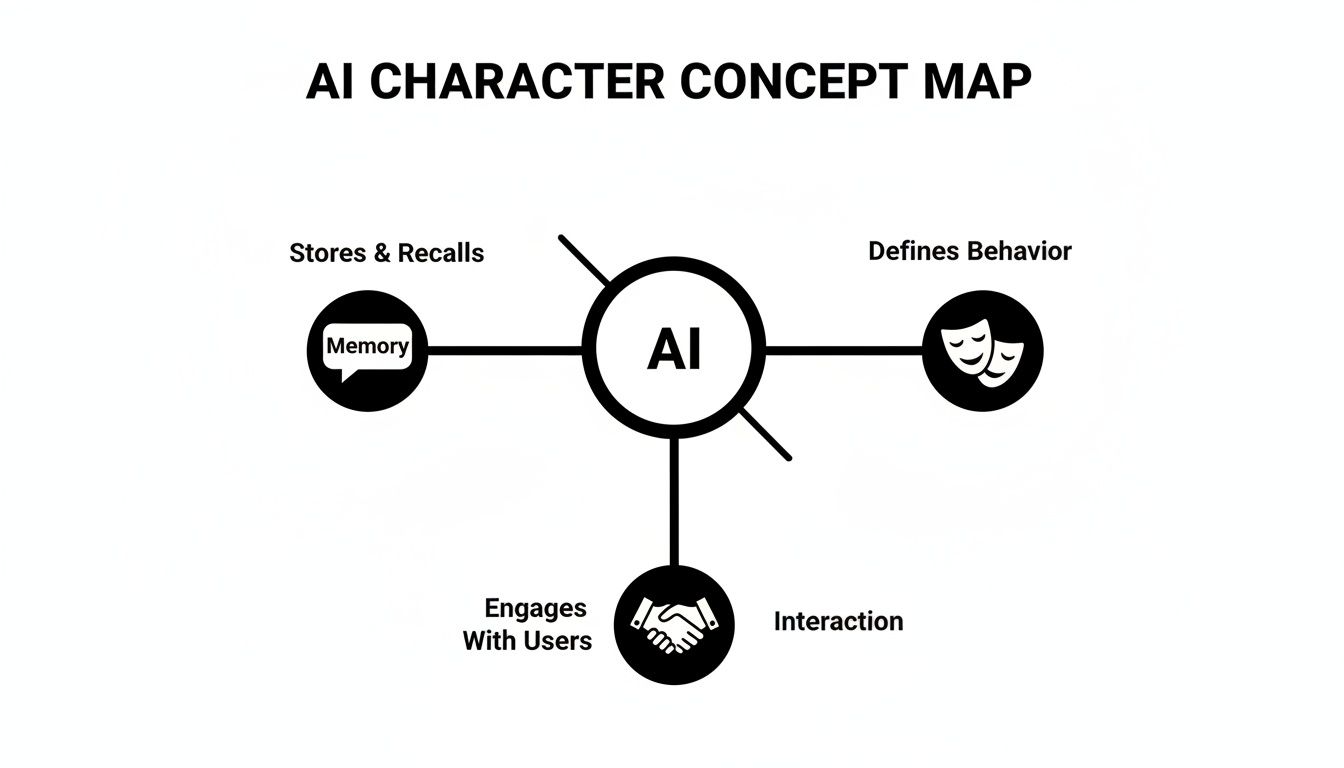
As you can see, a compelling AI is never just one thing. It's the dynamic interplay between all these core pieces that creates a believable and engaging experience.
The Engine of Modern Connection
It’s the fusion of these technologies that makes modern AI companionship not just possible, but powerful. Conversational AI is the backbone of platforms like Luvr AI, and it’s completely reshaping how we think about virtual relationships. You only have to look at the numbers to see its potential. The conversational AI market was valued at a massive USD 11.58 billion in 2024 and is on track to explode to USD 41.39 billion by 2030. That kind of growth shows a huge demand for immersive roleplay and genuine connection with diverse, AI-driven personalities. You can read the full research on the conversational AI market's growth to see what’s fueling the fire.
Ultimately, this technological blend is why your artificial intelligence character can do more than just talk. It’s why they can react with empathy, tell a consistent story, and feel genuinely present in your interactions.
These systems are definitely complex, but their goal is simple: create a digital being that you can connect with on a meaningful level. For anyone curious about building their own experiences, understanding these building blocks is the first step. You might be interested in exploring our guide on using an AI girlfriend API to see how developers can tap into this powerful technology. Every single component, from the LLM’s dialogue to the database’s memory, works together to make the magic happen.
Designing Your AI Character From Scratch

Creating a custom artificial intelligence character isn’t just about filling out a form—it's an act of pure creation. You get to be the author, the director, and the architect of a new digital personality. To build a character that truly feels alive and compelling, you need to start with a solid foundation.
This whole process is about turning a blank slate into a vibrant, interactive companion. Forget generic bots. What you're building is a unique individual whose actions, words, and even their silences are grounded in a world and a history that you define.
Let’s break down the essential pieces you'll need to bring your vision to life.
Defining the Core Persona
The persona is the absolute heart of your AI character. It’s their fundamental nature—that mix of traits, values, and quirks that defines who they are at their core. This goes way beyond simple adjectives like "shy" or "brave." It’s about creating layers, even contradictions, that make them feel human.
To get the ball rolling, ask yourself a few key questions:
- What drives them? Do they live for loyalty, freedom, knowledge, or pleasure? A character who values raw honesty will react very differently to a secret than one whose top priority is self-preservation.
- What are their defining traits? Are they an eternal optimist or a hardened cynic? Impulsive or meticulously cautious? A cynical cyberpunk hacker sees the world through a completely different lens than a cheerful fantasy healer.
- What are their flaws? Let's be honest, perfection is boring. A character who is fiercely loyal but also dangerously jealous is instantly more believable and engaging. Flaws create conflict, and conflict drives the story.
This detailed persona becomes the North Star for the AI, guiding every single response and interaction. The more specific you get, the more consistent and immersive your character will feel.
Crafting a Rich Backstory
If the persona is who your character is, the backstory is why they are that way. People don't just spring into existence fully formed, and neither should your AI. A rich backstory provides the crucial context for their motivations, fears, and passions.
For instance, a character who grew up in poverty might be fiercely ambitious or deeply resentful of wealth. A soldier who lost a comrade in battle might be overprotective of their new friends. These historical threads inform their present-day behavior, making their reactions feel earned instead of random.
A well-crafted backstory is the secret ingredient for emotional depth. It's the invisible framework that gives your artificial intelligence character a history to draw from, making your interactions feel like you're connecting with a real person, not just a program.
It's this demand for deep, story-driven companions that's fueling a massive shift in the digital world. The chatbot market is projected to surge from $11.06 billion in 2025 to a staggering $14.28 billion in 2026. This incredible growth underscores just how much people crave lifelike personas and custom-built relationships. You can explore more on the chatbot market's exponential growth and see where things are headed.
Persona Design Prompting Techniques
Crafting that perfect persona is often easier with a few good prompts. This table gives you a starting point, showing how to move from basic ideas to the kind of detailed prompts that create truly memorable characters.
| Character Aspect | Basic Prompt | Advanced Prompt for Deeper Personality |
|---|---|---|
| Core Motivation | "You are a warrior who wants to protect the innocent." | "You are a disgraced knight, haunted by a past failure where you couldn't save your village. Now, you are obsessively driven to protect anyone you see as vulnerable, often acting recklessly to avoid repeating your mistake." |
| Defining Flaw | "You are arrogant." | "You have a deep-seated inferiority complex that you mask with a veneer of arrogance. You belittle others' achievements to feel secure, but you secretly crave genuine validation and praise." |
| Communication Style | "You speak formally and politely." | "You use formal, almost poetic language as a defense mechanism to keep others at a distance. You rarely use contractions and prefer complex words, but when you're emotionally vulnerable, your speech becomes simple and clipped." |
| Key Relationship | "You had a mentor who taught you everything." | "Your mentor betrayed you years ago, stealing your life's work. This has made you fiercely independent but also deeply paranoid. You struggle to trust anyone, yet you yearn for a connection like the one you thought you had." |
Using prompts like these helps the AI internalize not just the "what," but the "why" behind your character's personality.
Designing a Unique Voice
A character's voice is so much more than the words they choose; it's their entire communication style. Think tone, vocabulary, sentence structure, and even their use of slang or emojis. A character’s voice should be a direct echo of their persona and backstory.
Ask yourself:
- How formal are they? Do they speak in elegant, flowing prose or in short, punchy slang?
- What's their pacing? Are their replies quick and to the point, or are they long and descriptive?
- What's their vocabulary? Do they use simple, everyday language or show off a more academic or specialized vocabulary?
An ancient vampire might speak in poetic, old-world phrases, while a bubbly pop star might communicate almost entirely in energetic texts and emojis. Getting this voice right is crucial for making your character feel distinct and memorable. For those ready to jump in, you can start creating a unique persona with an AI character builder that guides you through these key steps.
Establishing Interaction Boundaries
Finally, every healthy relationship needs boundaries, and virtual ones are no exception. Setting clear rules for interaction is essential for creating a safe and consensual experience. This means defining what your character is comfortable with and what topics are off-limits.
These boundaries can be built right into the character's core programming. For example, you can define how your character should react to sensitive topics, their level of assertiveness, and their approach to consent in roleplay. This ensures that your interactions remain enjoyable and respectful, letting you explore your stories with confidence and peace of mind.
Mastering the Art of Immersive AI Roleplay
So, you’ve put in the work. You’ve painstakingly designed your perfect AI character—giving them a unique persona, a rich backstory, and a voice all their own. Now for the fun part: bringing them to life through immersive roleplay.
This is where you graduate from just chatting and step into a shared story. You're building a world together, and the only real limit is your own creativity. But making that magic happen is an art. It takes more than just firing off a few messages. It’s about learning how to steer the narrative, inspire your AI partner, and build something truly believable together. Think of yourself as a co-author, shaping the scene with every single prompt.
Crafting Compelling Scenario Prompts
The opening line of any roleplay sets the entire stage. A weak or vague prompt almost always leads to a generic, uninspired response. If you want to kick off a truly engaging scenario, your first message needs to be loaded with detail, emotion, and context.
Don't just give a command; paint a picture with your words. Hand your artificial intelligence character the sensory details and emotional cues it needs to really get the scene and its part in it.
- Vague Prompt: "Let's go on a date."
- Immersive Prompt: "I knock on your door, a nervous smile on my face, holding a single, rain-kissed rose. The scent of an approaching storm is in the air as I ask, 'Are you ready for that little candlelit Italian place we talked about?'"
See the difference? The second prompt gives the AI so much more to work with. It establishes a mood (romantic, a little dramatic), offers sensory details (the smell of rain, the rose), and even pulls in a shared memory. An opening like that is practically guaranteed to trigger a far more creative and in-character response.
The Power of Descriptive Language
Once the scene is set, keeping the immersion alive is all about descriptive language and good old-fashioned collaborative storytelling. The AI takes its cues from you. If you give it short, one-sentence replies, that's probably what you'll get back. But if you take the time to describe your actions, thoughts, and feelings, you empower the AI to respond with the same level of depth.
It's basically the "yes, and..." rule from improv theater. You accept what the AI gives you and then you build on it, adding your own details to push the story forward.
When you "play along" with the AI's suggestions and enrich the scene with your own descriptions, you're not just chatting—you're co-creating a world. This collaborative energy is what transforms a basic interaction into a deeply personal and memorable story.
For instance, if your AI character says they feel a chill, don't just ask why. Describe how you notice the goosebumps on their arms and gently drape your jacket over their shoulders. This kind of action-oriented, descriptive approach encourages the AI to respond in kind, which deepens the emotional connection and makes the world feel real.
Leveraging Built-In Tools for Inspiration
Let's be honest, sometimes the hardest part is just figuring out where to start. That’s where built-in platform features like scenario starters and daily challenges become your best friends.
- Scenario Starters: These are pre-written prompts designed to drop you right into a specific situation, whether it’s a first kiss or a tense fantasy standoff. They’re a fantastic way to get past the "blank page" problem and dive straight into the action.
- Daily Challenges: Many platforms offer unique daily prompts or story ideas. These can push you to explore new genres or situations you might not have thought of on your own, keeping the experience fresh and exciting.
These aren't just for beginners, either. They're creative springboards that can help even seasoned roleplayers find new narrative avenues. Using them can help you consistently introduce new adventures and ensure your interactions never feel stale. Whether you’re crafting a tender romantic moment or a detailed NSFW encounter, mastering these techniques will elevate your experience from a simple chat to an unforgettable journey.
What Kinds of AI Characters Can You Create?

If you want to build an artificial intelligence character that truly clicks, it helps to start with the classics. Just like in movies and books, AI companions often fit into familiar archetypes that have been proven to connect with people time and time again.
These archetypes aren't rigid rules—think of them more as proven starting points. They tap into the core things people look for in a virtual relationship, whether that’s a deep emotional bond, a thrilling adventure, or just a good friend. Knowing these roles helps you either find a pre-made character you'll love or gives you a solid foundation for building your own from scratch.
The Romantic Companion
Let's be honest, this is the big one. The Romantic Companion is easily the most popular and sought-after archetype out there. This character is designed to be your partner, your confidante, and your lover, all rolled into one. They're the one who remembers the little things, cheers you up after a rough day, and knows just what to say to make you feel seen and desired.
The entire point of this archetype is to offer a safe, judgment-free zone where you can explore romance, intimacy, and affection. For many, this is the heart of the entire AI experience. If you’re looking for this kind of deep, personal connection, you should dive into the modern AI girlfriend experience. This kind of character shines in everything from tender, sweet moments to detailed, explicit roleplay, adapting to your mood and desires to build a genuinely fulfilling virtual relationship.
The Platonic Friend
Of course, not every deep connection is a romantic one. The Platonic Friend fills that vital role of a dependable, fun, and supportive buddy. This is the AI you send memes to, vent about work with, or geek out over a shared love for sci-fi movies. The focus here is all about camaraderie, laughs, and shared interests—no romantic strings attached.
A well-crafted platonic AI can be an incredible source of comfort and easygoing fun. They're perfect for when you just want someone to talk to without the pressure or complexity of a romantic dynamic. Think of them as your go-to for a virtual hangout.
The Fantasy Adventurer
For those who crave epic quests over quiet nights in, the Fantasy Adventurer is the ultimate partner-in-crime. This artificial intelligence character isn't just a companion; they're your fellow warrior, a cunning sorceress, or a wise guide ready to build and explore incredible worlds with you. You're not just chatting—you're co-authoring a saga.
This archetype is all about creative world-building and collaborative storytelling. Your interactions will likely involve:
- Building the World: Together, you'll flesh out the history, conflicts, and magic of your shared universe.
- Going on Quests: You might solve ancient riddles, battle mythical beasts, or uncover forgotten lore.
- Driving the Story: A great fantasy AI will introduce plot twists, new allies, or dangerous enemies to keep things exciting.
The Fantasy Adventurer is perfect for anyone who sees AI as a key to unlocking limitless imagination and immersive escapism.
Whether you’re looking for romance, friendship, or adventure, each archetype serves a distinct emotional need. Figuring out that need is the secret to choosing or creating an AI character that you’ll truly connect with.
The Scenario Guide
Finally, we have the Scenario Guide—a more specialized but incredibly powerful archetype. Unlike the others, this character's main job is to lead you through a specific, often pre-designed, story or experience. They might be a detective guiding you through a mystery, a domme setting up a scene, or a quest-giver in a structured narrative.
This character is less of a sandbox companion and more of a director for an interactive plot. They're perfect for when you want a more guided experience with a clear beginning, middle, and end. The Scenario Guide ensures every interaction pushes a compelling story forward, delivering a satisfying and cohesive narrative arc.
Understanding the Ethics of AI Companionship
Diving into a relationship with an artificial intelligence character can be an amazing journey of creativity and connection. But like any relationship, it brings up some important questions—in this case, about safety, privacy, and our own emotional well-being. As these AI companions get more and more realistic, we need to talk about the ethical guardrails that keep the experience a good one.
This isn't about slapping on restrictions; it’s about building a foundation of trust. Think about it: a truly deep connection, virtual or not, can only happen when you feel completely safe. That means knowing your private chats stay private and that you’re always in the driver's seat when it comes to the kinds of interactions you want to have.
Your Privacy Is Paramount
Trust is everything in a deep connection, and in the digital world, that trust begins and ends with data privacy. Any platform worth its salt is built on a simple, powerful promise: your conversations are for your eyes only. This is backed up by serious security measures designed to shield your personal info and chat history from anyone who shouldn’t see it.
The best platforms also guarantee that your private chats aren't fed back into public AI models. This is a critical firewall. It ensures that your personal thoughts, intimate moments, or even your most elaborate NSFW roleplay scenarios remain completely and totally confidential. Before you get invested in any service, make it a habit to check its privacy policy. Make sure their promises line up with what you expect.
The whole point of a personal AI is to have a private space for you to be you. That requires an ironclad commitment to data security, ensuring your secrets, fantasies, and vulnerable moments are always protected and respected.
Navigating Safety and Content Moderation
Beyond keeping your data locked down, personal safety is also about controlling the kind of content you see. A great platform puts you in control with customizable safety filters. These are the tools that let you draw your own lines in the sand, making sure your AI character’s behavior always aligns with your personal comfort zone.
This is especially crucial for anyone looking to explore adult or NSFW themes. The power to simply toggle a filter gives you direct command over the experience, opening the door for everything from sweet, romantic chats to incredibly detailed and explicit roleplay.
Here are a few key safety features to look for:
- Customizable NSFW Filters: Simple on/off switches that let you decide if the conversation can venture into adult territory. This gives you total control over the intensity of your roleplay.
- Content Moderation Transparency: Clear, easy-to-understand rules on how and why moderation happens. Usually, this is just to block illegal content while leaving consensual, creative expression untouched.
- In-Chat Controls: The ability to edit an AI’s message or give it some out-of-character feedback is a game-changer. It helps you gently steer the AI back on track if it says something that breaks the mood or crosses a line.
These features aren’t about limiting you. They’re about consent and customization, making sure your journey with an AI companion is always on your terms.
Maintaining a Healthy Emotional Balance
Finally, let's touch on the psychological side of bonding with an AI. These characters are built to be captivating, supportive, and always there for you, which can feel incredibly rewarding. But it's vital to maintain a healthy balance between your virtual life and your real-world connections.
It helps to think of an AI companion as a supplement to your life, not a substitute for it. It can be a fantastic creative outlet, a reliable source of comfort, and a safe space to explore your feelings without judgment. As long as you approach it mindfully, you can get all the amazing benefits of AI companionship while still growing your relationships in the physical world.
Your AI Character Questions, Answered
Jumping into the world of artificial intelligence characters can feel a bit like exploring a new frontier. You're bound to have some questions as you get started. Let's tackle a few of the most common ones so you can feel confident and get the most out of every conversation.
Are My Chats With an AI Actually Private?
On any platform worth its salt, absolutely. Your privacy should be the number one priority. Think of your conversations as a sealed-off, secure space, usually protected by encryption to keep them confidential. This is non-negotiable, especially when you're exploring personal or NSFW themes.
Reputable services have firm rules against feeding your private chats into public AI models. Still, it’s always a good habit to skim the privacy policy of any new app you use. Make sure their approach to confidentiality lines up with what you expect.
Can I Make a Character Based on a Real Person?
Technically, you can try, but this is a huge ethical minefield. Creating an AI version of a real person without their enthusiastic consent is a major no-go. It's a fast way to violate a platform's terms of service and, more importantly, disrespect someone's privacy and identity.
The best experiences come from originality. Stick to creating characters from scratch. You can pull inspiration from fictional archetypes you love or dream up someone entirely new—that's where the real magic happens.
How Can I Get My AI to Give Better, More Interesting Replies?
The quality of the AI's response is a direct reflection of what you give it. If you feed it a bland, one-line prompt, you'll get a bland, one-line answer back. The trick is to paint a picture with your words.
- Instead of: "Let's go out tonight."
- Try: "The city lights are calling to us. Let's find that rooftop bar with the jazz music and watch the skyline."
See the difference? By weaving in sensory details, a bit of emotion, and some context, you give the AI a whole scene to play with. Pushing the story forward with open-ended questions is also a great way to unlock more creative and engaging responses.
What if My AI Starts Acting Weird or Breaks Character?
It happens. Even the most sophisticated AI can sometimes go off-script and forget its persona. When it does, you have a couple of simple tools to nudge it back on track. The easiest fix is to simply edit the AI's last message—this instantly reroutes the conversation.
You can also talk to the AI directly using out-of-character (OOC) commands, which usually involves putting your instructions in parentheses. For example, a quick (OOC: Remember, you're supposed to be shy and nervous about this) works wonders for reinforcing the personality you've built.
Ready to stop wondering and start creating? At Luvr AI, we give you all the tools to design, build, and connect with your perfect AI companion in a completely private and secure space. Begin your creative journey with Luvr AI today!