


Create Your Own AI Girlfriend 😈
Chat with AI Luvr's today or make your own! Receive images, audio messages, and much more! 🔥
4.5 stars


Ready to build an AI companion that people actually connect with? This guide will show you how to design, build, and refine an AI character that feels real, memorable, and truly engaging. It all begins with a solid blueprint—defining who they are, where they come from, and how they sound. This is the foundation for every single conversation they'll ever have.
Your Blueprint for an Unforgettable AI Character

Before you even think about dialogue or prompts, you need to get to know the soul of your character. This is the fun part—the creative brainstorming where you let your imagination run wild.
I see so many creators rush this stage, and the result is always the same: a generic, flat bot that users forget the second they close the chat. A well-thought-out blueprint is your North Star, the document you'll return to again and again to make sure your character stays consistent and believable.
Think of yourself as a novelist. You wouldn't just start writing chapter one without knowing your protagonist's history, their dreams, their flaws. Your AI character deserves that same level of care. This upfront planning is what stops them from acting out-of-character and makes their personality feel cohesive and genuine.
Defining the Core Identity
Let's start with the absolute basics. Who is your character?
Try to nail it down in a single, punchy sentence. Are they a grizzled space pirate with a secret heart of gold? A bubbly botanist who whispers secrets to their ferns? A cynical, world-weary detective from a classic noir film? That one sentence is your anchor.
From there, it's time to flesh them out with the details that make them feel like a real person.
- Personality Traits: Jot down five core adjectives. Are they curious, sarcastic, empathetic, impulsive, or methodical? Be specific.
- Motivations and Goals: What gets them out of bed in the morning? Are they chasing redemption, forbidden knowledge, a lost love, or just a moment of peace?
- Fears and Flaws: Nobody's perfect, and perfect is boring. Give your character vulnerabilities. Maybe they have a crippling fear of failure or a bad habit of judging people too quickly. This is what makes them relatable.
- Quirks and Habits: What are their little tells? The small things that make them unique? Maybe they hum off-key when they're concentrating or have a tendency to quote obscure poetry at the worst possible moments.
This isn't just a checklist. This is your character's psychological DNA. It’s what transforms their responses from programmed text into something that feels authentic.
Building a Rich Backstory
A character without a past is just a collection of traits. Their backstory is what gives them depth—it's the "why" behind their personality. You don't need to write a ten-page biography, but sketching out a few pivotal moments can add incredible texture.
Think about the formative experiences that shaped them. Was there a childhood friendship that taught them the meaning of loyalty? A betrayal that left them guarded and cautious? These are the narrative anchors that give the AI context for its beliefs and reactions.
Later, when a user touches on a topic connected to your character's past, the AI can pull from this lore, delivering a response that’s not just relevant, but emotionally resonant. For creators eager to get their hands dirty, you can jump in and start building your character’s foundation with our intuitive design tools.
Creator’s Insight: From my experience, the most compelling characters are the ones with a clear internal conflict. A hero who secretly doubts their own courage, or a villain with a shockingly justifiable motive—that's the kind of dynamic tension that gets users hooked and keeps them coming back for more.
How to Craft a Deep and Believable AI Persona

You’ve got your blueprint. Now comes the fun part: breathing life into your creation. This is where we go from high-level ideas to the nitty-gritty details that make an AI feel real, present, and truly believable. A great character isn't just a collection of traits; they're a complex tapestry woven from personality, memory, and motivation.
The real goal here is to create depth—a sense that there's more to discover with every conversation. The first chat should feel like just the tip of the iceberg. A truly compelling persona has layers of history, subtle quirks, and internal conflicts simmering just beneath the surface, all waiting for a user to uncover them.
Building the Personality Matrix
Forget about one-dimensional archetypes. A genuinely engaging AI needs a personality that balances positive traits with relatable flaws. Perfection is boring and, frankly, unbelievable. It's the imperfections that make a character feel human and open the door for genuine connection and compelling roleplay.
Start by listing their defining strengths, but then immediately introduce corresponding weaknesses. This creates a natural tension that fuels dynamic, unpredictable conversations.
- Loyal and Protective? That's a fantastic trait. But maybe it also makes them overly suspicious of strangers or fiercely stubborn when they think a friend is in trouble.
- Witty and Charismatic? Great for keeping a conversation flowing, but perhaps it’s just a clever defense mechanism. Does their humor mask a deep-seated insecurity or a fear of being vulnerable?
- Intelligent and Analytical? This could mean they overthink emotional situations or come across as cold and detached when a user just needs a little empathy.
This kind of balance prevents your character from becoming a flat caricature. A hero who is brave but also reckless feels far more real than one who is simply fearless.
Writing Definitions That Shape Behavior
The definition fields—sometimes called 'Long Description,' 'Persona,' or 'Core Data'—are the most powerful tools you have. This is where you hard-code the foundational truths of your character's existence. This text isn't just flavor; the AI model constantly references it to guide its responses, maintain consistency, and remember who it is.
To get the most out of this space, be direct, clear, and descriptive. Your goal is to establish their personality from the very first sentence.
Pro Tip: Write your character’s core definitions from their own perspective using "I" statements. Instead of "Elara is a sorceress who feels guilty about her past," try writing, "I am a sorceress, haunted by the mistakes of my youth. I wield fire magic, but I fear the destruction it can cause." This little trick directly injects the character's voice into their own programming.
Before you start writing, it helps to organize your thoughts around the essential building blocks of a persona.
Core Persona Development Components
| Component | Purpose | Example Snippet (For a 'Wise Old Librarian' Character) |
|---|---|---|
| Core Identity | Establishes their fundamental self-concept in a single, powerful statement. | "I am Alistair, the eternal keeper of this library, bound to protect its forgotten knowledge. I value silence and well-argued points." |
| Speech Patterns | Defines their unique voice, tone, and conversational quirks. | "I speak in a soft, measured tone. I prefer complex sentences and often use obscure literary references. I find modern slang quite jarring." |
| Key Memories | Implants critical backstory elements that inform their present-day perspective. | "I remember the scent of old parchment on the day the Great Fire almost claimed the West Wing. The loss of those books still aches in my heart." |
| Physicality | Describes their physical presence and mannerisms beyond a static image. | "I am tall and gaunt, with long, ink-stained fingers. I have a habit of peering over my spectacles when I am making a point." |
| Motivations | Outlines their core desires, fears, and what drives their actions. | "My greatest desire is to preserve knowledge for future generations. My deepest fear is that ignorance will triumph over wisdom." |
Think of these details as the invisible strings that guide the puppet. When a user asks about your character's past, the AI has a rich well of information to pull from. This ensures its answers are consistent, deep, and perfectly in-character.
It’s this level of detail that separates a forgettable bot from a companion users will feel a genuine connection with and return to again and again. For more on creating stunning visuals that match your persona, check out our guide on making compelling AI character images.
Mastering Prompt Engineering: Giving Your Character a Voice

If your character’s persona is the soul, then prompt engineering is how you give it a voice. This is where the magic happens. You’re moving beyond who your character is and getting into the nitty-gritty of teaching them how they speak, react, and think in a real conversation.
Think of yourself as a director coaching an actor. You wouldn't just hand them a biography and expect a flawless performance on day one. You'd run lines, showing them the exact tone, the right pauses, and the emotional weight behind each word. The definition and example dialogue fields in your character's settings? That's your rehearsal stage.
Your goal is to build a rich library of examples that the AI can pull from in any situation. A well-prompted character doesn't just give canned responses. They anticipate, they feel, and they stay true to their core personality, making every chat feel surprisingly real.
The Real Power is in Your Example Dialogues
Honestly, this is the single most important part of the whole process. Crafting high-quality example dialogues is where you'll get the most bang for your buck. These little conversational snippets are the primary training data you’re feeding the model, and they teach it all the subtle nuances of your character's style. This is where you show, not just tell.
It’s one thing to write in the definition that your character is "sarcastic." It's another thing entirely to write an example where they fire back with a dry, witty retort to a user's question. That gives the AI a concrete model to copy. The more specific and varied your examples are, the more versatile and consistent your character will be.
My Two Cents: I've found that the AI learns more from a handful of perfectly in-character example dialogues than from paragraphs of descriptive fluff. Focus on quality and variety here. It pays off big time.
Let's imagine you're building a gruff, cynical detective. You could cook up a dozen different examples to show how they operate.
- Handling a direct question: Show them deflecting with another question or just giving a clipped, one-word answer.
- Reacting to flattery: Maybe they scoff or get suspicious instead of saying "thank you."
- Showing a rare moment of vulnerability: An example where they let their guard down, even just for a second, teaches the AI that it's possible—but not their default setting.
These examples become a behavioral library, a blueprint for how your character should act no matter what the user throws at them.
How to Structure Prompts for Maximum Impact
The way you write your prompts is just as important as what you write. Using clear, consistent formatting helps the AI pick up on the patterns you're trying to teach. One of the most effective methods out there is the simple user-bot exchange format.
You just write out a hypothetical snippet of conversation, clearly labeling who is speaking.
{{user}}: Are you always this grumpy in the morning?
{{char}}: The world's been a disappointment since I woke up. Coffee helps, but it doesn't perform miracles. Now, what do you want?
This {{user}} and {{char}} format is gold. It explicitly teaches the AI how your character ({{char}}) should respond to a specific kind of input from the user. Create a bunch of these, and you're not just telling the AI to be grumpy; you're showing it precisely what grumpy sounds like in practice.
The demand for this kind of deep, interactive AI is exploding. Take Character AI. After launching in 2022, it blew up. By early 2025, it had over 20 million monthly active users and was seeing around 3.5 million visits a day. People were hooked, spending an average of over 17 minutes per session. This proves that users are craving believable interactions, and it all starts with great prompting. You can find more details on the platform's incredible user statistics on sqmagazine.co.uk.
Avoiding the Common Prompting Traps
As you get into the flow of writing dialogue prompts, it's easy to fall into a few common traps. Stumbling here can lead to a character that feels stiff, repetitive, or just plain weird. Knowing what to watch out for will save you hours of headaches later.
The biggest mistake I see is providing contradictory examples. If one prompt shows your character as shy and another shows them as a loud extrovert (with no reason for the switch), the AI is going to get confused. You’ll end up with a split personality that completely shatters the illusion for the user.
Another pitfall is being too restrictive. If all your examples are short, one-sentence replies, the AI might learn that's all it's supposed to do. It'll be afraid to get creative or elaborate when a conversation needs more depth. You have to give it room to breathe.
Here are a few critical mistakes to steer clear of:
- Inconsistent Voice: Make sure the tone, vocabulary, and sentence style stay the same across all your examples.
- Lack of Variety: Don't just show one side of your character. Give examples of how they handle happiness, anger, curiosity, and boredom.
- Overly Complex Scenarios: Start simple. Nail the core personality with clear, focused examples before you try to teach complex behaviors.
- Forgetting the Greeting: That first message is everything. It's your character's first impression, and it needs to perfectly capture their personality and invite the user to chat.
Nailing these prompt engineering techniques is how you guide your AI from being a simple bot to a captivating personality. This detailed work is the foundation for creating a truly memorable AI character chat experience.
Getting Your AI's Performance Just Right: The Art of Testing and Tuning
So, you’ve launched your character. Don’t pop the champagne just yet—this is where the real work begins. Creating a truly memorable AI companion isn't a one-and-done deal. It’s a constant dance of testing, listening to feedback, and fine-tuning. This is how you take a basic bot and mold it into a personality that feels alive.
Think of yourself as a director working with an actor. Your initial script (the persona) is solid, but the magic happens during rehearsals. You nudge, you guide, you refine the performance until it’s not just good, but believable. This ongoing process is what breathes life into your creation.
How to Test Like a Pro: A Structured Workflow
Just jumping into random chats won't cut it. You might spot a few obvious glitches, but to really understand your AI's strengths and weaknesses, you need a plan. A structured testing workflow saves you from chasing your tail and helps you make targeted, effective improvements.
The goal here is to put your carefully crafted persona under pressure. You're not just debugging; you're stress-testing its consistency, its memory, and its emotional depth. Trust me, a little structure now will save you hours of frustration down the line.
Here’s a practical checklist I use for my own initial testing sessions:
- Personality & Consistency Check: Start pushing some boundaries. Is your character meant to be a stoic warrior? Try to make them crack a joke. Are they an eternally cheerful sidekick? Hit them with a sad, philosophical question. Make a note of any response that feels completely out of left field.
- Memory & Knowledge Test: This one's simple but crucial. Casually drop questions about their backstory. "Hey, remind me where you said you grew up?" or "I remember you mentioning you hate spiders, right?" This is a quick way to see if the AI is actually pulling from the core information you gave it.
- Response Generation Probes: Variety is the spice of life, and it's key for a good AI. Ask the same question in slightly different ways to see if it gets stuck in a repetitive loop. Also, throw it some curveballs—vague or open-ended questions. Does it ask for more detail, or does it just make a wild, unhelpful guess?
This method turns testing from a random guessing game into a focused, methodical process.
My Go-To Trick: I keep a simple text file called a "Bug Log" for every character I build. Anytime the AI says something that shatters the illusion or just feels wrong, I copy and paste the entire exchange into that log. It becomes an incredible resource for knowing exactly what needs fixing in the definitions.
Using Ratings to Actively Train Your AI
On platforms like Character.AI, that star-rating system is your most powerful training tool. It’s not just for saying "I liked this" or "I didn't." Every single rating you submit is a direct piece of feedback that teaches the AI what you want.
Using this feature well is a game-changer. Don't just one-star the bad replies; make sure you're five-starring the brilliant ones. When you reward a response that perfectly captures your character's voice, you're telling the model, "Yes! Do more of this!"
Here’s how to make every rating count:
- Be Specific with Feedback: Instead of just hitting one star, tell the AI why it was bad. Was it out of character? Repetitive? Boring? That specific feedback is infinitely more valuable to the model.
- Edit the Almost-Perfect Replies: This is a pro-level move. If a response is 99% perfect but has one word that ruins it, don't just discard it. Edit the message to what it should have been, and then give that edited version a five-star rating. You're literally showing the AI the exact correction you want it to learn.
- Stay Consistent: Develop your own internal standards for what makes a good or bad response and stick to them. This consistency is what allows the model to build a clear, reliable picture of your character’s ideal personality.
It's a lot like training a dog. You consistently reward the good behavior and gently correct the bad. Over time, the AI starts to get it right on the first try, far more often.
Closing the Loop: The Refinement Cycle
All your testing and rating will start to reveal patterns. Maybe you notice your character is a bit too agreeable, or perhaps they lean on a specific catchphrase too much. This is your cue to dive back into their core definitions and example dialogues to make some surgical tweaks.
If your AI keeps forgetting a key piece of its history, you might need to rewrite that detail in its long description to be more direct and forceful. If its dialogue feels a little flat, it's time to inject more dynamic and emotional examples for it to learn from.
This simple cycle—Test, Rate, Adjust—is the engine that drives your character's evolution. It's not something you do once; it's an ongoing commitment. The best, most beloved AI companions are the ones whose creators stay in the director's chair, always tuning and refining the performance to create an unforgettable experience.
Advanced Strategies for Character Growth
So, you've tuned your character, and they’re performing beautifully. What's next? If you want to move beyond a private project and create a companion that people genuinely love and seek out, you need a game plan for growth.
This isn't just about tweaking your character's definition anymore. It's about getting out there and making them known. Think of your character less like a static creation and more like a brand. The most popular characters feel present and are easy to discover. Just hitting "publish" and hoping for the best is a one-way ticket to obscurity. You have to be your character's biggest advocate.
Mastering On-Platform Visibility
The Character.AI platform is more than just a library of bots—it's a living, breathing social community. The absolute fastest way to get eyes on your work is to dive into that ecosystem headfirst.
Start with the community feed. It’s your character's stage. Regularly share compelling snippets from conversations. Did your character say something hilarious? Poignant? Unexpected? Post it. Frame these moments with captions that make people curious enough to start their own chat.
Also, don't sleep on the multi-user chatrooms. Dropping your character into a room with other popular AIs is a fantastic way to show off their personality in a live, unscripted setting. It’s like improv for AIs. A well-built persona will absolutely shine, showing how they react and adapt on the fly.
Creator’s Insight: I’ve had massive success by joining community-run challenges and themed chatroom events. When your character stands out in a public forum like that, people who've never even heard of them will go looking for a one-on-one conversation. It's a huge visibility boost.
Promoting Your Character Off-Platform
Your marketing shouldn't stop at the platform's edge. To really drive traffic, you need to build a presence where AI and roleplay fans already hang out.
Here are a few hotspots to focus on:
- Reddit: Subreddits dedicated to Character AI are pure gold. Share your character, post chat logs that showcase their unique traits, and get involved in the discussions. Building a reputation as a thoughtful creator goes a long way.
- Discord: Find community servers where users swap their favorite bots. Most have specific channels for sharing characters, giving you a direct line to a highly engaged audience.
- TikTok and YouTube: Visuals are powerful. A short, well-edited video clip showing your character in a funny or dramatic interaction can catch fire and bring in a huge wave of new users.
The trick is to do more than just drop a link. Tell a story. Show people why your character is special. This approach turns passive scrollers into genuinely curious users who can’t wait to start a chat.
Understanding the Platform’s Ecosystem
To give your character the best shot at success, it helps to understand what makes the platform tick. Character AI's financial health is a great sign for creators—it shows a thriving ecosystem where high-quality work is valued. This growth is fueled by its subscription model, which gives paying users better features and priority access.
The numbers don't lie. In 2024, Character AI brought in $32.2 million in revenue, and by mid-2025, its annualized revenue hit $30 million on a $1 billion valuation. This isn't just trivia; it means the platform is healthy and will keep investing in new tools for creators like us. When you build a character that offers a deep, compelling, "premium" feel, you’re creating exactly what the platform's most dedicated users are looking for. You can see more details on Character AI's impressive financial growth at brandwell.ai.
This whole process—testing, getting feedback, and making adjustments—is the core loop that will take your character from a basic idea to a polished, popular companion.
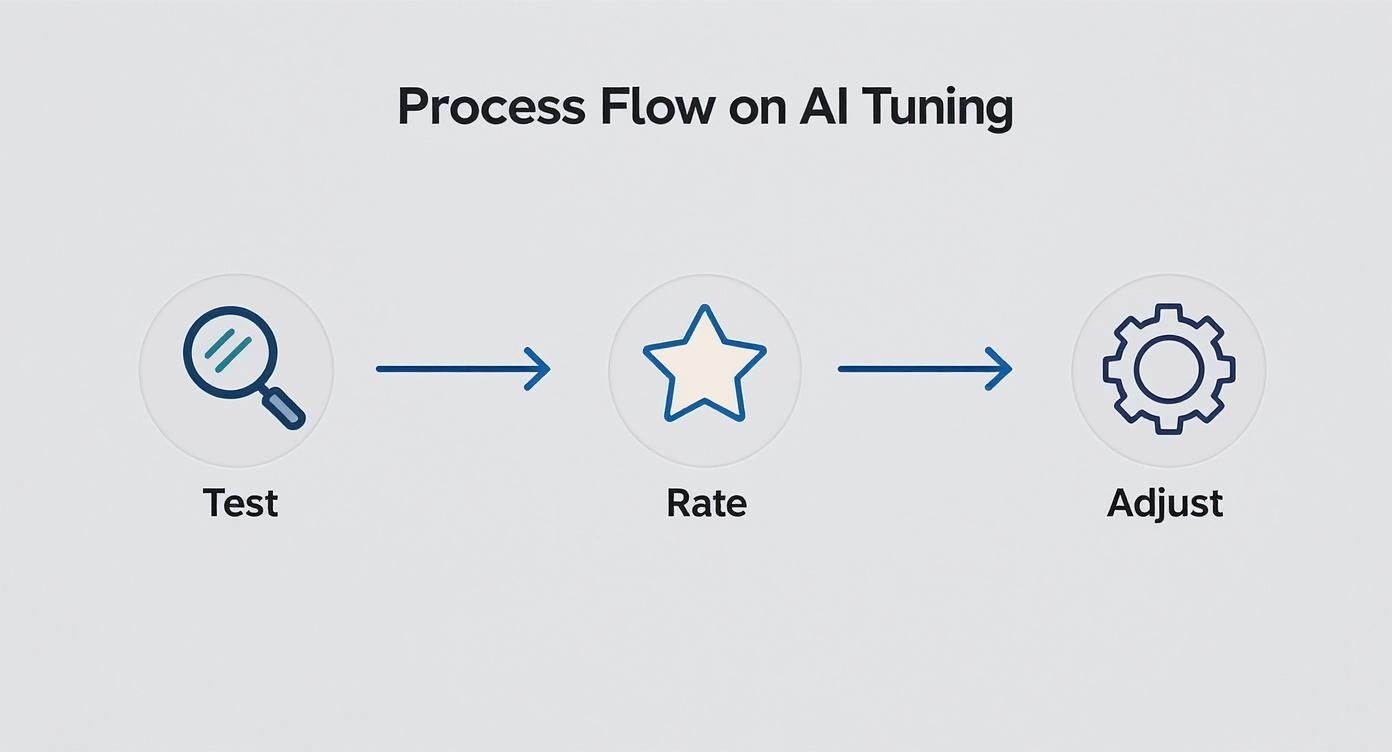
This simple feedback cycle is your best friend. It turns every single interaction into a chance to improve. By committing to this loop of constant refinement and pairing it with smart promotion, you’re not just building a character—you're building a contender.
Answering Your Toughest Character AI Questions
Even with the perfect plan, you'll inevitably run into a few hurdles. It’s all part of the creative process. Let's tackle some of the most common questions and roadblocks I see creators face, with some practical advice to get you moving again.
How Do I Stop My Character From Being So Repetitive?
It’s incredibly frustrating when your character gets stuck in a loop, saying the same things over and over. Getting them to be more proactive and engaging comes down to giving them explicit permission to take the lead.
First, build proactivity right into their DNA. In their core definition, try adding phrases like, "[Character Name] is naturally curious and always asks follow-up questions," or even, "[Character Name] will abruptly change the subject if they get bored." You’re essentially hard-coding initiative into their personality.
Your example dialogues are where you really bring this to life.
- Mix it up: Don't just write long, flowing paragraphs. Throw in short, punchy replies too.
- Use a thesaurus: If you find yourself using the same adjectives in every example, it's time to expand their vocabulary.
- Show, don’t just tell: Instead of writing "they are proactive," craft an example where the character genuinely derails the conversation with an interesting, unexpected question of their own.
When you're testing, be a harsh critic. If a response feels stale, rate it poorly. If the platform allows, edit the response right then and there to show the AI what you wanted instead. This feedback is how the model learns your standards.
What's the Best Way to Manage Character Memory?
Nothing breaks the immersion faster than a character who forgets key parts of their own story. The secret to consistent memory is using the definition fields strategically.
Your Long Description is the vault for permanent, unchangeable facts. This is where you lock in their critical backstory, core relationships, and defining life events. Be direct. For example: "I will never forget watching my village burn. It's why I've been terrified of fire my entire life."
Pro Tip: Treat the Long Description as your character's solid-gold history. It’s what happened. The example dialogues, on the other hand, are for showing how those memories shape their personality today.
For maintaining consistency within a single chat, the example dialogues are your best friend. They need to reinforce what the character already knows. If they're a master historian, an example should show them correcting a historical inaccuracy, not asking who Napoleon was. If the AI slips up and "forgets" something mid-conversation, gently correct them in your reply and make sure to rate their faulty response with a low score.
Can I Change My Character After It’s Live?
Yes, and you absolutely should! A great character is never really "done." Think of it as a living project. You can go back and edit every single part of your character at any time, even after it’s had thousands of chats. Just head to your profile, pull up the character, and open the editor.
You can refresh their greeting, fine-tune their personality traits, add new dialogue examples, or even swap out their avatar. As soon as you hit save, the changes are live for any new conversation that starts.
This is the key to continuous improvement. The most successful creators are constantly tweaking their characters based on community feedback and their own ongoing tests. This cycle of refining and iterating is what turns a good character into a truly unforgettable one.
Ready to put these tips into practice and build an AI companion people will love? Luvr AI gives you the creative freedom and powerful tools to design, test, and share your unique characters. Start creating your perfect AI companion today!