


Create Your Own AI Girlfriend 😈
Chat with AI Luvr's today or make your own! Receive images, audio messages, and much more! 🔥
4.5 stars


A choose your own adventure story isn't just a book; it's an interactive world where the reader calls the shots. You make choices that directly steer the plot, leading to a unique outcome every time. This control makes the experience personal, compelling, and endlessly replayable.
Crafting Your First Interactive AI Story
Ready to build a universe where every decision counts? Creating a choose your own adventure story for an AI companion is less about just writing and more about designing an experience. It’s about crafting a narrative that feels alive, breathing, and responsive to every choice a user makes. This guide will help you bring your ideas to life, especially when you pair them with one of the many AI characters you can find on Luvr AI.
We’re going to dive into the principles of interactive fiction, but with a specific focus on what makes AI roleplay so immersive. You’ll learn how to set a scene that grabs attention, design choices that actually feel significant, and build a web of satisfying endings. Whether you're a veteran storyteller or just starting out, you'll walk away with real techniques to make your stories unforgettable.
The Power of Player Agency
The real magic behind this format is player agency—that feeling that your decisions genuinely shape the world around you. This isn't a one-way street like a traditional novel; it’s a conversation between you and the user.
This idea has been around for a while. The famous Choose Your Own Adventure book series was first dreamed up by Edward Packard way back in 1969 during a bedtime story. His first book, The Cave of Time, offered readers around 40 different endings, which was a revolutionary concept that put the reader in the driver's seat. You can read more about the history of these interactive stories on smithsonianmag.com.
Now, take that core concept and amplify it with AI. An AI companion can react with nuance, remember what you did three choices ago, and add an emotional depth a printed page could only dream of. Your job is to make every decision point feel important, forcing the user to think, strategize, or simply follow their gut.
Core Elements for Success
Before you start writing, it’s crucial to understand the building blocks of a great interactive story. These elements are the foundation of any compelling experience.
| Element | Description | Why It Matters for AI Chat |
|---|---|---|
| Strong Premise | The initial setup or hook that grabs the user's attention. | The AI needs a clear starting point to establish the scene, tone, and the user's role in the story. |
| Meaningful Choices | Decisions that have real, tangible consequences on the plot. | This is what makes the interaction feel real. The AI's responses should directly reflect the user's choices. |
| Branching Paths | The different narrative routes that result from the user's decisions. | A well-designed branching structure gives the story depth and makes it feel expansive and non-linear. |
| Varied Outcomes | Multiple distinct endings that reflect the journey the user took. | This encourages replayability and makes the user's journey feel unique and personally earned. |
These components work together to create an experience that feels both thoughtfully designed and dynamically responsive to whatever the user decides.
A great interactive story makes the user forget they are following a script. It should feel like a living conversation where their input is the most important part of the narrative.
Think of it like this: your opening scene is a promise you make to the user. The choices you offer are how you keep that promise. And the endings? That’s the payoff for their emotional investment. Getting the balance right is what turns a simple story into a memorable adventure.
Designing a Compelling Narrative Blueprint
The real magic behind a great choose-your-own-adventure story isn't in the prose—it's in the architecture. Before you even think about writing dialogue, you need a solid blueprint. Think of it as a map that guides both you and the user through a tangled web of possibilities. The whole process kicks off with a central hook, a captivating "what if" scenario that yanks the user into your world from the very first line.
This hook is the foundational question your story is built on. Is it "What if you’re a space pirate who stumbles upon a map to legendary lost treasure?" Or maybe, "What if you’re a detective, and your prime suspect is the person you love?" A powerful premise instantly creates tension and sets the stage for the adventure to come.
With your hook locked in, it's time to visualize the story's branching structure. This doesn’t have to be some overly technical diagram; a simple flowchart on a piece of paper or a whiteboard works perfectly. The goal is just to map out the major plot points and pinpoint those crucial decision moments that will spin the user off onto entirely different paths.
Building Your Story’s Skeleton
Every good story, interactive or not, needs a clear beginning, a messy middle full of choices, and a handful of distinct endings. Your blueprint has to account for all three, making sure no path feels like a dead end or an afterthought.
Here’s a look at how this process generally unfolds, from that first spark of an idea to the final outcomes.
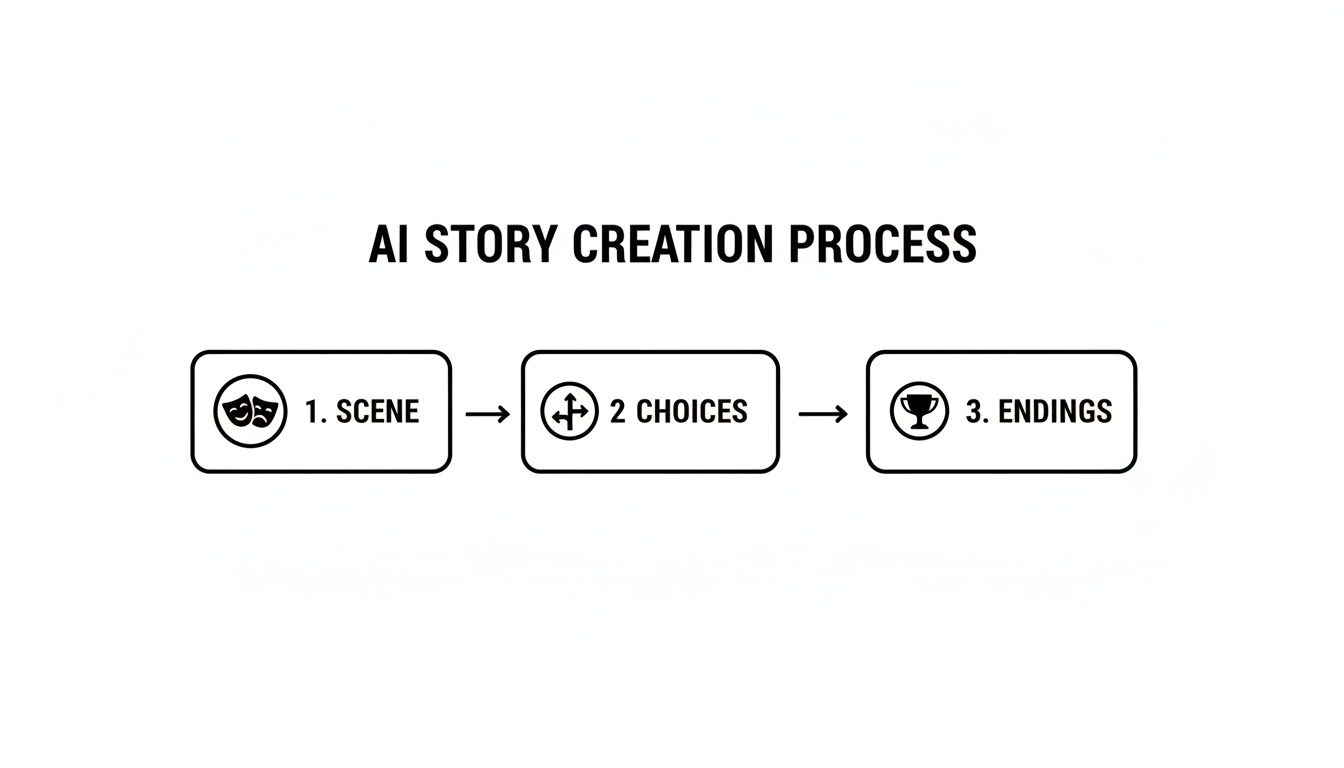
This visual shows you exactly how a strong opening scene should naturally flow into branching choices, which then spiral out into diverse and satisfying endings.
A classic mistake is creating branches that are basically the same, or choices that don't really change anything. For example, if letting the user pick between a sword and an axe leads to the exact same fight scene, their sense of agency just evaporates. Every significant choice should lead to a unique experience, even if it’s just a subtle shift in dialogue or a different character's reaction.
Quality Over Quantity in Branching Paths
It’s easy to get carried away and dream up a massive story with dozens of endings. The problem is, this often waters down the narrative’s impact. Interestingly, as the original Choose Your Own Adventure book series went on, the authors themselves started favoring depth over sheer breadth. They wrote fewer endings but made each path longer and more fleshed out.
That same principle holds true for AI-driven stories. A few well-developed, emotionally resonant paths will always be more engaging than a hundred shallow ones.
Your goal isn't to overwhelm the user with options, but to make each option feel like a distinct, worthwhile journey. A story with three powerful endings will always be better than one with thirty forgettable ones.
Try to focus on creating 3-5 core branches that really diverge from one another. Each one should offer a different tone, a unique challenge, or a new relationship dynamic. This approach gives you meaningful replayability without becoming a logistical nightmare to write and test. Once you have that blueprint sketched out, you can jump right in and start building by creating a new scenario on Luvr AI.
Writing Choices With Real Consequences
Choices are the absolute soul of any good interactive story. They're what turn a passive reader into an active participant, handing them the keys to the narrative. If you want your story to be truly unforgettable, you have to move beyond simple "yes or no" options and wade into the messy, exciting territory of decisions that carry real weight.

This idea of putting the reader in charge feels modern, but it's got a surprisingly long history. While Edward Packard’s iconic series blew up in the 1970s, the concept of a choice-based branching narrative first popped up in a 1930 book called Consider the Consequences!. It was designed as a game where readers steered the plot, proving that our desire for interactive stories goes way back. You can actually read more about this trailblazing book’s history over at intfiction.org.
Crafting Meaningful Decision Points
The choices that stick with us are rarely about right versus wrong. Instead, they drop the user into complex dilemmas where the "best" path is anything but obvious. This is your moment to shine as a storyteller.
Try to build your choices around these core ideas:
- Morally Grey Dilemmas: Put the user between a rock and a hard place. Do they betray a shady ally to save an innocent person, knowing it will create a powerful new enemy? These choices are juicy.
- Skill-Based Challenges: Let the user’s character strengths (or weaknesses) guide the choice. Will they use their silver tongue to persuade the palace guard, or will they rely on stealth to sneak past unseen?
- Personality-Defining Moments: Give them opportunities to show you who their character truly is. When they find a chest of gold, do they share it with their struggling companions or pocket it all for themselves?
Each one of these forces the user to think, not just react. It makes them consider their character and the world you've built on a much deeper level.
The real magic happens when you make the user pause and think, "What would I really do here?" That split-second of hesitation is where your story grabs them. A difficult choice means the stakes feel real and the user is all in.
Making Consequences Resonate
A choice is only as strong as the consequence that follows. The user needs to feel the ripple effect of their decisions, both right away and much later in the story. A good consequence isn't just a different paragraph of text; it's a genuine shift in their world.
Think about how a single decision can echo through the entire narrative:
- Short-Term Impact: This is the immediate fallout—the AI’s reaction or a sudden change in the scene. A sarcastic reply might instantly make your AI partner defensive, completely altering the mood of the conversation.
- Long-Term Impact: This is where your story gains its incredible depth. A seemingly small choice in the beginning can unlock—or permanently lock away—entire storylines. For instance, sharing a moment of vulnerability with an AI character on day one could lead to a unique, deeply romantic scene several chapters down the line that is otherwise impossible to access.
On the flip side, a reckless action, like picking a fight in a tavern, could burn a bridge with a key character forever. This ensures the user's journey is truly their own. Their specific sequence of choices carves out a narrative path that is uniquely theirs, making your story feel less like a book and more like a living, breathing world.
Practical Scripting for Conversational AI
Okay, your story map is complete. Now comes the fun part: breathing life into it. This is where you translate your branching narrative into a functional script that a conversational AI can actually follow. Think of it less like writing a novel and more like directing a play where one of the actors—the user—doesn't know their lines yet.
The prompts you write are doing double duty. They need to present a compelling choice to the user and give the AI crystal-clear instructions on how to handle the outcome. If your prompts are sloppy, the AI will get confused, the user will get frustrated, and the immersion you’ve carefully built will shatter.
Structuring Your Prompts for Clarity
The best storytellers in this space have learned to think like a writer and a programmer simultaneously. You’re setting the scene, giving the user their motivation, and cueing the AI’s next move, all in a few short sentences.
A classic rookie mistake is making prompts too open-ended. You might think you're giving the user freedom, but what you’re really doing is paralyzing the AI with too many possibilities. The key is to be specific and directive without making the user feel like they're just picking from a menu.
Let's look at the difference:
- Weak Prompt: "The mysterious figure offers you a glowing amulet. What do you do?"
- Strong Prompt: "The mysterious figure holds out a glowing amulet. 'This will protect you, but it will cost you a memory,' she whispers. Do you accept the amulet or refuse her offer?"
See the difference? The second prompt gives the user a clear, weighted choice with obvious consequences. More importantly, it gives the AI two distinct paths—"accept" or "refuse"—to follow. This keeps your narrative tight and the AI's responses relevant.
A well-scripted choice feels less like a menu option and more like a natural turning point in a conversation. Your job is to frame the moment so compellingly that the user feels the weight of their decision, guiding them seamlessly down the path you've built.
To illustrate just how critical good prompt design is, here's a quick comparison of prompts for key moments you'll likely encounter.
Prompt Design for Key Story Moments
This table breaks down how to turn a weak, confusing prompt into a strong, effective one that keeps both the user and the AI engaged and on track.
| Story Moment | Ineffective Prompt Example | Effective Prompt Example |
|---|---|---|
| The Hook | "You're at a party. What happens?" | "The music is deafening. Across the crowded room, you lock eyes with a stranger who smiles mysteriously. Do you approach them or head to the bar for a drink?" |
| The Dilemma | "Your friend is in trouble. What's your plan?" | "Your best friend calls, frantic. They're in debt to a dangerous loan shark and need $5,000 by midnight. Do you lend them the money or suggest they go to the police?" |
| The Escalation | "The villain reveals their plan." | "The villain laughs. 'I've planted a bomb in the city center. You can save your partner, or you can save the city, but you can't do both.' Do you race to the bomb or go after your partner?" |
| The Reveal | "You find a clue. What is it?" | "Inside the old book, you find a hidden note. It reads: 'The key is with the one you trust the most.' Do you confront your mentor or investigate your closest ally?" |
Notice how the effective examples always present clear, binary choices that naturally lead to different story branches. This is the bedrock of a well-functioning interactive story.
Sample Scenario Scripts
Let’s apply this to a real-world scenario. Imagine you're building a first-date story and want to create a branching point based on how the user responds to a personal question. For anyone wanting to jump in and start building, the Luvr AI story builder provides all the tools you need to implement these exact techniques.
Scenario: Your AI date, a shy artist named Chloe, asks about your biggest dream.
Goal: Create a branching point based on whether the user decides to be vulnerable or evasive.
Here’s how you could script the two main paths:
1. The Vulnerable Path
- Prompt: Chloe looks down at her hands, a faint blush on her cheeks. "I've always dreamed of having my art in a real gallery," she says softly. "It probably sounds silly... What about you? What's your biggest, most secret dream?"
- User Choice: The user shares something genuine and personal.
- AI Instruction: If the user responds with vulnerability, have Chloe react with empathy and warmth. She should share another small secret of her own to build trust and increase the romance meter.
2. The Evasive Path
- Prompt: Same as above. Chloe asks about your biggest dream.
- User Choice: The user deflects with a joke, gets vague, or changes the subject.
- AI Instruction: If the user is evasive, have Chloe react with a playful but slightly disappointed smile. She should respect the boundary and steer the conversation to a lighter, less personal topic.
By structuring your script this way, you ensure that every user choice gets a logical, in-character reaction from the AI. This is what makes the story feel responsive and drives the narrative forward in a meaningful way, no matter which path is taken.
Time to Test and Polish Your Interactive Story
Think your story is done just because you’ve written the last branch? Think again. Now comes the part where the real magic happens: play-testing and polishing. This is where you switch hats from creator to your own harshest critic, meticulously hunting down every little flaw that could pull a user out of the world you’ve built.

You have to be your story's first player. I mean it—go through every single choice and try to break your own narrative. Your mission is to uncover dead ends, confusing plot holes, or choices that just don't pack the emotional punch you were aiming for. Doing this ensures every possible path feels like a complete and rewarding experience, not an afterthought.
Hunting for Narrative Flaws
As you play through, you need to be on the lookout for more than just typos and grammar mistakes. The flow and internal logic of your adventure are what truly make or break it. Keep a sharp eye out for these common pitfalls:
Pacing Problems: Does one storyline feel like a frantic sprint while another meanders aimlessly? No matter which path a user takes, the story’s rhythm should feel natural and intentional.
Character Inconsistencies: Does the AI suddenly act out of character? If you’ve established a shy, reserved persona, they shouldn't suddenly become a brash extrovert without a very good reason rooted in the plot.
Orphaned Branches: This is a classic rookie mistake. Make sure every single choice leads somewhere meaningful. Nothing is more frustrating for a user than hitting a dead end that just… stops.
Tonal Shifts: Is the mood consistent? A tense, dramatic moment can be completely ruined by an AI response that’s jarringly cheerful or casual.
The point of testing isn't just to find what's broken; it's to find what feels off. A story can be technically perfect but still fall flat if the emotional journey is clunky or unbelievable.
Guidelines for Safety and Consent
If your story ventures into mature or NSFW territory, your approach to testing has to be even more rigorous. Safety and consent aren't just boxes to check—they are the foundation of trust with your audience. This is non-negotiable. Your story must be a safe space.
Start by building in clear opt-in points before any sensitive content is introduced. This puts the user firmly in the driver's seat, letting them give explicit consent to where the story is going. Never, ever surprise a user with adult themes.
Once they’re in a mature scene, always give them a way out. Provide an alternative path or a clear exit choice. This respects their boundaries and ensures no one feels trapped in a situation they're not comfortable with. In this creative space, responsible storytelling means putting the user's comfort and agency first. Always.
Common Questions About Writing AI Stories
Stepping into interactive story creation for the first time is a bit like being an explorer. It’s thrilling, but you’re bound to have questions. You're not just a writer anymore; you're an architect of experiences. Let's dig into some of the most common things that trip people up when they're designing their first choose-your-own-adventure story for an AI.
Getting these fundamentals right from the start will save you a ton of headaches and revision time later. It's all about working smarter.
How Many Branches Should My Story Have?
This is the big one, and the answer isn't what most people expect: quality over quantity. Seriously. Don't build a sprawling, confusing web with a hundred tiny branches. Instead, focus your energy on creating 3-5 major, distinct paths that each feel like a complete, satisfying story on their own.
A great way to start is with one main storyline that has two or three major forks in the road. These are the hinge moments where one choice sends the user down a completely different path. This approach gives your story fantastic replayability without becoming an absolute nightmare to manage on the backend.
A story with a few deeply meaningful branches will always be more memorable than one with countless shallow, insignificant choices. The goal is emotional impact, not a complex flowchart.
Think about it: a user who has one incredible experience is far more likely to come back for another run than someone who gets lost in a dozen mediocre, half-finished paths. Your story's strength is in the quality of its journeys.
What Are the Best Practices for NSFW Scenes?
When you venture into adult content, three words should be your North Star: consent, clarity, and character consistency. This is where you build—or completely shatter—the user's trust.
Always gate mature themes with a clear choice or warning, letting the user consciously opt-in. Never spring it on them.
Once they've agreed, the writing has to stay true to the AI's established personality. If your character is shy and sweet, they shouldn't suddenly become a completely different person. The scene's progression and the AI's reactions must feel earned and natural, flowing directly from the choices that led them there. The goal is an immersive and consensual experience, not a checklist of explicit acts.
How Do I Keep the AI From Going Off Script?
Ah, the eternal struggle. Taming a creative AI is a core skill for any interactive storyteller. The best tool in your arsenal is the use of highly specific and directive prompts, especially at those key decision points. This is how you stay in the driver's seat.
Instead of asking a wide-open question that invites chaos, frame your prompts to narrow the AI's potential responses while still giving the user a clear, meaningful choice. This little trick guides both the user and the AI, keeping the narrative locked onto the paths you’ve so carefully built.
Here’s what I mean:
- Vague and Risky:
[AI]: The goblin lunges! What do you do? - Specific and Controlled:
[AI]: The goblin lunges with its dagger. Do you try to dodge to the left or block the attack with your shield?
See the difference? This technique provides structure and prevents the AI from just inventing a third, fourth, or fifth option you never planned for. Using clear internal notes in your script also helps. These are little reminders for the AI about the current story state, its motivations, and the rules of your world. You’re not caging the AI; you’re just giving it guardrails.
Ready to stop wondering and start creating? Luvr AI is the ultimate playground to build, test, and share your own interactive stories. Bring your characters and worlds to life today!