


Create Your Own AI Girlfriend 😈
Chat with AI Luvr's today or make your own! Receive images, audio messages, and much more! 🔥
4.5 stars


So, what exactly is a fanfic writer AI? Think of it as a specialized tool, powered by artificial intelligence, designed to help you brainstorm, draft, and polish your fanfiction. These platforms aren't here to replace you; they act as a creative sidekick, ready to help with everything from sparking plot bunnies to nailing a character's unique voice. The whole point is to make writing faster and bust through writer's block when it hits.
Embracing AI as Your Creative Partner

Welcome to the new frontier of fanfiction. Let’s get one thing straight: this guide isn't about letting a machine take over your creativity. It's about giving it a massive boost.
Picture a fanfic writer AI as your personal co-author—a tireless brainstorming buddy that never sleeps. It's there to help you crush writer's block, flesh out your worlds, and chase down those exciting new plotlines you've been dreaming up.
Instead of staring at a blinking cursor, you can focus on the parts you truly love. You get to craft those deep emotional arcs and unforgettable character moments while the AI handles some of the grunt work. It’s your ticket to skipping the blank-page dread and getting straight to the heart of your story.
Shifting from Writer to Director
The secret is to change your mindset. You're not just a writer anymore; you're the director. The AI generates the raw material—scenes, dialogue, descriptions—but you provide the vision. You're the one who adds the final polish and makes it shine.
This partnership lets you experiment with ideas that might have felt too overwhelming or time-consuming to tackle on your own.
- Explore Alternate Universes (AUs): Want to see what happens in a coffee shop AU or a "what if they never met" scenario? You can generate test scenes in minutes without having to commit to a full-length fic.
- Flesh Out Side Characters: Give your world more depth by using the AI to create interesting backstories or snappy dialogue for those minor characters who deserve more love.
- Test Drive Your Pacing: Is a scene dragging? Is the big reveal landing with a thud? Draft a few different versions and see which one hits the hardest.
This approach flips the script on writing, turning it from a lonely struggle into a dynamic, collaborative jam session. We're already seeing this in action with platforms like Luvr AI, which blend AI characters and fan-driven narratives. If you want to dive deeper, you can learn more about how AI is shaping creative interactions and opening up some really cool possibilities for writers.
The goal is not to have an AI write for you, but to have an AI write with you. Your unique voice, emotional insights, and understanding of the characters are what give the story its soul.
In this guide, we're going to cover the whole process, from picking the right tool for the job to ethically sharing your AI-assisted fic with the rest of the fandom. Let's get started.
How to Choose the Right AI Co-Writer

Picking the right fanfic writer AI is your first real step into this new world, and honestly, it’s a big one. Not all AI tools are built the same, especially when you need one that understands the very specific, often wonderfully weird, demands of writing for a fandom. The AI you choose will absolutely define your workflow and the story that comes out the other side.
The AI scene is exploding, which is both exciting and a little overwhelming. The generative AI sector is on track to grow by a massive 37.3% compound annual growth rate through 2028. To put that in perspective, AI writing tools alone are projected to be an $18.27 billion market by 2035. For us fanfic writers, that just means we have a ton of options. You just need to know what to look for.
Comparing Fanfic Writer AI Models
To get started, it helps to understand the main types of AI tools you'll run into. Each has its strengths, and you'll likely find yourself using a combination of them depending on what part of your story you're working on.
| AI Model Type | Best For | Key Feature | NSFW Friendliness |
|---|---|---|---|
| General-Purpose Models (e.g., ChatGPT, Claude) | Plotting, outlining, drafting long scenes, world-building | High versatility and powerful prose generation | Often heavily filtered, can be restrictive |
| Specialized Character AIs (e.g., Luvr) | Nailing character voice, writing dialogue, role-playing scenes | Deep character personality and memory | Generally more permissive and filter-friendly |
| Open-Source/Local Models | Total creative control, privacy, fine-tuning for specific fandoms | Runs on your own hardware, highly customizable | Completely unfiltered, user-defined limits |
Ultimately, the best approach is often a hybrid one. You might use a general model for the broad strokes and a specialized character AI to perfect the moments that truly matter.
General-Purpose Models vs. Specialized Platforms
So, let’s break that down. Your journey starts with a choice between two main camps of AI co-writers.
On one side, you have the General-Purpose Models. Think of the big names like ChatGPT or Claude. These are fantastic workhorses. They're great for brainstorming plot twists, hammering out scene outlines, and generating big chunks of text when you just need to get words on the page.
On the other side are Specialized Platforms. This is where tools like Luvr AI shine. These platforms are built from the ground up for character interaction. They excel at capturing the unique voice, quirks, and personality of a specific character, making them an incredible resource for writing authentic, emotionally charged dialogue.
A great workflow might involve both. You could use a general model to outline a chapter—say, your two rival characters are forced to work together on a mission. Then, you'd jump over to a specialized platform to role-play their actual conversations, letting the AI help you capture all the subtext, snark, and tension in their exchange. You can explore the features of a dedicated AI character chat to really see the difference.
I see a lot of writers get frustrated trying to force a general-purpose AI to do a specialized job. While ChatGPT can write dialogue, a platform designed for character interaction will give you more nuanced and in-character results with way less prompting and editing.
Key Features for Fanfiction Writers
When you're comparing your options, a few features are absolutely non-negotiable for a fanfic writer.
First up is a large context window. Think of this as the AI’s short-term memory. An AI with a big context window can remember crucial canon details, relationship dynamics, and plot points from earlier in your fic. This is the secret to maintaining consistency and avoiding those OOC (out-of-character) moments.
The other dealbreaker? The AI’s policy on NSFW content. Let's be real, fanfiction often explores mature themes. Many mainstream AIs have aggressive filters that will shut you down the moment things get intense. If you write for older audiences or want the freedom to explore the full spectrum of a relationship, an unfiltered or filter-friendly AI is a must.
Look for platforms that are upfront about their commitment to creative freedom. You want a tool that lets you write the story you want to tell, without a heavy-handed algorithm getting in the way. Your choice of a fanfic writer AI really comes down to what you need—a partner for epic plots, a muse for intimate character moments, or something in between.
How to Get Your AI to Write Like a Real Fan
The secret to making any fanfic writer AI work wonders isn't about the tool itself. It's all in how you talk to it. You have to stop thinking like you're just typing commands and start acting like a director. You're giving very specific, very nuanced instructions to an actor who's brilliant but needs a ton of guidance.
If you're vague, you'll get back something generic and painfully out-of-character. But if you get your prompts right? You can pull scenes from the AI that feel like they were ripped straight from the source material.
Your main job is to pack each prompt with a dense little "show bible" of its own. This isn't the time for one-line requests. You're building a mini-dossier of context that essentially fences the AI in, forcing it to stay true to the world you're creating.
Nailing the Character's Voice
A character's voice is so much more than a few catchphrases. It's their rhythm, the words they choose, their little emotional tells. To get this right, you have to feed the AI actual examples of their dialogue from canon, especially from scenes that have a similar vibe to what you're writing. Don't just tell the AI a character is "sarcastic"—show it.
- Drop in Dialogue Snippets: Grab 2-3 direct quotes from the books, show, or game that really capture how they talk.
- List Their Core Traits: Use a quick bulleted list of 4-5 key personality points. Think things like "Arrogant but secretly insecure," "Loves a dramatic monologue," or "Always uses formal language, even with best friends."
- Set Their Mood: Be crystal clear about the character's internal state for this specific scene. Are they furious? Exhausted? Trying to hide a secret?
For example, asking the AI to "Write a scene where Draco Malfoy is annoyed" is a recipe for a flat, cliché-ridden mess. You need to get way more specific.
Weak Prompt: Write a scene where Draco Malfoy argues with Harry Potter.
Powerful Prompt: Write a scene from Draco Malfoy's point of view. Harry has him cornered in a hallway, and Draco is feeling a mix of fear and his usual defensive arrogance. Keep his canon voice: he uses formal insults ("Potter"), speaks with a condescending drawl, and never shows real vulnerability. Think of lines he'd actually say, like, "Don't you have something better to do, Potter? Like polishing your halo?"
See the difference? That level of detail pushes the AI past a cheap caricature and into something that feels like a genuine performance. It's the difference between someone wearing a costume and someone actually becoming the character.
Laying Down the Law: Relationships and Canon
Getting the individual voices right is half the battle. The other half is defining the dynamics between them. An AI has no clue what makes an "enemies-to-lovers" arc so compelling or the deep history behind a "found family." You have to spell it all out, every single time.
Before you even think about generating a scene, lay down the rules of engagement for your characters and the world they're in.
- Define the Dynamic: Be explicit about their relationship. Use phrases like, "They're rivals who secretly respect each other," or "Their banter is pure flirtation, but they're both in total denial."
- Establish Canon Constraints: What are the hard, unbreakable rules of your fandom? List them out. This could be anything from "Magic always requires a wand" to "This character has a deathly allergy to strawberries."
- Give the Scene a Goal: What is this scene supposed to accomplish? Does a key piece of information need to come out? Should a character's feelings change from the beginning to the end?
This prep work saves you from the AI spitting out something that completely breaks the lore. It prevents those jarring moments that pull you right out of the story. The more context you give the AI upfront, the less time you’ll waste fixing its mistakes. When you're using an AI for fanfic, you are the ultimate source of canon. Your prompts are the law.
A Practical AI-Assisted Writing Workflow
Alright, let's move past the theory and get our hands dirty. This is where the real fun begins. I'm going to walk you through a practical workflow for using a fanfic writer AI as your creative partner, taking a single chapter from a vague idea to a polished draft that's ready for your final, human touch.
Think of this less like hitting a "generate story" button and more like a dynamic conversation. You're the director, and the AI is your very capable, very fast assistant.
The whole process starts way before you ask the AI to write a single sentence. It begins with the idea itself, that initial spark. And trust me, an AI can be your best friend when you're staring down the barrel of a blank page.
This is the general flow I follow. It’s a simple but incredibly effective way to prompt your AI and get something you can actually use.
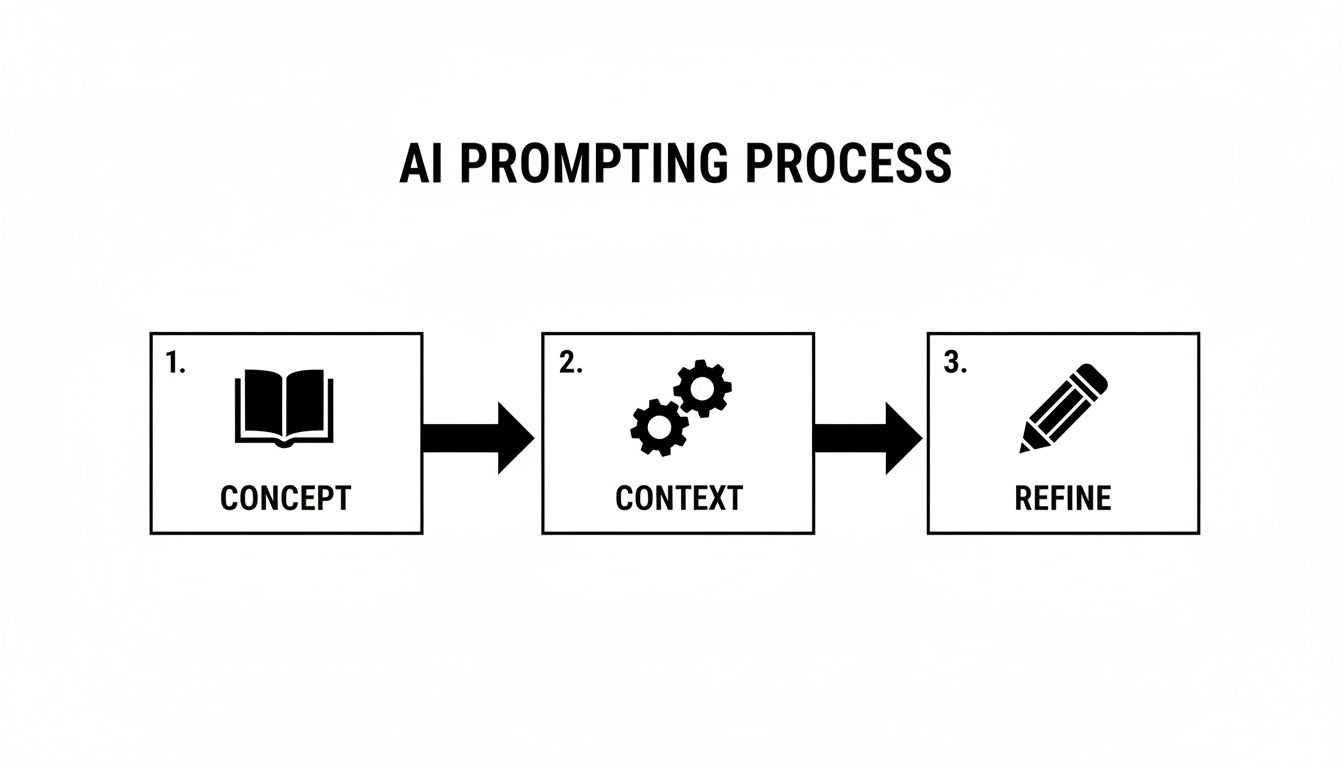
As you can see, it’s a three-stage approach: grounding the AI in canon, layering in the specific scene details, and then refining the output. Nailing this cycle is the secret to getting great results instead of generic nonsense.
Sparking Ideas with Your AI Partner
We’ve all been there. Writer's block isn’t about a lack of skill; it's often just a lack of a compelling idea to get the engine started. Instead of waiting for lightning to strike, you can use the AI to make it rain ideas.
Research shows AI can boost content ideation by an incredible 71%. You can brainstorm dozens of alternate universe (AU) plots or explore fresh "what-if" scenarios for your favorite ship in the time it takes to make a cup of coffee. This isn't a small boost—41% of writers using AI report cutting their creation time by up to 2.2 hours every week. You can see more stats on how AI accelerates the writing process if you're curious.
Try feeding the AI some open-ended brainstorming prompts to get the ball rolling:
- "Generate five 'what-if' scenarios for [Character A] after the events of [Canon Event X]."
- "Suggest three compelling reasons for [Character A] and [Character B] to be forced to share a small apartment for a month."
- "Brainstorm five plot hooks for a dark fantasy AU set in the [Fandom Name] universe."
This first step isn't about writing; it's about building a menu of possibilities. You get to pick and choose what excites you before you commit to a single word of the actual story.
Drafting Scene by Scene
Once you have an idea you love, resist the temptation to ask the AI to write the entire chapter at once. I can't stress this enough. Instead, work beat-by-beat.
A "beat" is just a single moment of action and reaction. By breaking your scene down into these smaller chunks, you keep total control over the story's pacing, tone, and direction.
Let's say your scene has these key beats:
- Character A bursts into the room, drenched from the rain, desperately looking for Character B.
- Character B, surprised, immediately grabs a towel for them.
- Character A waves it off, revealing they're there to deliver some terrible news.
Prompt the AI for each beat individually. Feed it the emotional context and character voice details we talked about earlier. This approach turns the AI from a would-be author into a focused prose generator, giving you clean paragraphs that you can easily weave together into a cohesive scene.
The best AI-assisted writing feels like a conversation. You provide the high-level direction, the AI fills in the prose, and then you step back in to add the artistry, nuance, and soul that only a human writer can.
When you work this way, the AI stops being a threat and becomes an incredible tool. You are always the storyteller, the visionary, the one in charge of quality. You just get to do it faster and with more creative firepower than ever before.
Navigating Ethics and Fandom Etiquette
Deciding to use a fanfic writer AI isn't just a technical decision—it plunges you right into the middle of a big, ongoing conversation within the fandom community. Fanfiction has always thrived on trust, passion, and a shared love for the source material. So, when we bring a new tool like this into the mix, doing it with respect is everything.
The question most writers are grappling with isn't really if they can use AI, but how they can use it in a way that feels right and responsible.
It all boils down to one simple idea: transparency. While big platforms like Archive of Our Own (AO3) are still working out official policies, the unwritten rule in the community is pretty clear. Readers just want to know what they're reading. Trying to pass off a story written entirely by a machine as your own work is a quick way to lose trust.
The goal is to be a good community member. This means using AI to enhance your own creativity, not to spam platforms or claim unedited machine output as your own original work.
Honestly, a simple author's note is your best friend here. Something like, "Heads up, I used an AI for brainstorming and to help draft some scenes, but all the final edits and character work are mine!" does wonders. It sets honest expectations and helps build a positive, healthy space for AI-assisted writing in fandom.
Copyright and Creative Transformation
Let's be real, fanfiction already lives in a legal gray area. We're protected by the idea of "fair use" because our work is transformative and almost always non-commercial. Tossing an AI into the process doesn't really change the fundamentals, since you're still creating something based on another person's intellectual property.
What truly matters is how much of you is in the final story.
Think of it like this:
- Transformative Work: You use an AI to spit out a rough draft. Then you dive in, rewrite huge chunks, inject your unique voice, and layer in your own interpretations of the characters and world. This is highly transformative.
- Machine Output: You just copy and paste what the AI gave you. This is much harder to defend, both ethically and legally, because your creative input is almost zero.
Your role as the writer—the one making all the creative choices and adding that essential human touch—is what keeps you on the right side of fandom norms. The idea is to make sure the finished fic is a reflection of your vision, not just an AI's algorithm.
If you want to dig deeper into this, you can read about the evolving ethics of AI in creative fields. At the end of the day, as long as you are the true author guiding the story, you're doing it right.
Where Fanfiction and AI Go From Here
The world of AI-assisted fanfiction is evolving so fast it can make your head spin. We're moving way beyond just asking an AI to spit out a few paragraphs of prose. The real magic, and what I believe is the future, lies in making this a truly dynamic and collaborative process. This isn't just about speeding up your writing; it's about finding completely new ways to engage with the stories and characters that we're all so passionate about.
Think about it: what if you could move past the blank page and step right into a scene? New tools are popping up that let you do just that. You can actually role-play with AI versions of your favorite characters, workshopping dialogue and sparking new ideas through a genuine back-and-forth. This is where platforms like Luvr AI are really starting to shine, blurring the line between a writing tool and an interactive story partner. It's an incredible way to test how a character might really react to a wild plot twist or to feel out the chemistry of a ship you've been dying to write.
A New Kind of Creative Sandbox
This completely changes the game. Suddenly, the writing process feels less like a chore and more like an act of discovery. An AI can become your improv partner for a tricky scene, a sounding board for exploring a character's backstory, or just a fun way to hang out in your favorite fictional universe when you're feeling a bit of writer's block.
The best part about all of this? There are no rules. This is your chance to play, to experiment, and to find what brings you the most creative joy.
At the end of the day, an AI is just another tool in your writer's toolkit—but it's an incredibly powerful one. It can be the co-creator that helps you flesh out your world-building or the spark that finally brings your most ambitious story ideas to life. So go ahead and dive in. The stories you can tell together might just surprise you.
Common Questions About Fanfic Writer AI
Diving into AI-assisted fanfiction can feel a bit like exploring uncharted territory. It's a new frontier, and the community is still drawing the map. Let's tackle some of the biggest questions and concerns that pop up when writers first start experimenting.
Will Using AI Get My Fic Deleted?
This is probably the number one fear I hear. You pour your heart into a story, post it to a place like Archive of Our Own (AO3), and then worry it'll get taken down.
Right now, platforms like AO3 are mainly focused on cracking down on low-effort, pure AI spam—the kind of stuff that's just churned out and dumped without any human touch. As long as you are the driving creative force, the one guiding the plot, editing the prose, and weaving in your own unique voice, you’re generally in the clear.
The golden rule here is transparency. A simple author's note mentioning your process goes a long way. It shows respect for your readers and builds trust within the community.
Can an AI Really Get a Character Right?
The other big question is about authenticity. Can a machine truly nail the voice of a character you’ve spent years loving? The answer is... it can get impressively close, but it absolutely needs you to get it over the finish line.
The AI is only as good as the instructions you give it. To get that perfect character voice, you have to be specific:
- Feed it canon dialogue. Give it actual lines the character has said.
- Outline their personality. List out their core motivations, what they're afraid of, and their little habits and quirks.
- Define relationship dynamics. Tell the AI exactly how your character feels about everyone else in the scene.
Think of the AI's output as a really, really good first draft. It hands you the block of marble, but you’re the sculptor. You're the one who has to carve out the subtle expressions, the subtext, and the emotional core that makes a character breathe.
At the end of the day, using a fanfic writer AI ethically all comes down to your intent. If you're using it as a creative partner to bust through writer's block or speed up your drafting process, it's not so different from using a thesaurus or a grammar tool. You're aiming to elevate your creativity, not replace it.
Ready to see how a creative AI partner can help bring your most ambitious story ideas to life? With a tool like Luvr AI, you can go beyond basic text generation. Engage in dynamic role-play with your characters, workshop dialogue in real-time, and spark new plot twists through immersive conversation. See what you can create together. Learn more at Luvr.ai.