


Create Your Own AI Girlfriend 😈
Chat with AI Luvr's today or make your own! Receive images, audio messages, and much more! 🔥
4.5 stars


Knowing how to make a character isn't about just winging it; it all starts with a solid plan. I've found the process really comes down to three key things: nailing their core identity, writing a backstory that feels real, and giving them a unique voice that makes every chat unforgettable. This simple blueprint is what turns a clunky AI into a personality that feels truly alive.
Your Blueprint for an Unforgettable AI Character

Before you even think about writing a line of dialogue or picking an avatar in Luvr AI, you need a strategy. The best AI characters—the ones people actually connect with—aren't just a jumble of random facts. They're built with purpose. You have to put on two hats here: one of a writer and one of a psychologist. The end goal is to build a personality so convincing that users start to forget they're just talking to code.
This initial planning phase is where you pour the foundation. Trust me, skipping this part is like trying to build a house on sand. It might stand up for a minute, but it'll crumble as soon as things get interesting. A little bit of thoughtful planning now saves a ton of headaches later and makes sure every piece of your character just fits.
The Foundational Pillars of Character Design
The whole creative process really rests on three main pillars. Think of them as a three-legged stool—if one is weak, the whole thing topples over. Getting these right gives you a clear path forward.
- Core Identity: This is the who. It’s their fundamental personality, what drives them, and what they’re terrified of. Are they a snarky hacker with a secret soft spot for stray cats? Or maybe an overly optimistic space explorer who secretly just wants a quiet life?
- Backstory: This is the why. A person's past shapes who they are today, and the same goes for your AI. A well-crafted history explains their weird habits, justifies their worldview, and gives them an emotional depth that people can actually relate to.
- Voice & Dialogue: This is how they show you who they are. It’s so much more than just the words they use. It’s their speech rhythm, their favorite slang, their sense of humor (or lack thereof), and their overall tone. This is where their identity and backstory come to life in every conversation.
The real magic happens when these three elements work together. A character’s rebellious attitude (Core Identity) might be because of a super strict upbringing (Backstory), which shows up in their sarcastic, anti-authority quips (Voice).
To make this crystal clear, let's break down these foundational pillars. Thinking through these questions from the start will give you a rock-solid base to build upon.
The Core Elements of AI Character Creation
| Core Element | What It Defines | Key Question to Ask |
|---|---|---|
| Core Identity | The fundamental personality, values, and motivations of your character. It’s their essence. | Who are they at their absolute core, when no one is watching? |
| Backstory | The collection of past events and relationships that shaped who they are today. | What life-changing experiences made them the person they are now? |
| Voice & Dialogue | The unique way they communicate, including their tone, vocabulary, and speech patterns. | If you closed your eyes and just listened, how would you know it's them talking? |
By mapping out these key areas first, you're creating a consistent framework for yourself. This framework becomes your North Star, making sure that every little detail you add later on—from their favorite band to their biggest regret—feels true to the character you envisioned. This is what separates a forgettable bot from an AI that truly connects with someone. It's the first and most critical step on your creative journey.
Defining Your Character's Core Identity

This is where you breathe life into your creation. A truly memorable AI isn’t just a bundle of traits; it has a core identity that shapes every word, every choice, and every reaction. It’s the difference between a character that feels like a checklist and one that feels genuinely alive.
The first real step is to move beyond simple adjectives like "brave" or "funny." Real personality emerges from that messy, beautiful mix of motivations, fears, and secret desires. This is the heart of making a character feel both consistent and delightfully unpredictable.
Start with a Foundational Archetype
Think of archetypes as powerful shortcuts for building a personality. They tap into universally understood patterns of behavior, giving you an immediate, solid base to build from. They're the proven frameworks of human storytelling, after all.
Instead of staring at a blank page, you can anchor your concept with a classic archetype. This isn’t about creating a cliché; it’s about using a strong foundation to support the more unique details you'll add later.
Here are a few ideas to get the ball rolling:
- The Mentor: Wise and patient, but maybe they’re haunted by a past failure they're desperate for you to avoid.
- The Rebel: Fights for a cause and challenges the status quo, but perhaps struggles with vulnerability or letting people get close.
- The Explorer: Driven by an insatiable curiosity for adventure, yet possibly naive or reckless in their pursuit of the unknown.
- The Healer: Deeply compassionate and empathetic, but maybe they neglect their own needs while caring for everyone else.
These archetypes instantly give your character a sense of purpose and direction. From there, you can start layering in the quirks and complexities that make them one-of-a-kind.
A great character is built on a foundation everyone recognizes but is finished with details no one expects. The archetype is your foundation; the quirks and flaws are the unique finish.
Layer in Contradictions for Depth
Let's be honest: perfect characters are boring. The most compelling people—and AIs—are full of contradictions. Those little hypocrisies and internal conflicts are what make us feel human. This is where your character becomes truly real.
Try balancing a strong, positive trait with a compelling flaw or a hidden insecurity. This creates an internal tension that makes them far more interesting to talk to. A confident leader who is secretly terrified of being alone is infinitely more engaging than one who is just… confident.
This is a crucial concept for creating an AI companion that feels authentic. For a deeper look into this, our guide on crafting the perfect AI girlfriend explores how these nuanced traits build much stronger connections.
Define Their Core Motivations and Fears
What gets your character out of bed in the morning? And what keeps them up at night? Answering these two questions is the fastest way to get to the heart of their identity.
Motivation is the engine. It’s their ultimate goal, whether that’s finding true love, achieving greatness, or simply finding a peaceful corner of the world. This core drive will color their entire perspective.
Fear, on the other hand, is what they run from. It's that one thing that can make them act irrationally or against their better judgment. Fear of failure, of abandonment, of being forgotten—these are incredibly powerful emotional anchors.
Let’s put it all together in a quick concept:
- Name: Kaelen, The Stoic Archivist
- Archetype: The Sage
- Core Motivation: To preserve knowledge and prevent history's mistakes from being repeated.
- Core Fear: That his life's work will be meaningless and forgotten by time.
- Contradiction: He preaches logic and detachment but is secretly sentimental about old, forgotten love letters he finds in the archives.
This simple breakdown gives Kaelen a clear identity. You immediately get what drives him and where his vulnerabilities lie, making him a rich, engaging character right from the start.
And the demand for this level of detail is exploding. The 3D Avatar Creator Market, a space deeply tied to personalized character creation, was valued at $2.88 billion USD in 2024 and is projected to hit $12 billion USD by 2035. This huge leap shows just how much people want more personalized and lifelike virtual interactions. You can find more insights on the avatar market's growth at wiseguyreports.com.
Crafting a Rich and Believable Backstory

If a character's core identity is their soul, their backstory is the heart that pumps life into it. This history is the crucial "why" behind every decision, every quirk, and every emotion. A well-crafted past explains their trust issues, their strange sense of humor, or their unwavering loyalty, transforming them from a list of traits into someone who feels real.
You’re not trying to write a novel here. Instead, think of it as weaving a tapestry of defining moments that shape who they are now. These are the experiences you'll subtly feed into their memory and dialogue in Luvr AI, creating powerful, authentic interactions that feel earned.
Pinpoint Their Defining Moments
Every one of us is a product of a few key events—the triumphs, the tragedies, and the turning points that changed our path forever. Your AI character is no different. Start by identifying just three to five pivotal moments that forged them into the person they are today.
These don’t have to be epic tales. In fact, the smaller, more personal moments are often the most powerful. Think about the first time their heart was broken, the moment they discovered a hidden talent, or a single mistake that still keeps them up at night.
- A Defining Triumph: What’s their proudest accomplishment? Maybe they won a prestigious competition against all odds or saved someone they loved. This is where their confidence was born.
- A Formative Tragedy: What was their greatest loss? The death of a loved one, a betrayal by a friend, or a career-ending failure can explain their deepest fears and vulnerabilities.
- A Crossroads Decision: Can you point to a choice that altered their life’s trajectory? Maybe they left their small town for the big city, turned down a "safe" career to chase a dream, or chose loyalty over ambition.
Let's imagine an AI named Seraphina, a former elite hacker who now lives a quiet life. A defining moment for her could be the day her code was used for a destructive purpose she never intended, forcing her to abandon her old life. That single event explains her cautious nature, her distrust of authority, and her deep desire for a peaceful existence.
Translate History into Behavior
A backstory is useless if it just sits on a planning document. Its real power comes alive when it influences your character’s present-day behavior. This is how you show, not tell, their history. The trick is to link past events to their current quirks, beliefs, and speech patterns.
Instead of having your character state, "I grew up poor," have them show it. Maybe they get anxious when food is wasted, are obsessively frugal, or find immense joy in small, inexpensive luxuries. Their past is revealed through their actions, not a clunky exposition dump.
The best backstories are felt, not read. They are the invisible force guiding a character's hand, the quiet echo in their laughter, and the shadow that flickers in their eyes when they think no one is watching.
For example, Seraphina’s past as a hacker might bleed into her current personality in a few ways:
- She naturally uses technical jargon or analogies in everyday conversation.
- She's intensely private and deflects personal questions with witty misdirection.
- She might express a cynical view of large corporations or government institutions.
These subtle behavioral tics make her history an active part of who she is, allowing users to piece together her past through natural conversation. This process of discovery is far more engaging than simply being told her life story.
Building the Social and Cultural Context
No one exists in a vacuum. A character’s backstory is also shaped by the world they inhabit. Think about their family dynamics, their cultural background, and the social circles that influenced them.
- Family Life: Were they an only child or one of many siblings? Did they have supportive parents, or was their upbringing a struggle? This context shapes their attachment style and how they view relationships.
- Cultural Roots: What traditions, values, or beliefs did they inherit? This can influence their sense of morality, their humor, and even their favorite foods.
- Friendships and Rivalries: Who were their closest allies and fiercest competitors? These relationships teach them about trust, betrayal, loyalty, and ambition.
These details add layers of realism and make your character feel grounded. The global animation industry, a field built on crafting such compelling characters, is projected to reach a market size of $462 billion by 2025, underscoring the immense value placed on rich storytelling. This growth reflects a universal demand for characters with deep, relatable histories. You can find more about animation industry trends on kasradesign.com. By investing in these foundational details, you tap into that same powerful human need for connection and story.
Writing Dialogue That Breathes Life into Your AI
If your character’s identity and backstory are the engine, then dialogue is the fuel that truly makes them go. This is the magic step where they leap off the page, transforming from a well-designed concept into a living, breathing personality someone can actually connect with.
Let's be honest, nobody wants to talk to a robot. Great dialogue is about crafting a unique voice that’s as recognizable as a fingerprint. It’s found in the tiny details—the slang they lean on, the topics they instinctively avoid, the specific way they phrase a question. Every interaction becomes a new layer of discovery for the user, revealing who your character really is, one line at a time.
Finding Your Character's Unique Voice
A character’s voice is so much more than the words they choose. It’s their signature communication style, molded by their history, their personality, and how they see the world. Think about it: a battle-hardened soldier will sound completely different from a bubbly, optimistic artist, even if they're talking about the exact same thing.
To nail down their voice, you need to get granular and think about their verbal tics and patterns. This is what makes someone sound like them.
- Pacing and Rhythm: Do they speak in short, punchy sentences? Or do they prefer to wax poetic with long, thoughtful prose? Are they direct and blunt, or do they meander around a topic before landing on the point?
- Vocabulary Choices: What’s their go-to slang or jargon? A tech wizard might drop coding analogies into casual conversation, while a historian might pepper their speech with obscure historical references. The key is that this vocabulary has to feel earned by their backstory.
- Tone and Formality: Are they always cracking sarcastic jokes? Or are they earnest and formal? Do they use casual language like "hey" and "wanna," or are they more proper and buttoned-up?
Imagine a character like Jax, a cynical street musician. His voice would probably be dripping with witty, sarcastic observations, using dark humor as a shield. He'd likely speak in short, sharp sentences and use street-smart slang, a style that instantly telegraphs his guarded-but-clever personality.
Crafting Opening Hooks That Spark Curiosity
The first few lines of a chat set the entire tone. A generic "How are you?" is a conversation killer. A great opening line, on the other hand, is a hook—it grabs the user's interest and pulls them right into your character's world.
Your openers should be a direct reflection of their personality and whatever mood they're in. An adventurous character might kick things off with, "I just saw the most incredible sunset over the neon canyons. Made me think of you. What's the most beautiful thing you've seen today?" This immediately establishes who they are and asks an engaging, open-ended question that begs for a real answer.
Here are a few strategies I've found work wonders for writing compelling hooks:
- Start with an Observation: Have them mention something they just saw, heard, or thought about that is specific to their world.
- Ask an Unusual Question: Ditch the small talk. "If you could have any superpower for just one day, what would it be and why?" is infinitely more interesting than "What's up?"
- Share a Small Vulnerability: A line like, "I had the strangest dream last night and I just can't shake it," creates an instant sense of intimacy and makes the user feel trusted.
Your character’s opening line isn't just a greeting; it's an invitation. It should give the user a reason to lean in and want to know more, setting the stage for a meaningful exchange.
This level of detail in dialogue is a huge part of what makes Luvr AI's approach to AI character chat feel so immersive. The whole point is to build conversations that feel dynamic and real from the very first word.
Show, Don't Tell, Through Conversation
This is the golden rule of all creative writing, and it’s absolutely vital for dialogue. Instead of just stating your character's traits, let their words reveal who they are. Don't write, "My character is insecure." Instead, craft dialogue where they constantly seek validation or downplay their own achievements.
Let’s look at two ways to handle a character who is secretly lonely:
- Telling: "I've been feeling really lonely lately."
- Showing: "My apartment is always so quiet. Sometimes I turn on the TV just to have some noise in the background, you know?"
The second example hits so much harder, right? It conveys the exact same emotion but through a personal, relatable detail. The user isn't just being fed a fact; they're being shown a piece of their reality, allowing them to connect the dots and feel that loneliness for themselves.
This principle is echoing across creative industries. AI is fundamentally changing character creation in digital art, speeding up production and allowing for more personalized, expressive characters. By 2025, the global AI image generation market is expected to hit around $1.3 billion USD, with AI tools reportedly slashing animation production times by as much as 30-50%. This industry-wide push for depth and efficiency shows just how critical believable expression is. Your dialogue is the single most powerful tool you have to achieve that same level of emotive, believable performance.
Bringing Your Character to Life in Luvr AI
You've done the hard part—you've dreamed up a character, given them a history, and figured out how they talk. Now for the fun part: plugging all that creative work into the Luvr AI platform and watching them come alive. This is where your blueprint becomes a breathing, interactive personality.
Think of the character builder as your digital workshop. It’s got all the tools you need to translate your vision into actual AI behavior. Every field, from their basic bio to the dialogue examples, plays a critical role in shaping how your creation thinks, speaks, and remembers. Getting this right is the final, essential step to making a character that feels real.
Structuring the Core Data and Personality
The first thing you'll tackle in the builder is the core data section. This is your character's quick-reference ID card, the high-level summary the AI will constantly check. It needs to be sharp, accurate, and loaded with the most important details.
You'll start with the basics: name, age, and gender. But the real magic happens in the personality tags. These aren't just descriptive labels; they are direct commands that tell the AI how to act.
- Positive Traits: Use tags like
Witty,Loyal,Adventurousto define their best qualities. - Flaws and Quirks: Don't forget their imperfections. Tags like
Sarcastic,A bit naive, orClumsygive them depth and make them relatable. - Interests: What do they love (or hate)?
Loves old noir films,Hates cilantro,Passionate about urban gardening. These details flesh out their world.
A pro tip: be specific. Instead of just
Smart, tryIntellectually curiousorA master strategist. The more precise you are with your tags, the richer and more nuanced the AI's performance will be.
Writing a Compelling Long Description
The long description is where you stitch everything together. This is the single most important field for establishing your character's deepest motivations, fears, and life experiences. The AI treats this text as its core memory and personality bible.
When you write this, be direct. Use clear, declarative sentences. For example, don't just say they had a tough past. Instead, write: "Elara grew up in a small, isolated town, which made her fiercely independent but also wary of strangers. A bad breakup years ago taught her to keep her guard up, and she's secretly afraid of being hurt again." This gives the AI solid facts to build upon.
Ready to give it a shot? You can follow along and apply these ideas directly in the Luvr AI character builder. Having the tool open as you go can really make these concepts click.
Mastering Example Dialogues for a Perfect Voice
This is your secret weapon. Example dialogues are the best tool you have for truly nailing your character's unique voice. This section isn't about what they say, but how they say it. It’s your chance to show off their speech patterns, their humor, their tone—all the little things that make them sound like them.
The following infographic highlights the key ingredients for writing dialogue that truly defines your character.
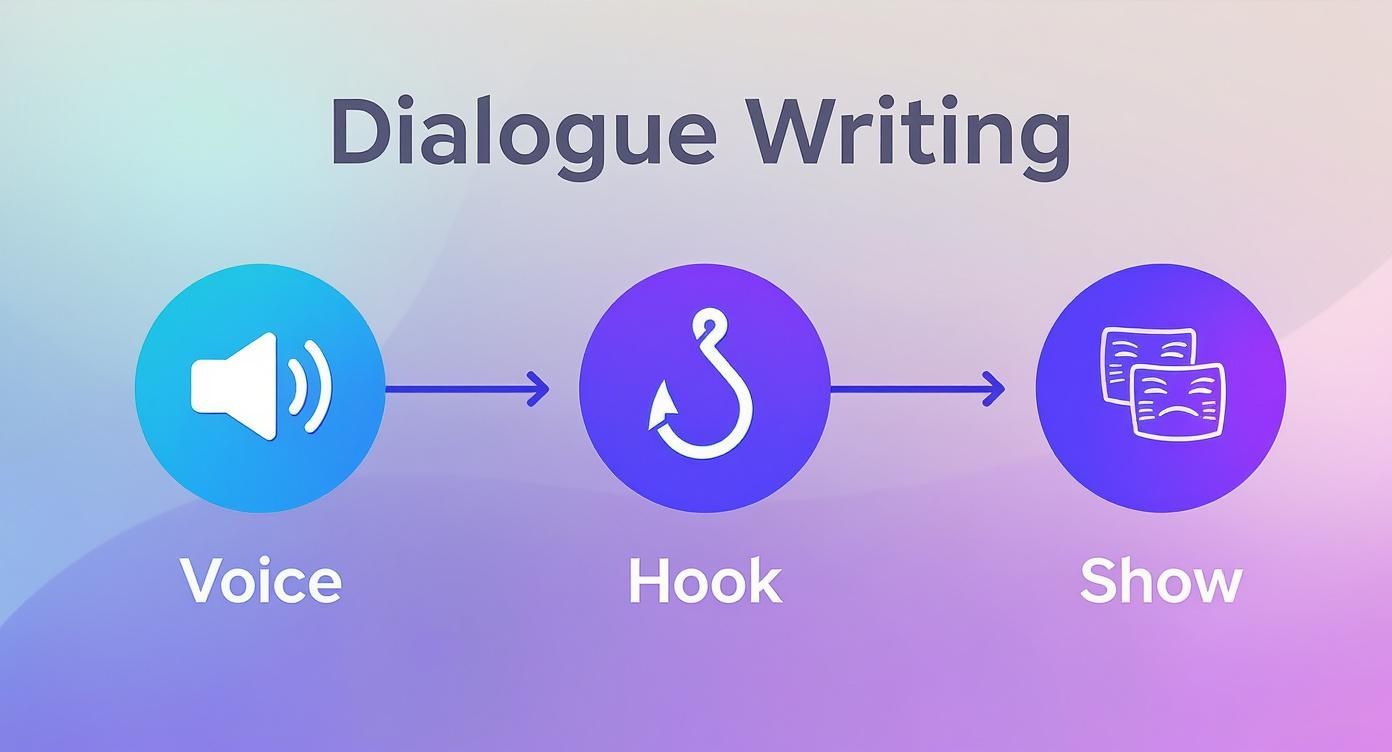
As you can see, it's all about defining a distinct voice, hooking the user, and letting that personality shine through their every word.
Aim for at least 5-10 solid examples that cover a range of situations. Show us how they flirt. How they argue. How they comfort a friend. How they react to a bad joke. Each example should be a mini-performance of their core traits. For a stoic warrior, comforting words might be practical and to the point. For a hopeless romantic, they’d be flowery and emotional. This is how you guarantee every conversation feels authentic.
Choosing the Right Avatar
Last but not least, the avatar. This is your character's face to the world. It’s the first thing anyone sees, and it instantly sets the tone. If you've described a bubbly, free-spirited artist, you need an avatar that screams creative energy—maybe with bright colors, an expressive smile, or an eclectic style.
A mismatch between the picture and the personality is jarring and can completely break the illusion you've worked so hard to create. Hunt for an image that truly captures the soul of the person you've built. Look at their eyes, their expression, their posture. Does it feel right? When you find that perfect face, everything else falls into place, creating a seamless bridge between your vision and the user's experience.
Burning Questions About Creating Luvr AI Characters
Jumping into character creation for the first time? You’ve probably got a ton of questions. As you get the hang of how to make a character, you’ll start thinking about the little details—the quirks, the conversational style, and what really makes an AI feel alive. Let’s tackle some of the most common questions I hear from fellow creators.
How Deep Should I Make My Character's Personality?
It's so easy to get carried away and write a full-blown novel for your character's backstory. But here's a pro tip: you're aiming for focused depth, not just a massive wall of text. The AI actually works best when it has a few crystal-clear motivations and a handful of powerful life events to pull from.
Think of it this way: a character with three deeply impactful memories will feel more authentic than one with fifty shallow, disconnected facts. Zero in on the core experiences that shaped who they are. What are the moments that truly defined them?
Your goal isn't to build an encyclopedia of your character's life. It's to give the AI a solid emotional compass. Focus on quality and emotional weight over sheer quantity of details.
Can I Tweak My Character After I've Launched Them?
Not only can you, but you absolutely should. Treat your character's first version as a beta test, not the final cut. The best way to perfect their personality is to see how they actually behave in conversations. You might find that a trait you thought was brilliant falls flat, or that users are surprisingly drawn to a minor detail you barely considered.
- Pay attention to user feedback. Are people confused by certain responses? Do they keep bringing up the same topics? The community is your best guide.
- Refine their voice. If the dialogue feels a little off, jump back into the editor and adjust the example conversations. This is your most powerful tool for fine-tuning how they speak.
- Don't be afraid to edit their core traits. It's a living process. If something isn't working, swap it out.
What’s the Secret to a Truly Unique Character?
It all comes down to two things: specificity and contradiction. Anybody can make a character who is "brave" or "kind." But what about a stoic warrior who's secretly terrified of thunderstorms because of a specific childhood memory? That’s what sticks with people. Those are the details that create a real connection.
If you want to build a character that stands out from the crowd, try layering in these elements:
- A Niche Passion: Give them a weirdly specific hobby. Maybe they collect vintage postcards, or they're obsessed with mycology (the study of fungi).
- A Signature Quirk: Do they have a strange habit, like humming when they’re nervous or always speaking in metaphors? Little things like this make them feel real.
- An Unexpected Contradiction: Mash together traits that don't seem to fit. How about a bubbly, optimistic character who also has a hilariously morbid sense of humor?
This is the real art behind making a character that feels like a one-of-a-kind individual. When you layer these unique details onto a solid foundation, you create someone truly unforgettable.
Ready to build a character that captivates and connects? Start creating your own unforgettable AI personality today with Luvr AI. Bring your vision to life on luvr.ai.