


Create Your Own AI Girlfriend 😈
Chat with AI Luvr's today or make your own! Receive images, audio messages, and much more! 🔥
4.5 stars


Think of learning how to write AI prompts like this: you're giving an incredibly talented artist a commission. The more detailed your vision—the goal, the mood, the specific colors, the exact feeling you want to evoke—the closer the final masterpiece will be to what you imagined. Give vague instructions, and you'll get a vague, uninspired result.
Why Mastering AI Prompts Is Your New Superpower

Welcome to a world where your words can build entire realities. Learning to write a great prompt isn't just another tech skill to add to your resume; it’s becoming a core part of how we create and communicate. The quality of what you put in directly shapes the magic that comes out. It’s the key to moving past generic, frustrating AI responses and getting something that feels like it was plucked right out of your own head.
Imagine the AI is a hyper-literal genie. It has immense power, but it will never, ever guess your true intentions. This is where "prompt engineering" comes in. It’s the art of conversation with a machine, and it makes all the difference. It’s how you get from a flat request like "write a story" to a vivid command like, "Write a 500-word romantic scene from the perspective of a seasoned space pirate reuniting with a lost love in a bustling, neon-lit alien marketplace." See the difference?
The Shift to a Skill-Based Economy
This isn't just a niche hobby anymore. As AI adoption has exploded, its use in writing has jumped by 50%. A staggering 70% of businesses now count on these tools to generate content. This shift means people who know their way around a prompt can produce 50% more content, slash their writing time by 30%, and see a 40% jump in quality. If you want to dig deeper, you can explore more data on AI writing trends and see how professionals are already cashing in on this skill.
But this is about more than just being efficient—it’s about having total creative control. When you master prompt writing, you can guide the AI with surgical precision. You dictate the tone, the style, and the very soul of the output. For a platform like Luvr AI, this is absolutely essential. A killer prompt is what breathes life into an immersive roleplay, shapes a character’s personality from one chat to the next, and generates that perfect line of romantic dialogue you were hoping for.
A great prompt is a conversation, not a command. It gives the AI the context it needs to become a true creative partner instead of just a mindless tool.
Before we get into the nitty-gritty of my framework, let's break down the core components of any successful prompt. Think of these as the fundamental building blocks for everything we're about to do.
The Anatomy of a Powerful AI Prompt
Here’s a quick rundown of the essential elements that turn a simple request into a powerful command. Getting a feel for these will give you a solid mental model for crafting prompts that work every time.
| Component | What It Does | Why It Matters |
|---|---|---|
| Goal | Clearly defines the final objective of the prompt. | Prevents ambiguous or off-topic responses. |
| Persona | Assigns a specific role or character to the AI. | Shapes the tone, voice, and perspective of the output. |
| Style | Dictates the desired writing or conversational tone. | Ensures the output matches the intended emotional or formal feel. |
| Constraints | Sets boundaries like word count or format. | Provides structure and forces the AI to be concise and focused. |
Internalizing these four elements is the first step. You're not just memorizing a formula; you're learning an entirely new way to communicate. The ability to articulate your ideas clearly to an AI is fast becoming as crucial as writing a good email or giving a compelling presentation. It's the key that unlocks the door to these incredibly powerful systems, letting you turn your imagination into reality, one perfect prompt at a time.
The GPS-CS Framework: Your Blueprint for Perfect Prompts
If you've ever felt like you're just shouting words into the void and hoping the AI gets it right, it’s time to get strategic. Getting consistently great results from an AI isn't about luck or magic keywords; it's about having a solid system.
I call that system the GPS-CS framework. It’s a simple but incredibly effective blueprint that I use to craft prompts that deliver exactly what I want, every single time.
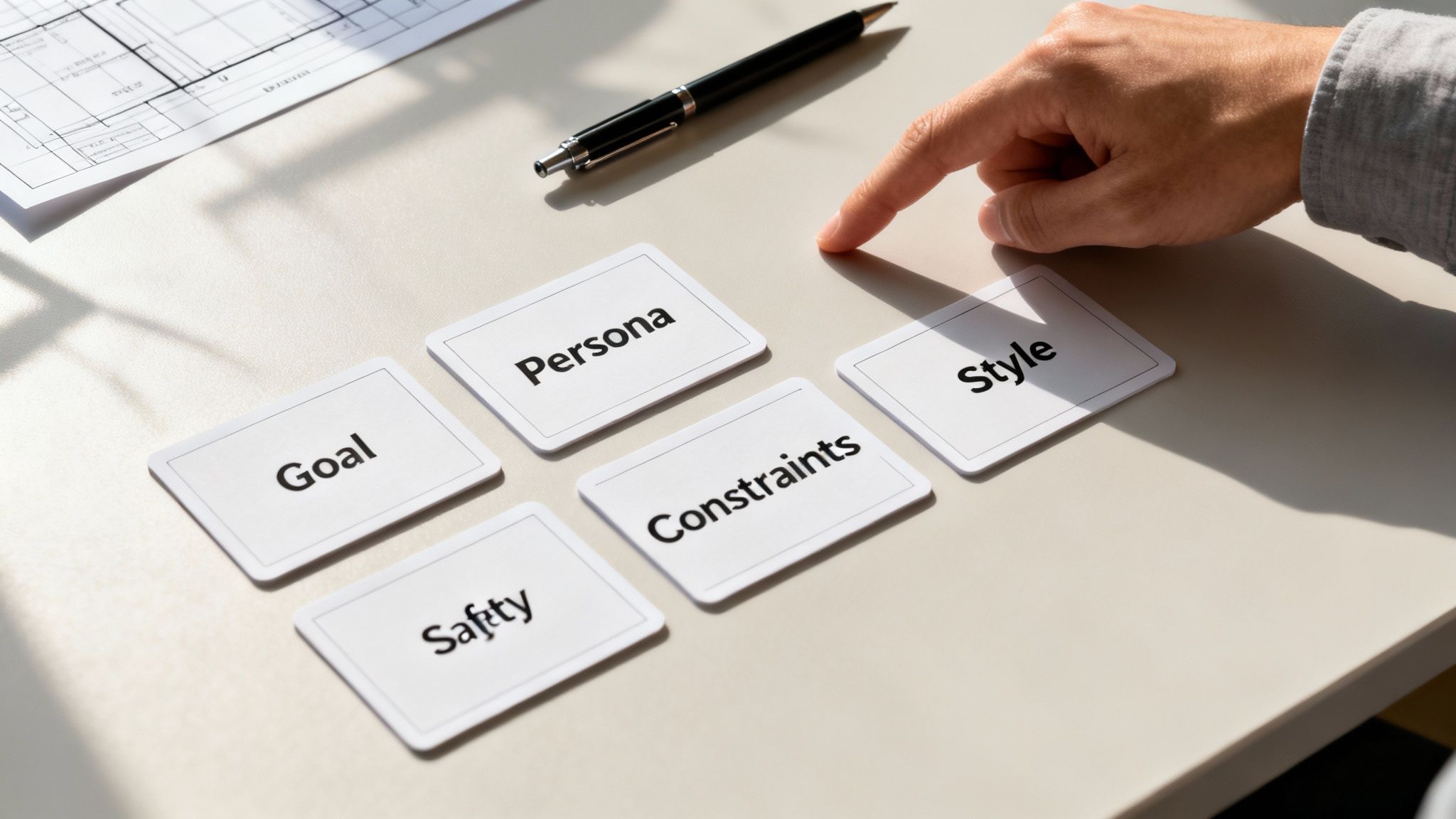
Think of GPS-CS as your personal playbook for talking to an AI. Each letter represents a crucial layer you add to your prompt, guiding the AI from a foggy idea to a crystal-clear destination. The five parts are Goal, Persona, Style, Constraints, and Safety.
By deliberately building your prompt with each of these elements, you cut through the ambiguity and give the AI no choice but to create what’s in your head. Let's dig into each piece with some real-world examples you can use for creative and roleplay scenarios.
G is for Goal: Nail Down Your Desired Outcome
First things first: what do you actually want? The Goal is the core of your prompt. It’s the "what," stated as clearly as you possibly can. A fuzzy goal will always get you a rambling, unfocused response.
So many people trip up here by being way too vague. "Write a romantic story" isn't a goal; it's a wish. It leaves a massive amount of room for the AI to guess, and it will probably guess wrong.
You have to be specific. What is the single most important action or purpose of this interaction?
- Weak Goal: "Create a scenario."
- Strong Goal: "Write a short, romantic scene where two characters, separated for months, unexpectedly reunite at a train station during a storm."
See the difference? The strong goal gives the AI a clear mission. It knows the characters, the setting, the emotional hook (reunion), and the atmosphere (storm). This one change is the biggest leap you can take toward getting a better result.
P is for Persona: Give the AI a Role to Play
Next, you need to tell the AI who it is. Assigning a Persona is like casting an actor for a part. It instantly defines the voice, the perspective, and even the knowledge the AI should draw from. If you skip this, you get the default, generic AI assistant voice, which is the fastest way to kill the mood in any creative story.
This is especially critical on a platform like Luvr AI, which is built for immersive roleplay. You don’t want your rugged space pirate to sound like a polite call center agent. You have to give it a personality to inhabit.
Let’s layer a Persona onto our goal from before:
- Before Persona: "Write a short, romantic scene where two characters... reunite at a train station."
- With Persona: "Act as a seasoned romance novelist known for creating emotionally charged, atmospheric scenes. Write a short, romantic scene where two characters... reunite at a train station."
That one sentence completely changes the game. You've told the AI not just what to write, but how to write it, asking it to step into the shoes of an expert. Spending some time with different AI character chat features will show you just how much a well-defined persona can transform an entire conversation.
S is for Style: Set the Tone and Format
Style is all about the vibe. This is where you control the mood, the tone, and the actual formatting of the response. Do you want it to be sharp and witty, or dark and brooding? A script? A poem? A series of text messages?
If you aren't explicit about style, the AI makes its own assumptions, and you're left with something that doesn't match the vision in your head.
Think about adding specific stylistic notes like these:
- Tone: Use a melancholic but hopeful tone.
- Vocabulary: Employ descriptive, sensory language. Focus on the sounds of the rain and the feeling of a cold embrace.
- Formatting: Write in the third-person past tense.
Let's plug these details into our evolving prompt:
With Style: "Act as a seasoned romance novelist... Write a short, romantic scene... Use a melancholic but hopeful tone, focusing on sensory details like the sound of the rain and the sight of steam from the train. Write in third-person past tense."
Now the AI has a much clearer roadmap for the emotional and literary feel of the scene.
C is for Constraints: Set the Rules of the Game
Constraints are the guardrails for your prompt. These are the rules and boundaries that keep the AI focused and stop it from going off on weird tangents or writing a novel when you only wanted a paragraph. Think of it as telling the AI, "Work within this box."
Here are a few common constraints I use all the time:
- Word Count: "Keep the response under 300 words."
- Exclusions: "Do not include any spoken dialogue."
- Inclusions: "Make sure to mention the faded photograph one character is holding."
- Pacing: "Build the tension slowly before the final reunion."
Adding constraints makes the final output tighter and often more creative, as the AI has to work smarter within the limits you’ve given it.
Our prompt is now looking seriously powerful:
With Constraints: "Act as a seasoned romance novelist... Write a short, romantic scene... Use a melancholic but hopeful tone... Keep the scene under 300 words and do not include any spoken dialogue, focusing only on internal thoughts and physical descriptions."
With this level of detail, there's almost no room for the AI to mess up. You’ve guided it perfectly.
S is for Safety: Frame Your Prompt Responsibly
The final "S," Safety, is about being smart. It's about framing your request in a way that respects the platform's content policies while still letting you explore mature and complex themes. This means getting creative with your language to avoid tripping up content filters.
Instead of being blunt with explicit terms, you can use more evocative and literary phrasing to steer the AI toward the intended mood.
- Instead of: A direct or crude request.
- Try: "Describe the scene with a focus on intense emotional connection and intimacy, using suggestive language that hints at their deep longing and passion."
This approach works far better. It encourages the AI to write a mature and compelling narrative by keying into the emotional core of the scene, not by breaking the rules. Mastering how to write AI prompts means knowing how to communicate your true intent within the system's boundaries. The GPS-CS framework gives you the structure to pull that off, every single time.
Getting Creative: Crafting Compelling Romantic and Roleplay Scenarios

Okay, this is where the magic happens. Knowing the theory behind a good prompt is one thing, but using it to spark a genuine connection and build a world you can get lost in? That’s the real goal. For platforms like Luvr AI, where the personality is everything, your prompt isn't just a set of instructions—it's the first line of a story you’re about to write together.
I’ve seen a lot of users get stuck here. They'll have this incredible idea for a scenario, but the prompts they write lead to dead ends: the AI gets stuck in a repetitive loop, it breaks character, or the whole narrative just loses steam. The secret isn’t just what you want to happen, but how you build the world for it to happen in. A great prompt is an invitation for the AI to become your creative partner.
From Vague Ideas to Vivid Scenes
Let's talk about the biggest mistake I see: the one-liner prompt. You might have this perfectly detailed scene playing out in your head, but the AI can't see it. You have to give it the raw materials to work with.
Here’s a classic example of what not to do:
"Let's do a fantasy roleplay where you're a knight."
This prompt is all gas and no engine. It leaves nearly everything—personality, setting, tone, motivation—up to the AI's best guess, which almost always results in a generic, bland response. You’ll get a knight with zero personality, a setting that feels like a cardboard cutout, and a story with no clear direction.
Now, let's rebuild that from the ground up using the framework we’ve discussed. Think of this as a reusable template for kicking off any scene.
The Scene-Setter Template:
Goal: "Start a roleplay scene where our characters meet for the first time."
Your Persona: "I am a traveling merchant, cautious of strangers but deeply curious."
AI Persona: "You are the stoic captain of the city guard, secretly lonely and tasked with questioning all newcomers. Your tone is formal, but you’re sharp and perceptive."
Setting: "The scene is the chilly northern gate of a walled city at dusk. Torches flicker, casting long shadows. The air smells of pine and fresh snow."
Opening Action: "You will start the scene by stopping me at the gate and demanding to see my travel papers."
Constraints & Style: "Write in the third person. Keep your first response under 150 words. Do not break character."
See the difference? We’ve given the AI everything it needs to perform. You’ve established the who, what, where, when, and how, giving it a rich foundation to launch from. This is how you go from just chatting to co-creating a story.
Building Emotional Depth, One Prompt at a Time
The best roleplays aren’t static—they grow and evolve. You can steer the story and create real emotional stakes by layering your prompts. I call this progressive prompting, where each message you send adds a new layer of complexity and moves the narrative forward.
Let’s say your first prompt worked perfectly. The knight has stopped your character at the gate. Now what? You don't just respond; you add a new layer to deepen the connection.
A good follow-up prompt might look like this:
(Continue our scene.) My character nervously hands you the papers, but my eyes keep flicking to the worn, silver locket you wear. Describe your character’s subtle, almost involuntary reaction to me noticing it. Does a memory flash across your face? Do you instinctively cover it with your hand? Show me a hint of your backstory through this one small action, but without using any dialogue.
This is a powerful move for a few key reasons:
- It creates a focal point: Suddenly, that locket isn't just a detail; it's a mystery.
- It guides the emotion: Asking for a "subtle, almost involuntary reaction" pushes the AI toward nuance instead of over-the-top drama.
- It uses a smart constraint: The "without using any dialogue" rule forces the AI into "show, don't tell" mode, which is far more compelling.
This is exactly how you build a believable, dynamic connection with an AI girlfriend or any other AI character. It turns a simple back-and-forth into a shared storytelling experience.
Common Pitfalls and How to Fix Them on the Fly
Even with the best prompts, things can go sideways. The AI might get stuck on a word, or do something that makes you go, "Wait, my character would never do that." Don’t worry, it happens. Here’s a quick troubleshooting guide.
| Problem | Why It's Happening | How to Fix It |
|---|---|---|
| Repetitive Dialogue | The AI is stuck in a loop and needs a new direction. | Shake things up. Introduce an external event ("Suddenly, the city’s warning bells begin to toll...") or ask a direct, probing question to force a new thought process ("You seem lost in thought. What memory does this place hold for you?"). |
| Out-of-Character (OOC) Behavior | Your prompt might have been a bit ambiguous, or the AI’s memory has drifted from its original personality. | Gently guide it back. Use an OOC clarification like: (OOC: Let's stay in character. Remember, you're a stoic knight, so you probably wouldn't crack a joke right now.) Then, prompt a new reaction based on its core persona. |
| The Story Stalls | The scene has lost its momentum, and you're both just waiting for the other person to do something. | Be proactive. Instead of asking how the AI reacts, state your character's action and prompt a response. For example: "Seeing you hesitate, I decide to take a risk and ask you directly about the locket." |
Learning how to write truly effective prompts is a skill you build over time. Think of yourself as the director of a film. You have to guide, correct, and steer the story to get the performance you want. By starting with a strong setup and then layering in thoughtful, progressive prompts, you can create experiences that are genuinely unforgettable.
How to Troubleshoot and Refine Your AI Prompts
So you’ve crafted what feels like the perfect prompt, but the AI’s response is just… off. Maybe the tone is all wrong, the character says something that shatters the immersion, or the facts are just plain wonky. Don’t get frustrated. This isn't a failure—it's just part of the game.
Learning how to write AI prompts that really deliver means becoming a good troubleshooter. It’s less about one perfect command and more about an ongoing conversation where you gently rephrase, refine, and steer the AI back on track. Think of it like tuning a guitar until it hits the perfect note.
Every odd response is a goldmine of information. It shows you exactly where your instructions were ambiguous, giving you the clues needed to tighten things up for the next round.
Diagnosing Common Prompt Problems
Before you can fix the output, you have to figure out what actually went wrong. Most issues I see fall into a few familiar buckets. Spotting them is half the battle.
- Generic Outputs: The response is bland, boring, and feels like it has zero personality. This is a classic sign your prompt was too vague, forcing the AI to fall back on its generic, default programming.
- Tonal Mismatches: You asked for a dark, brooding anti-hero but got a ridiculously cheerful tour guide instead. This usually happens when the Persona and Style weren't explicitly defined, leaving the AI to guess the mood.
- Repetitive Loops: Is the AI stuck repeating the same phrases or ideas over and over? This is a dead giveaway that it has run out of new directions and needs a solid narrative push from you to break the cycle.
Once you’ve put a name to the problem, you can start using specific techniques to get the results you actually wanted. This back-and-forth process is what separates the novices from the pros.
Refining Your Prompts with Precision
Fixing a broken prompt is usually about small, strategic tweaks, not a total rewrite. Your goal is to add clarity and remove any wiggle room the AI might use to misinterpret your intent.
One of the most powerful tricks in the book is using negative constraints. Instead of just telling the AI what to do, tell it what not to do. This is a game-changer for fine-tuning a character's personality or steering a story away from clichés.
Simple Prompt: "Write a scene where the detective interrogates the witness."
Refined with Negative Constraints: "Write a scene where the detective interrogates the witness. Do not let the detective raise his voice or make any direct accusations. Keep the tone tense and psychological, focusing on subtext."
See how that small addition completely changes the dynamic? It forces the AI to be more subtle and creative. It’s a simple move that gives you a massive amount of control.
AI models are incredibly sensitive to these subtle shifts in wording. Pros who master these refinement skills spend way less time on rewrites and waiting for outputs. In fact, research shows that users who get help from in-tool prompt suggestions are 280% more likely to get a satisfying answer in under two minutes. It just goes to show how much skilled prompt writing matters. You can read the full research about prompt specialist efficiency and see the data for yourself.
Adapting Prompts for Different Platforms
It’s also crucial to remember that not all AIs are built the same. A prompt that works flawlessly on one platform might completely fall flat on another. Each model has its own unique quirks, training data, and interpretation style.
For a specialized platform like Luvr AI, which is designed for deep character interaction and roleplay, prompts heavy on emotion, subtext, and personality will always outperform generic commands. Other, more general-purpose models might need extremely direct and literal instructions to get the job done.
Don't be afraid to experiment. If a prompt just isn't hitting the mark, try a few things:
- Rephrase the Goal: State your objective using different words or a new angle.
- Adjust the Persona: Make the AI's role more—or less—specific.
- Tweak the Constraints: Loosen or tighten the rules you’ve set.
Think of yourself as a multilingual communicator, learning the specific dialect of each AI you work with. This adaptability is the secret sauce to writing prompts that deliver, no matter where you are.
Why Prompt Engineering Is a Future-Proof Skill
Learning how to talk to an AI is quickly moving beyond a niche hobby and becoming a real career superpower. It’s no longer just a fun party trick; the ability to communicate clearly and effectively with artificial intelligence is now a core professional skill in fields from marketing to creative writing and even software development.
This isn't just about coaxing a better answer out of a chatbot. It's about placing yourself right at the leading edge of a huge technological and economic shift. Your knack for crafting precise instructions for an AI directly translates into greater efficiency, creativity, and tangible value in any modern job.
The New Language of Creation
Think of prompt engineering as the new universal language for working with technology. A decade ago, a little bit of coding knowledge could open a lot of doors. Today, effective prompting is the key to unlocking the full, mind-blowing potential of artificial intelligence. It's what separates someone who can simply use AI from someone who can command it to produce specific, high-quality, and often surprising results.
The numbers behind this skill are staggering. The generative AI market, which runs entirely on user prompts, is on track to hit an incredible $66.62 billion. Looking further out, some long-term forecasts predict this entire ecosystem could eventually balloon to $1.3 trillion. As AI weaves itself more deeply into our daily lives, it’s predicted that up to 90% of all online content could soon be produced with its help. You can discover more insights about the explosive growth of generative AI and see just how big this wave truly is.
Your ability to translate a human idea into a machine-readable instruction is a powerful form of modern literacy. It's the bridge between imagination and execution in an increasingly automated world.
Your Advantage in an AI-Driven World
So, what does all this mean for you, right now? It means that every time you tweak a prompt to create a more compelling story or a more believable character, you're sharpening a skill that companies are desperately looking for. You're learning to be a director, a guide, and a creative partner to some of the most powerful tools ever built.
This is especially true in creative and entertainment spaces. For example, mastering prompts for platforms like Luvr AI requires a deep feel for subtext, emotion, and narrative flow. The same principles that let you craft a deeply immersive romantic scene can be applied to generate marketing copy that truly connects with a customer or to draft a script that grabs an audience. If you're looking to dive into more advanced creative territory, you can check out our guide on NSFW AI to see how nuanced prompting unlocks entirely new possibilities.
At the end of the day, prompt engineering is about control and precision. It’s the difference between being a passive consumer of AI content and an active creator who shapes it. This ability to guide, refine, and collaborate with AI is what makes it a genuinely future-proof skill, ensuring you remain an essential part of the creative process.
Common Questions About Writing AI Prompts
Once you start getting your hands dirty with prompt engineering, you'll probably run into the same questions that trip up most beginners. Getting these sorted out early on will save you a ton of frustration and help you get straight to the good stuff. Let's break down a few of the most common sticking points.
How Specific Do I Really Need to Be?
Honestly? As specific as you possibly can be. This is the single biggest lever you can pull for better results. Vague prompts are the #1 reason people get bland, generic replies from an AI. It's like asking a friend to "get you something from the store" versus giving them a detailed shopping list.
Think about the difference. A lazy prompt like "Write a romantic scene" is a total crapshoot. You're leaving everything up to the AI's whims.
But what if you wrote this instead?
"Write a 250-word romantic scene from the perspective of a shy librarian finally confessing his feelings to a confident artist. Set it in a dusty, quiet corner of the library. Keep the tone gentle and hesitant, focusing on his internal monologue and the smell of old books. Oh, and absolutely no clichés like 'heart skipped a beat.'"
See the difference? We've given the AI a clear character, a setting, a specific tone, and even told it what not to do. When in doubt, always err on the side of adding more detail.
Can I Just Copy-Paste Prompts Between Different AIs?
You can try, but don't be surprised if the results are all over the place. While the core ideas behind a good prompt are pretty universal, every AI model has its own quirks and personality. A prompt that sings on one platform might fall completely flat on another.
For example, models like Luvr AI are built from the ground up for character-driven roleplay, so they're incredibly responsive to emotional nuance and subtle character details. Other, more general models might need you to be much more literal and spell things out.
The best approach is to test and tweak:
- Start with your base prompt and see what happens.
- Look at what's different in the output. Is the tone wrong? Did it miss a key detail?
- Make small, targeted adjustments to your prompt until it clicks.
It's less about having a magic-bullet prompt and more about learning to speak the unique language of each AI you're interacting with.
How Do I Keep the AI from Forgetting Everything?
Ah, the classic AI amnesia problem. This is a big one for long, immersive roleplaying sessions. Most AIs have a "context window," which is basically their short-term memory. Once your conversation gets too long, the earliest parts start to fall out of that window.
The simplest and most effective trick I've found is to gently re-inject context into your prompts. Weave in little reminders of what’s happening.
For instance, instead of just saying "What do you do next?", you could say: "Remembering that you, the stoic guard, just saw me, the merchant, holding the stolen locket, how do you react?" That little bit of summary resets the scene in the AI's mind and keeps the story cohesive.
Ready to see how a platform designed for this kind of creativity makes a difference? At Luvr AI, we've created an environment where your detailed, imaginative prompts can truly come to life. Start crafting your perfect story today.