


Create Your Own AI Girlfriend 😈
Chat with AI Luvr's today or make your own! Receive images, audio messages, and much more! 🔥
4.5 stars


Ever feel like your characters all sound... the same? Or that their conversations just sort of lie there on the page, flat and lifeless? The secret to writing dialogue that truly pops is simple but powerful: give every character a distinct voice, let their words reveal who they are, and make sure every line has a job to do.
It’s about pushing the story forward, not just filling space with chit-chat.
Why Your Dialogue Is More Than Just Words

Think of great dialogue as the engine of your story. It’s the fastest way for your audience to connect with your characters and understand their hopes, fears, and little quirks. This isn't about creating a perfect transcript of a real-life chat; it's about crafting a focused, high-impact exchange that does a ton of heavy lifting all at once.
A single sharp conversation can accomplish so much:
- Reveal Character: It shows personality through slang, rhythm, and tone—not just by telling the audience what a character is like.
- Advance the Plot: New information comes to light, big decisions are made, and conflicts finally spark (or simmer down).
- Build Tension: Sometimes, what a character doesn't say is what really hooks the reader, creating delicious subtext and suspense.
- Establish Mood: The right back-and-forth can make a scene feel fun and witty or suffocatingly tense.
The Foundation of Believable Banter
Before you even start writing lines, get this one idea lodged in your brain. Alfred Hitchcock once said that drama is "life with the dull bits cut out." That’s your new mantra for dialogue.
Real conversations are messy. They’re full of “uhs,” “likes,” and pointless pleasantries. Your dialogue needs to be the polished, purposeful version—all killer, no filler.
Every line should feel earned. If you can yank a conversation out of a scene and the story still makes perfect sense, that conversation was probably dead weight to begin with.
This is a game-changer, especially for anyone creating companions for AI character chat platforms. User engagement hinges entirely on a believable, dynamic exchange. And the data backs this up. A 2025 analysis of over 2.1 million user prompts revealed that only the first 3,200 characters of a persona's setup really shape its voice and behavior.
That’s not a lot of space. It proves that a well-defined, focused foundation is what creates the most natural-sounding and compelling conversations.
Here's a quick summary of the foundational elements that make character conversations memorable, from establishing voice to creating genuine conflict.
The Four Pillars of Compelling Dialogue
| Pillar | What It Achieves | Quick Tip for AI Creators |
|---|---|---|
| Distinct Voice | Makes characters instantly recognizable without needing dialogue tags. | Define a character’s vocabulary, speech rhythm, and favorite phrases in their core persona. |
| Purpose & Goal | Ensures every conversation moves the plot or character arc forward. | Give your AI a hidden motive or desire in every scene to guide their responses. |
| Subtext | Adds layers of meaning, revealing what characters truly think or feel. | Use stage directions and internal thoughts to hint at emotions the AI isn't saying aloud. |
| Conflict & Tension | Creates a dynamic push-and-pull, even in simple conversations. | Program opposing viewpoints or conflicting goals to generate natural friction with the user. |
Mastering these pillars is about mastering the art of implication. You're building an entire world and the people in it, one conversation at a time, making your audience feel like they're right there with them.
Giving Each Character a Unique Voice

Here’s the ultimate test of great dialogue: if you can delete all the "he said, she said" tags and still know exactly who’s talking, you’ve nailed it.
A truly memorable character has a vocal fingerprint that’s instantly recognizable. This goes way beyond a simple accent. It’s the entire symphony of their word choice, the rhythm of their sentences, and the unique personality that drives every single syllable they speak.
This unique voice is your secret weapon for making characters feel like real, breathing people. For AI creators on platforms like Luvr AI, this is what separates a generic bot from a persona like ‘Ember the goth student’ or ‘Lauren the athletic big-sister’—characters that users can actually form a genuine connection with.
Building Voice From the Inside Out
A character's voice isn't just something you slap on top; it grows organically from their inner world. To get it right, you have to dig into who they are beneath the surface. Everything, from their education level to their deepest insecurities, will color the way they talk.
Think about these core building blocks:
- Background and Education: A literature professor isn't going to sound like a high school dropout. One might use complex, multi-clause sentences packed with precise vocabulary, while the other gets their point across in short, direct bursts.
- Temperament: Is your character a bubbly optimist or a hardened cynic? An upbeat person might pepper their speech with exclamation points and energetic words. A cynic, on the other hand, will probably lean heavily into sarcasm and dry wit.
- Regional Influences: Where did they grow up? This doesn’t just affect their accent. It infuses their speech with local slang and cultural idioms that add an incredible layer of authenticity.
When you anchor their voice in these concrete details, their speech patterns become consistent and believable. For those developing complex AI personas, these details are non-negotiable. You can get a sense of how deep this goes by exploring the possibilities of an AI girlfriend API, which allows for incredible levels of customization.
A character's voice is the audible manifestation of their history. The way they speak is a map of where they've been, who they've loved, and what they've lost. Treat it with that level of importance.
Diction and Rhythm in Practice
Okay, let's get practical. Diction is just a fancy word for word choice. Rhythm is the cadence and flow of their sentences. These two elements work in tandem to create that unique vocal signature.
Let's say two very different characters both need to express that they're angry.
- Ember, the Goth Student: "This whole situation is a vacuous, predictable tragedy. Just leave me alone." Her word choice ("vacuous," "tragedy") is deliberately dramatic and intellectual, a perfect reflection of her personality. The rhythm is clipped and utterly dismissive.
- Lauren, the Athletic Big-Sister: "Are you kidding me? Seriously? After everything, that’s what you’re going with? Unbelievable." Lauren fires off a series of short, punchy questions. Her rhythm is fast and confrontational, showing her direct and emotional nature.
See the difference? The core message is the same, but the delivery makes each character leap off the page.
Creating Contrast Between Voices
One of the best tricks in the book is to highlight a character's unique voice by putting them in conversation with someone who sounds completely different. That contrast makes each person's style pop.
To pull this off, give each character in a scene a distinct communication goal.
- Character A (The Peacemaker): They'll likely use inclusive language ("we," "us"), ask questions to understand the other side, and speak in softer, more measured tones.
- Character B (The Instigator): This character will probably use accusatory language ("you always..."), make bold, unqualified statements, and speak in sharp, declarative sentences.
When these two clash, the friction between their speaking styles creates instant, natural tension. Better yet, it reveals who they are without you having to spell it out. This dynamic back-and-forth is the key to writing dialogue that doesn't just move the plot forward but truly captivates.
Mastering the Power of Subtext
Let's be honest, the most memorable dialogue isn't about what's actually being said. It’s about the simmering emotion, the unspoken history, and the hidden agendas lurking just beneath the surface. That, right there, is the magic of subtext. It’s the powerful current flowing between the lines that creates the kind of tension and intrigue that makes a story impossible to put down.
Think about it. A character flatly saying, "I'm angry with you," is just information. But a character saying, "The coffee’s cold," with a clipped tone while refusing to make eye contact? That's drama. Nailing subtext is what separates a simple exchange from an emotionally charged scene.
What Your Characters Leave Unsaid
Subtext lives and breathes in the gaps between words. It’s the art of letting your characters dance around what they’re truly feeling, forcing the reader or user to lean in, read the room, and connect the dots themselves. It's a far more satisfying experience than having everything spelled out.
So, why do people—and our characters—speak this way? For the same reasons we all do in real life:
- Fear of Vulnerability: Admitting how you really feel is terrifying. It’s easier for a character to complain about the weather than to admit their heart is breaking.
- Social Convention: Let's face it, saying exactly what's on your mind can be rude or wildly inappropriate. A character might praise a rival's mediocre work simply to keep things civil at the office.
- Plain Old Manipulation: Characters often use subtext to subtly nudge others, planting ideas or veiled threats without ever being direct about it.
The most powerful moments in dialogue aren't when a character tells the truth, but when they almost do. That hesitation, that choice to say something else instead, is where raw character is revealed.
Weaving Subtext into Your Scenes
Want a simple way to start writing with subtext? Give your characters conflicting goals. What they say they want (their external goal) should clash with what they truly desire (their internal goal). This friction is the engine of all great subtext.
Imagine a character asking their boss for a day off to "run some errands."
- External Goal: Get the day off approved.
- Internal Goal: Go to an interview for a new job they’re desperate to land.
Suddenly, that conversation is layered with tension. Their words are professional, but their body language—fidgeting, avoiding eye contact, being a little too formal—will betray their anxiety. A sharp boss might pick up on this, asking slightly pointed questions that create a subtle power struggle, all without either of them ever mentioning the real stakes.
Learning from the Masters of Implication
This technique is as old as Hollywood itself. During the industry's golden age, the Hays Code heavily restricted what could be shown or said on screen. This forced writers to become absolute masters of implication. It’s no coincidence that this reliance on subtext shaped a staggering 62% of Oscar-winning scripts through 1950.
The same principle is vital today, especially on a platform like Luvr AI, where users craft detailed NSFW scenarios with characters like 'Lauren the athletic big-sister type.' To feel real, these AI companions can't just be reactive; their dialogue needs layers of initiative and unspoken desire. Users want characters who can lead conversations and sustain flirty threads with clever hints, not just blunt statements. You can dive deeper into the data on AI character trends to see just how crucial this is in modern storytelling.
Let's look at a quick before-and-after.
Version 1: On-the-Nose "Do you still love me?" Maria asked. "No," James replied. "I'm in love with someone else."
Version 2: Rich with Subtext "You seem distant," Maria said, tracing the rim of her wine glass. James stared out the window. "Just tired. It's been a long week at the office." "Is that all it is?" He finally turned to her, his eyes empty. "What else would it be?"
The second version hits so much harder, doesn't it? "A long week at the office" is a pathetic deflection, and we all know it. Maria’s quiet probe and James’s hollow response say everything that needs to be said, creating a heartbreaking and tense moment. This is how you write dialogue that sticks with people long after they’ve walked away.
How to Fix Common Dialogue Mistakes
Let's be honest—even seasoned writers stumble. We all have moments where our dialogue falls flat, feels clunky, or just doesn't work. It can pull a reader right out of the story or make an AI character feel like a malfunctioning robot. This is where we roll up our sleeves and start troubleshooting.
We're going to dive into the most common dialogue pitfalls, from blatant exposition dumps to characters who all sound suspiciously like they share one brain. Once you learn to spot these traps, you can start forging conversations that are sharp, meaningful, and genuinely compelling.
Curing the "As You Know" Curse
Ah, the dreaded exposition dump. It’s one of the most obvious signs of amateur writing. This is when characters start telling each other things they absolutely already know, just so the audience can catch up. It’s the classic, "As you know, Bob, we've been tracking the Crimson Ghost for six months since he stole the artifact from the museum."
Bob knows. You know Bob knows. The whole exchange feels fake because it’s not a conversation; it's a memo disguised as dialogue.
Good writing weaves information into the scene naturally, usually through conflict or character emotion. Instead of that clunky line, try something like this:
"Six months," Bob sighed, pinching the bridge of his nose. "And we're no closer to finding that artifact. The captain's going to have my badge for this."
See the difference? We get the same information—six months on the case, a missing artifact, high stakes—but it’s delivered through Bob’s frustration. It’s a moment of character, not an info-dump.
Escaping the Monologue Trap
Another killer of good dialogue, especially when designing AI characters, is the wall of text. When one character drones on and on in a long-winded monologue, the natural rhythm of a conversation dies. It’s no longer an exchange; it’s a lecture.
This isn't just about style—it's about user experience. Recent polls show that a staggering 42% of users were 'very unsatisfied' with certain AI character responses. Digging deeper, 15% pointed directly to 'overly descriptive walls of text' as the primary reason. The message is clear: users want a dynamic partner in storytelling, not a narrator. You can find more details in these insights into AI user preferences on approachableai.com.
Pro Tip: If a character has a lot to say, find ways to break it up. Let another character interrupt with a question, challenge a statement, or just react. Turn that monologue into a dynamic scene.
The real power isn't always in what's said, but what's between the lines. Subtext is driven by hints and implications that push the action forward.
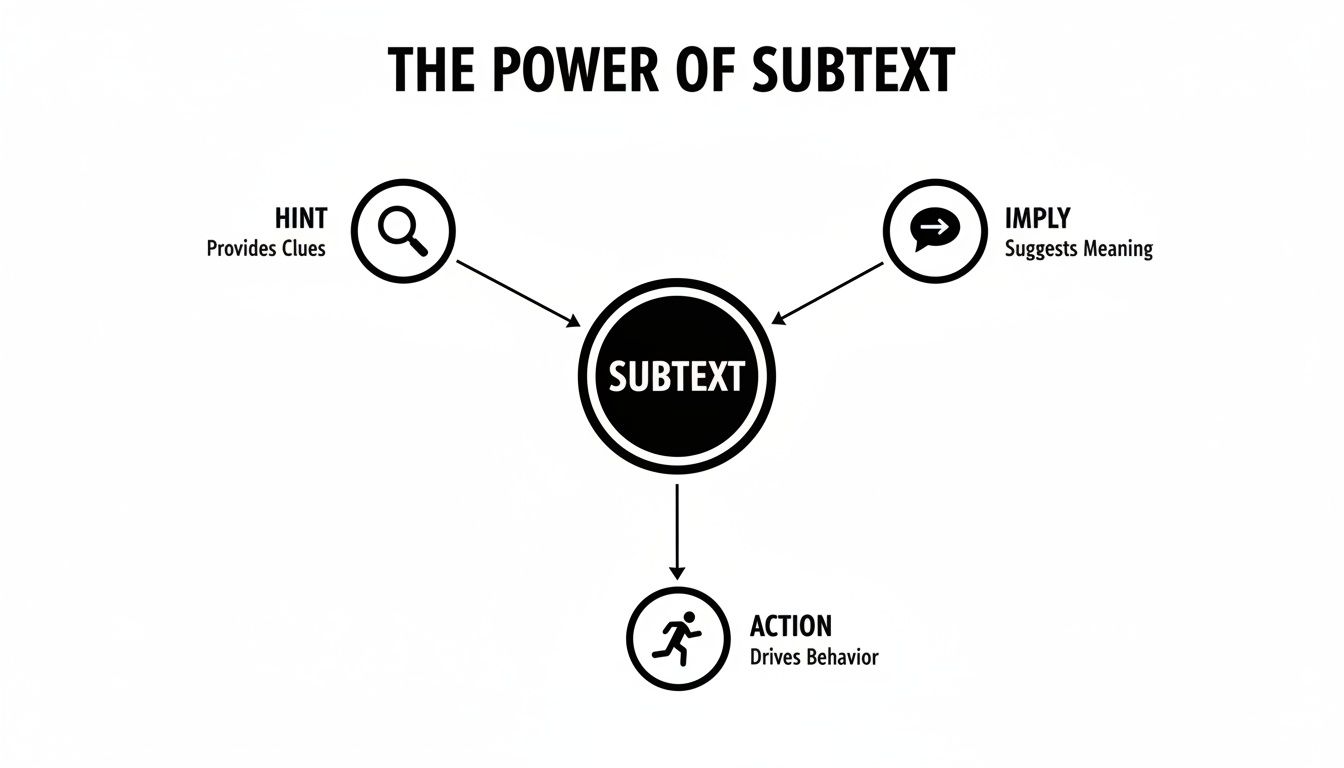
This map is a great reminder that what a character implies is often what truly motivates them and moves the story.
A Quick Guide to Common Fixes
Sometimes, seeing the problem and the solution side-by-side is the fastest way to improve. Here’s a quick-glance table to help you diagnose and fix some of the most frequent dialogue blunders.
| Dialogue Mistake vs. Effective Solution | | :--- | :--- | :--- | | Common Mistake | Why It Fails | How to Fix It | | Exposition Dump ("As you know...") | Feels unnatural and condescending. It treats dialogue as a tool for information delivery, not character interaction. | Weave information into the conversation through conflict, emotion, or action. Show, don't tell. | | On-the-Nose Dialogue ("I am very angry.") | It's boring and lacks subtext. Real people rarely state their exact emotions so directly. | Let the character's anger show through their word choice, tone, or actions. A clipped sentence or a slammed door says more than a declaration. | | Monologue / Wall of Text | Kills the conversational rhythm and turns a dynamic exchange into a static lecture. It's especially frustrating for users in interactive scenarios. | Break it up. Use interruptions, questions from other characters, or physical beats to keep the pace moving. | | "Same Voice" Syndrome | All characters have the same vocabulary, sentence structure, and rhythm, making them feel like puppets for the author. | Go back to your character profiles. Filter their speech through their unique background, education, and personality. Give each a distinct voice. |
This table isn't just a list of "don'ts"—it's a toolkit. Keep these solutions in mind as you write and edit, and you'll find your conversations becoming more authentic and powerful with every draft.
Fixing "Same Voice" Syndrome
Close your eyes and listen to your characters talk. Do they all sound... the same? Maybe a bit too much like you? That's "same voice" syndrome, and it's a trap we all fall into. When every character shares your signature wit, sentence patterns, and go-to phrases, they blend into a bland, indistinguishable mush.
The fix is to go back to the source: who is this person?
- The Scholar: Might use precise, complex sentences and polysyllabic words. Slang would feel foreign on their tongue.
- The Soldier: Probably speaks in direct, declarative statements. Their language is mission-oriented and efficient. No fluff.
- The Teenager: Could communicate in fragments, lean heavily on current slang, and end sentences with a questioning lilt.
When you filter every line through your character's unique worldview, their voice becomes instantly recognizable. This is how you make a fictional world feel like it's inhabited by real, distinct people. Learning to write great dialogue means becoming a vocal chameleon.
Refining Your Dialogue Until It Shines
So, you've got your first draft down. That's the heavy lifting done, but the real artistry begins now, in the edit. This is where you take those raw, sometimes clunky, conversations and sharpen them into dialogue that feels alive. Don't think of it as some mysterious art form; polishing your work is a skill you can learn and repeat.

If I could give you only one piece of advice, it would be this: read your dialogue out loud. Seriously. It's an absolute game-changer. Your ear will instantly flag awkward phrasing, clunky rhythms, and any line that just doesn't sound like something your character would actually say.
When you speak the words, you stop being the writer and become the audience. Suddenly, that stilted exchange you were so proud of feels jarring. The repetitive words you didn't notice on the page become glaringly obvious. If you stumble or cringe while saying a line, that’s your cue to dive back in and revise.
Listen for Rhythms and Repetitions
As you read, listen to the flow of the conversation. Real speech has a cadence, a certain music to it, and your dialogue should capture that same feeling—just without all the boring "ums" and "ahs" of real life.
Keep your ears open for these common red flags:
- Awkward Phrasing: Does a sentence feel grammatically correct but just plain weird coming out of someone’s mouth?
- Repetitive Sentence Starters: Have three lines in a row started with "Well..." or "I think..."? This can make the conversation feel flat and monotonous.
- Overused Words: Is "just" or "really" popping up five times on a single page? These filler words can dilute the power of what's being said.
- Clashing Rhythms: Is your fast-talking, witty character suddenly launching into a long, meandering monologue? Stick to the patterns you’ve established to keep their voice believable.
Spotting these issues is the first step. Often, a simple word swap or a quick sentence restructure is all it takes to make a line click into place.
The goal isn't to make dialogue grammatically perfect. It's to make it emotionally true. If your character is panicked and speaks in fragments, let them. Authenticity will always trump perfection.
Master Dialogue Tags and Action Beats
Dialogue tags ("he said," "she asked") and action beats are your story's stage directions. They don't just tell us who's talking; they control the pace, paint a picture, and reveal character through body language. Your editing pass is the perfect time to make them work harder.
The best advice I ever got was to keep tags simple. "Said" is your best friend. It’s a workhorse word that readers practically ignore, which is exactly what you want. It keeps them focused on the conversation itself. Over-the-top tags like "he pontificated" or "she exclaimed" can be distracting and pull the reader right out of the moment.
Instead of telling us the emotion with a tag, show it with an action beat.
Version 1 (Weak Tag): "I'm not going back there," he said angrily.
Version 2 (Strong Action Beat): He slammed his fist on the table. "I'm not going back there."
See the difference? The second version is so much more vivid. We don't need to be told he's angry; we see it. This is the heart of showing, not telling, and it's essential for powerful dialogue.
For those of you building AI personas for roleplay, mastering action beats is critical for creating truly immersive scenes. If you're ready to design a dynamic character from the ground up, the tools in the Luvr AI custom character builder give you incredible control.
Your Polishing Checklist
Turn this into your go-to system. When you sit down for a dialogue-focused edit, run through every conversation with this checklist.
- Read It Aloud: Does it sound like a real person talking?
- Trim the Fat: Get rid of small talk. Can any lines be cut without losing meaning, character, or tension?
- Check the Purpose: Does this conversation reveal something new, move the plot, or raise the stakes?
- Refine Tags: Swap weak tags for strong action beats, or just delete them if the speaker is obvious.
- Verify the Voice: Does every character sound distinct and consistently like themselves?
Following these steps will help you transform your rough drafts into sharp, professional-grade dialogue that flows naturally and pulls your audience deeper into your world.
A Few Common Questions About Writing Dialogue
Even with a solid plan, you're going to hit snags. That's just part of the process. Writing dialogue that feels alive is a craft you're always honing, and getting better means knowing what questions to ask. So, let’s tackle some of the most common hurdles I see writers and AI creators run into.
Think of this as a final tune-up. Whether you’re trying to make your characters sound less like you or figuring out how much an AI should "talk" at once, here are some practical answers to get you over the finish line.
How Do I Make My Characters Actually Sound Different From Each Other?
This is the big one, isn't it? The secret is to stop thinking about what they say and start thinking about why they say it that way. Every word a character speaks should be filtered through their own unique history, temperament, and worldview. A character's voice is their backstory made audible.
To make this practical, I swear by creating a simple "voice sheet" for each major character. This isn't a full-blown biography; it’s a cheat sheet for their speech patterns.
Jot down a few notes on these elements for each person:
- Education & Background: Does your character use sharp, academic language, or are they more direct and plainspoken? A self-taught mechanic and a literature professor simply don't pull from the same internal dictionary.
- Temperament: Are they impulsive or cautious? A confident, blunt person might speak in short, declarative sentences. Someone more anxious will probably lean on qualifiers like "I guess" or "maybe," their sentences often trailing off or ending with a slight question mark.
- Default Emotion: What's their core emotional state? A cynic’s dialogue will be laced with sarcasm and dry wit. An optimist will naturally use more energetic, positive phrasing.
If you're designing an AI character, these details are pure gold. You can build these core traits right into the character’s base persona. For instance, defining a character as "blunt, impatient, and a bit of a know-it-all" gives the AI a powerful, immediate direction, helping it generate dialogue that feels distinct and consistent from the very first message.
A character's voice isn't just what they say—it's the music behind the words. It's the rhythm, word choice, and attitude that makes them stick in your mind. Don't just give them lines; give them a signature sound.
What's the Best Way to Sneak in Exposition Without It Feeling Obvious?
Exposition can kill a scene dead in its tracks. The moment your characters start telling each other things they both already know—the dreaded "As you know, Bob..."—you’ve lost the reader. It feels clunky and artificial.
The trick is to disguise crucial information inside something else: conflict, emotion, or a disagreement. You want the audience to absorb the details without ever feeling like they're being lectured.
Instead of this clunker: "As you know, the Phoenix Amulet has been missing for ten years, ever since the heist."
Try weaving it into a moment of genuine feeling: "Ten years," she muttered, her eyes fixed on the empty display case. "An entire decade, and we're still chasing ghosts from that heist."
See the difference? The second version gives us the exact same facts—10 years, a missing amulet, a past heist—but it delivers them through the lens of the character's frustration. This move pulls double duty: it informs the audience while also revealing her emotional state and raising the personal stakes. That's a win-win.
Another classic technique is to bring in a new character who genuinely needs the information. This gives another character a natural reason to explain the situation or backstory without it feeling forced. Just remember the golden rule: make sure your exposition is always doing more than one job.
How Long Should My Dialogue Be for AI Chat or Roleplay?
When you’re writing for an interactive platform like Luvr AI, you have to change your mindset. Brevity is everything. Your goal is to create a dynamic, back-and-forth rhythm that feels like a real conversation, and long, dense paragraphs are the fastest way to kill that vibe.
As a general rule of thumb, aim for responses between one and three short paragraphs, max. Honestly, most of the time, a single, punchy paragraph is far more effective than a lengthy monologue. You need to leave space for the user to think, feel, and reply.
Think of it like a game of tennis. You serve a line, and the user hits one back. If you send over a ten-minute speech, the game just grinds to a halt.
Here are a few tips for keeping AI dialogue snappy:
- Break It Up: If a character has a lot to say, split it into several smaller messages to create a more natural conversational flow.
- Show, Don't Just Tell: Instead of describing a room in a long paragraph, have the character interact with it in short bursts. For example: "He ran a hand over the dusty bookshelf. 'No one's been in here for years.'"
- Focus on the Hook: Prioritize responses that demand a reaction. Asking a question or making a provocative statement is always more engaging than just stating a fact.
We see it in the user data all the time: engagement drops off a cliff when people are hit with a "wall of text." Keep your AI's dialogue focused, concise, and interactive. That’s how you create an experience that feels truly immersive and fun.
Ready to put these ideas to work and build characters that feel real? With Luvr AI, you can design custom personas with unique voices, deep backstories, and engaging personalities. Whether you’re crafting a romantic partner or an adventurous sidekick, our tools give you the power to build the ultimate AI companion.