


Create Your Own AI Girlfriend 😈
Chat with AI Luvr's today or make your own! Receive images, audio messages, and much more! 🔥
4.5 stars


Writing dialogue that feels real is less about copying real-world conversations word-for-word and more about capturing their messy, imperfect spirit. It's a craft. The secret lies in letting your characters' unique voices shine through, embracing the natural chaos of human interaction, and understanding that what isn't said is often more powerful than what is.
It’s not about perfect grammar; it’s about revealing character through every stutter, interruption, and turn of phrase.
Why Most Dialogue Falls Flat and How to Fix It

Let’s be honest: nothing kills a good story faster than clunky dialogue. It’s the kind of writing that makes you wince, instantly yanking you out of the world you were just immersed in. It’s the difference between a scene that crackles with tension and one that feels like two bored robots reciting a script.
So where do writers go wrong? The biggest trap is making dialogue too perfect. Too clean. Real people almost never speak in beautifully formed, grammatically flawless sentences.
Authentic conversation is a beautiful mess. We talk over each other, forget what we were saying, use quirky slang, and often dance around the thing we actually want to say. Stiff, on-the-nose dialogue fails because it forgets this simple truth. It becomes a tool for clumsy exposition, stripping characters of any real personality just to get from plot point A to B.
The "Perfect Speech" Trap
We’ve all seen it. Every line is a direct, logical response to the last, and its only purpose is to push the plot forward. This is where you get "exposition dumping," where characters explain things to each other they obviously already know, all for the reader's benefit. It feels hollow because it is.
"The most 'realistic' dialogue isn’t that which mimics the language you hear every day; it’s that in which your characters’ voices ring true."
This gets to the heart of it. A character's speech should be a window into their soul. It should reflect their history, their current mood, and their relationship with the person they're talking to. A cynical detective from Brooklyn won't sound like a cheerful botanist from the Midwest. Fixing flat dialogue begins the moment you start listening to these individual voices.
To help visualize the difference, here’s a quick breakdown of what to avoid and what to lean into.
Realistic vs. Unrealistic Dialogue at a Glance
| Characteristic | Unrealistic Dialogue (Avoid) | Realistic Dialogue (Embrace) |
|---|---|---|
| Pacing & Rhythm | Long, perfect monologues; evenly paced back-and-forth. | Overlapping speech, pauses, interruptions, sentence fragments. |
| Purpose | Purely for exposition; tells the reader everything directly. | Reveals character, builds tension, and moves the plot with subtext. |
| Language | Formal, grammatically perfect, no contractions or slang. | Uses contractions, slang, filler words, and individual verbal tics. |
| Clarity | Characters always say exactly what they mean. | Characters hint, lie, evade, and speak with hidden motives. |
| Individuality | All characters sound the same—like the author. | Each character has a distinct voice, vocabulary, and cadence. |
Keeping these distinctions in mind is a game-changer. It helps you shift from simply writing words to crafting authentic human interactions.
Three Pillars of Authentic Dialogue
Ready to elevate your dialogue? It boils down to a few core practices that separate the amateurs from the pros. If you're looking for more ways to build characters that leap off the page, you'll find great stuff over on the Luvr AI blog.
Here’s where to focus your energy first:
Listen to People. Seriously. Become an eavesdropper. Pay attention to how people actually talk at coffee shops, in line at the store, or on the bus. Notice the rhythms, the filler words ("um," "like," "you know"), and the strange, unexpected ways conversations twist and turn. It’s a goldmine.
Embrace the Flaws. Give your characters permission to be imperfect speakers. Let them stammer when they're nervous, use contractions, and speak in choppy fragments when they're emotional. These so-called "flaws" are what make them feel human.
Write for the Ear, Not Just the Eye. This is the single best piece of advice I can give you: read your dialogue out loud. Your ears will immediately catch the clunky phrasing, unnatural rhythms, and robotic sentences that your eyes skimmed right over. If it sounds wrong when you say it, it will feel wrong when your reader reads it.
Giving Your Characters a Voice That’s Truly Theirs

Great dialogue is more than just clever lines. It’s about making sure every character sounds like a real, distinct person. Here’s a quick test: cover up the names next to the dialogue in your manuscript. Can you still tell who’s speaking? If not, you’ve got a problem. Your characters are probably blending together, all sounding suspiciously like you.
The secret to truly realistic dialogue is giving each character a unique verbal signature. This isn't just about slapping on an accent or a catchphrase; it's a deep reflection of who they are—their history, their job, their education, and their emotional state at that very moment.
Think about it. A seasoned detective who's seen it all will speak in short, direct sentences, probably laced with a bit of cynicism. A bubbly, twenty-something barista, on the other hand, might speak in energetic bursts, using the latest slang. Their life experiences directly shape the words they choose.
Building a Character’s Verbal Toolkit
To nail this, you have to get into the nitty-gritty of how people actually talk. Don't just decide a character is "sarcastic"—figure out how they use sarcasm. Is it dry and subtle? Or is it loud and performative?
Get specific by defining these elements for every character:
- Vocabulary and Diction: Does your character use simple, everyday words, or do they have a more sophisticated vocabulary? Word choice is a massive tell for their background and education.
- Sentence Structure: Are their sentences long and winding, or short and punchy? This can show whether they’re a thoughtful planner or an impulsive doer.
- Rhythm and Cadence: Everyone has a natural rhythm to their speech. Some people fire off words like a machine gun, while others speak with a slow, deliberate pace that forces you to lean in.
- Favorite Phrases or Crutches: Think about the little verbal tics people have. Do they say "y'know?" or "basically" all the time? These quirks make a character feel real.
A character's voice is their personality made audible. It's how they present themselves to the world, revealing more about their inner life than the literal words they're saying.
Once you’ve locked these traits in, the real work begins: staying consistent. Your gruff mechanic shouldn't suddenly start quoting Shakespeare unless there's a very good, plot-driven reason for it.
Seeing (and Hearing) It in Action
Let’s put this into practice. Imagine a scene with two characters: a nervous tech intern and his stone-faced boss, talking about a project that just went up in flames.
Intern: "Um, so, right. The server... it, like, crashed. I’m really not sure—I mean, I followed the protocol, I think. It just sort of... stopped."
Boss: "Stopped. The server with the quarterly projections just stopped. Cut the qualifiers, Johnson. Give me a clear SITREP, now."
See the difference? The intern’s speech is full of fillers (“um,” “like”) and hesitancy, instantly painting him as anxious and out of his depth. The boss is the complete opposite—her language is clipped, professional, and full of jargon ("SITREP"). Their power dynamic and personalities jump right off the page, no exposition needed.
If you're looking for a great way to practice and refine these unique personas, you might find it useful to explore tools designed to help you create and maintain consistent AI characters.
This is the kind of detail that takes dialogue from good to unforgettable. When you invest the time to craft a distinct voice for every character, you're not just writing a story—you're bringing people to life.
Let Your Dialogue Be Messy
One of the biggest red flags for stilted, unnatural dialogue? It’s too perfect. Perfectly polished, grammatically flawless sentences are one of the fastest ways to make your characters sound like they’ve just walked off an assembly line.
Real human conversation is a beautifully chaotic dance. It’s full of interruptions, weird tangents, and half-finished thoughts. It's messy. And that’s exactly what makes it feel alive. When you try to make every single line a perfectly crafted, plot-propelling statement, you accidentally strip away the very humanity you’re trying to create.
Think about the last chat you had with a friend. Did you stick to one topic from start to finish? I doubt it. You probably complained about traffic, mentioned a weird dream you had, and then eventually circled back to what you originally wanted to talk about. This is the texture of real life, and your dialogue desperately needs it to feel authentic.
When characters speak only to serve the plot, their words feel less like a conversation and more like they're just reading off a checklist. Letting your dialogue be imperfect is letting your characters be human on the page.
Give Them Permission to Get Distracted
Our minds are constantly jumping from one thought to another, and our speech is a direct reflection of that chaos. A character might be in the middle of a serious, heartfelt confession when they suddenly notice a weird bird out the window or remember they forgot to buy milk.
These small, seemingly random detours aren't just for realism—they’re a goldmine for character development. They reveal what’s really on a character's mind, lurking beneath the surface.
For instance, a character trying to downplay their crushing anxiety about a looming deadline might start obsessing over the weather. It’s a classic deflection, a subconscious tic that tells the reader far more about their internal state than a blunt statement like, “I’m worried.”
These tangents also make the truly important moments land with much greater impact. When a character finally cuts through their own chatter to say something vital, the contrast makes their words feel earned and incredibly significant.
The most compelling dialogue isn’t just an exchange of information; it’s a reflection of the messy, unpredictable nature of human connection. The "flaws" are where the truth lives.
Don't Be Afraid of Small Talk
It’s tempting to cut right to the chase, but people rarely dive headfirst into heavy subjects without warming up. They start with the mundane. This isn't just filler; it’s a crucial part of how we build rapport and test the conversational waters.
In fact, some analyses of authentic speech show that around 70% of real-life dialogues start with everyday topics before getting to the heart of the matter. People complain about their commute or what they had for lunch not just to fill silence, but to ease into a more meaningful connection. You can read more about these fascinating observations on dialogue from The Write Practice.
You can weaponize this in your writing to build incredible tension. Imagine two characters discussing the terrible office coffee for a full minute before one of them finally works up the nerve to bring up the massive secret they’ve been hiding. The small talk becomes a pressure cooker, making the eventual reveal that much more explosive.
Here are a few simple ways to weave these imperfections into your scenes:
- Interruptions: One character cuts another off. This can show agreement, impatience, or a power struggle. It immediately makes the exchange feel more dynamic.
- Trailing Off: A character starts a sentence but doesn't finish it. This can signal hesitation, a sudden realization, or that they've been distracted by something else.
- Filler Words: A light sprinkle of words like "um," "like," or "you know" can make a character sound more natural, especially when they're nervous or trying to gather their thoughts.
- Non-Sequiturs: A character says something that seems completely unrelated. This is a fantastic tool for revealing a hidden preoccupation or a wandering mind.
By learning to embrace these beautifully human flaws, you'll create conversations that feel less like a script and more like a genuine moment captured between two people.
What Characters Don't Say (And Why It Matters Most)
Let's be honest: what isn't said is almost always more interesting than what is. This is the heart of subtext—the real meaning, the raw emotion, simmering just under the surface of the words your characters use. If you want to write dialogue that feels real, you have to master this. Why? Because real people almost never say exactly what they mean.
We dance around the truth. We hide our real feelings behind polite little phrases, vague answers, and sometimes, outright lies. We do it out of fear, social pressure, or the simple desire to nudge a situation in our favor without a big confrontation. Your characters absolutely should, too. When a character clenches their fists, stares out the window, and mutters, "I'm fine," the reader feels that chasm between the words and the truth.
That gap is where the magic happens. It's where your story finds its emotional punch. You're not just telling a story; you're inviting the reader to lean in, listen closely, and figure out what's really going on.
The Art of Saying Less
Think about the last awkward conversation you had. It wasn't a clean, logical exchange of information, was it? It was probably a messy tangle of hints, assumptions, and loaded questions. People beat around the bush. We read into things. We try to get what we want without ever having to ask for it directly. That's not just realistic—it's a goldmine for storytelling.
In fact, this isn't just a writer's trick; it's deeply embedded in how we communicate. A fascinating 2019 linguistic study found that a whopping 68% of emotional content in everyday conversation comes through implication, not direct statements. If you're curious about the nuts and bolts of how people really talk, you can find some great insights on realistic dialogue.
Subtext makes your reader a detective. It asks them to piece together the clues—the awkward pause, the weird turn of phrase, the nervous fidget—to uncover the truth. That active participation is what makes a story impossible to put down.
Instead of a character flatly stating, "I'm jealous of your promotion," imagine them offering a tight, brittle smile and saying, "Wow. You must have worked so hard for that." The italics do the heavy lifting. The subtext doesn't just whisper jealousy; it screams it.
How to Weave Subtext into Your Scenes
Building great subtext is about creating a deliberate, delicious tension between what a character says and what they actually do or feel. You're essentially telling two stories at once: the one on the surface, and the emotional war raging underneath.
Here are a few of my go-to techniques for injecting subtext into a scene:
- Dodge the Question: When a character avoids a direct question, it’s a massive red flag. Answering a question with another question or abruptly changing the subject tells the reader, "I'm hiding something."
- Use Powerful Pauses: Silence can be absolutely deafening. A hesitation before an answer can signal shock, confusion, or that the character is frantically building a lie in their head. Let the silence hang in the air.
- Throw a Loaded Compliment: You know the type. The backhanded compliment. It sounds nice on the surface but has a stinger hidden inside. Think: "I love your new haircut. It's so... brave." Ouch.
- Let Body Language Betray Them: This is a classic for a reason. A character can say "yes" while subtly shaking their head. They can insist they aren't angry while stabbing their peas with a fork. Actions always, always speak louder than words.
Let's put it into practice. Imagine two exes bumping into each other for the first time in years.
The on-the-nose version (No Subtext):
"I've missed you so much, Sarah. I regret how things ended."
"I've missed you too, Mark. I was heartbroken."
Okay, we get it. But it's boring. There's no tension.
Now, let's try it with subtext:
"Sarah. You look... good."
"You too, Mark. Corporate life is treating you well, I see."
See the difference? In this version, every word is loaded. The hesitant "good" is a stand-in for a thousand unspoken feelings. Her comment about "corporate life" isn't just an observation; it's a subtle dig, hinting at old arguments and a life she didn't want. The conversation is technically polite, but the air is thick with history, regret, and tension. That is what makes dialogue pop off the page.
How To Polish Your Dialogue Until It Shines
Even the most brilliant first drafts have rough edges. Once you've got the bones of your story down, it's time to go back and make that dialogue sparkle. This is where you transform good conversations into unforgettable ones, turning clunky exchanges into dialogue that practically sings off the page.
The single most powerful tool in your editing arsenal? Your own voice.
Reading your dialogue out loud is absolutely non-negotiable. It's the fastest way to catch awkward phrasing, clunky rhythms, and sentences that just don't land right. If a line feels weird coming out of your mouth, you can bet it will feel even weirder in a reader's head.
Read It Like You Mean It
Don't just mumble the words to yourself—perform them. Get into character and act out the scene. Pay close attention to the ebb and flow. Does this sound like something a real person would actually say in this moment? It’s a deceptively simple trick that works wonders for sniffing out stiff, unnatural dialogue.
There's data to back this up. A 2017 novelist survey revealed that 78% found reading their work aloud massively improved its realism. Another guide pointed out that this one technique can help you spot 65% more instances of "forced" dialogue compared to silent editing alone. You can find more practical tips for mastering book dialogue on Spines.com.
Trim, Tighten, and Tune Up
Once you’ve read everything aloud and marked the clunky parts, it's time to get your hands dirty. Think of yourself as a mechanic, fine-tuning each line for maximum impact.
Here's a quick checklist to run through as you revise:
- Slash Redundant Dialogue Tags: If the context makes it obvious who's speaking, you probably don't need "he said" or "she asked." Let the conversation breathe without constant interruptions.
- Use Contractions (Please!): Real people use contractions. "Don't," "can't," "it's," and "they're" are your friends. Sprinkling them in is an instant way to make dialogue feel less stilted and more authentic.
- Keep Your Characters Consistent: Is your stoic, hardened detective suddenly waxing poetic? Make sure every line feels true to who that character is. If you're struggling to nail down a unique voice, practicing with an AI character chat can be a great way to experiment and find their rhythm.
- Kill the "As You Know" Exposition: Characters shouldn't be telling each other things they both already know just for the reader's benefit. Find a more creative, subtle way to weave in that crucial backstory.
Think about dialogue as having layers. What's said on the surface is only half the story; what's simmering underneath is often where the real meaning lies.
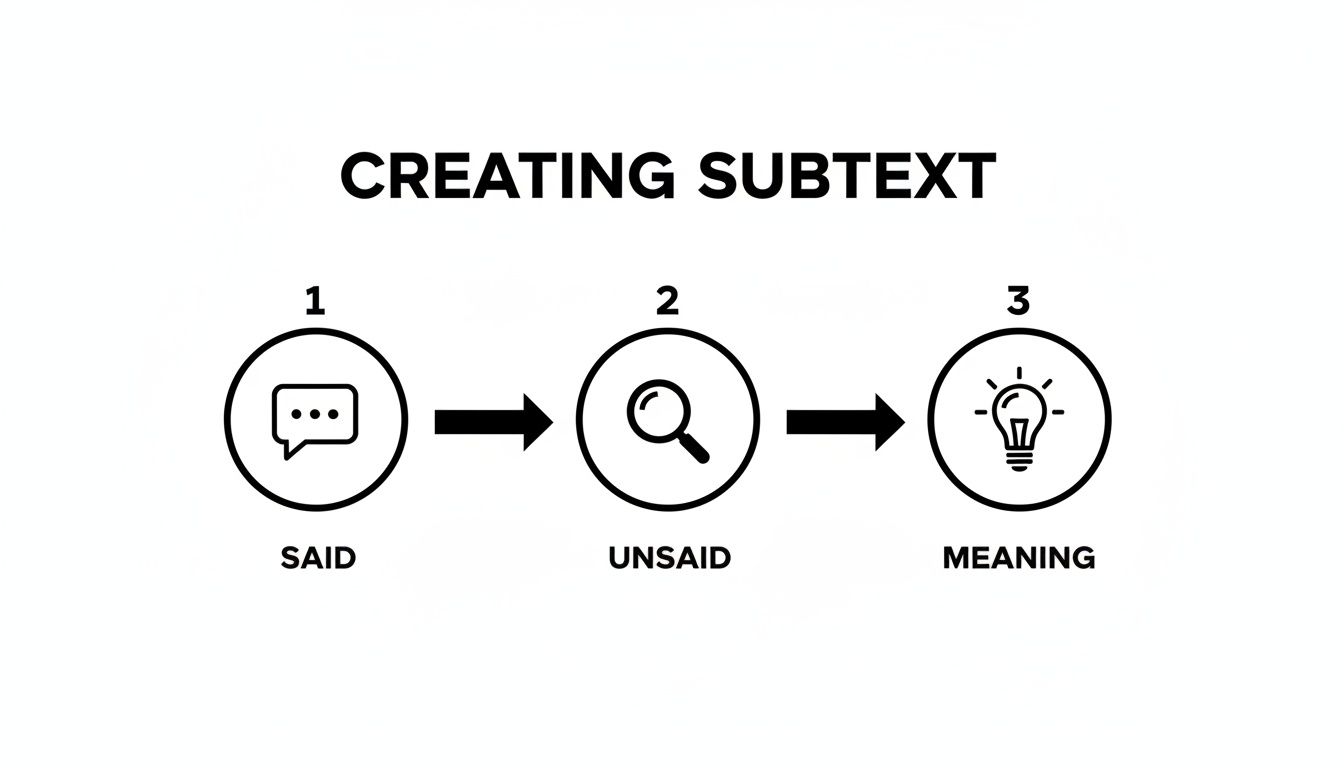
The real magic happens when you master the art of the unsaid, letting readers connect the dots themselves.
Key Takeaway: Polishing dialogue isn't about achieving grammatical perfection. It's about making it feel real. Cut what doesn’t serve the story, embrace the messy, natural patterns of human speech, and always—always—read it aloud. Your readers will thank you.
Stuck on Dialogue? Let’s Tackle the Tough Questions
Even when you've got a handle on the basics, writing dialogue can throw you some real curveballs. You're in the zone, the words are flowing, and then—bam. You hit a snag. Let's walk through a couple of the most common hangups I see writers struggle with, so you can keep your story moving.
How Do I Stop My Dialogue From Sounding Like an Info-Dump?
Ah, the dreaded exposition dump. This is probably the single biggest mistake new writers make. It's tempting to use your characters as mouthpieces to explain the backstory, but it’s a trap. People just don't talk like that. They don't give each other a rundown of events they both already lived through.
Think about it. Instead of having a character say, "As you know, after the Great Widget War of '09, we were forced to relocate," you need to find a way to weave that history into the present moment. Try hinting at it through conflict.
Maybe it sounds more like this: "I'm not going back there. Not after '09." Suddenly, you've created tension and mystery instead of just delivering facts. The reader is hooked, wondering what the heck happened in '09.
My go-to gut check is this: Is this line only here for the reader's sake? If the characters have no reason to say it to each other, cut it. Find a better, more organic home for that information.
How Can I Write a Group Scene Without It Turning Into a Mess?
Juggling a conversation with three, four, or even more characters can feel like herding cats. If you're not careful, it turns into a boring, predictable back-and-forth where everyone gets a turn to speak. Real group conversations are never that tidy.
Here’s how to embrace the beautiful chaos of a group chat:
- Pick a Leader: In any group, someone usually drives the conversation. Let one or two characters carry the main thread while others pop in with shorter comments, questions, or reactions. Not everyone needs a monologue.
- Show, Don't Just Tell: Lean heavily on action beats to orient the reader. Instead of endless "he said" or "she asked," show us what people are doing. He leaned forward, slamming his mug on the table. She shot a nervous glance at the door. These little actions break up the text and keep the scene visually engaging.
- Let Them Interrupt Each Other: Real conversations are full of interruptions, people talking over each other, and finishing each other's sentences. Don’t be afraid to use an em dash to have one character cut another off. It’s a fantastic tool for revealing personality and urgency.
Learning how to write realistic dialogue means understanding the power dynamics in the room. Who holds the floor? Who’s desperate to get a word in? Sometimes, the person who says the least makes the biggest impact when they finally do speak.
Ready to put these skills to the test? With Luvr AI, you can create unique AI companions and practice the art of conversation in countless scenarios. It's a fantastic way to experiment and see what makes dialogue feel truly alive. You can start crafting your characters by visiting Luvr AI.