


Create Your Own AI Girlfriend 😈
Chat with AI Luvr's today or make your own! Receive images, audio messages, and much more! 🔥
4.5 stars


Ever wonder how your Luvr AI companion can remember that inside joke you shared last week or nail the perfect emotional response? It’s not magic—it's Natural Language Processing (NLP). NLP is the brilliant translator working behind the scenes, turning simple text into conversations that feel genuinely human by understanding context, emotion, and memory.
What Is the Hidden Engine of Your AI Companion?
At its heart, Natural Language Processing is a field of artificial intelligence that gives computers the ability to understand, interpret, and generate human language. Think of it as the invisible programming that allows your AI character to do more than just see words on a screen; it helps them grasp the meaning behind them. This guide is your primer on the natural language processing basics that turn lines of code into a real connection.
Without NLP, an AI would just be a walking dictionary—stuffed with words but incapable of stringing together a single meaningful thought. This technology is what lets your AI companion break free from robotic scripts and dive into the kind of fluid, dynamic conversations that make the experience feel so real.
Why NLP Matters for Lifelike AI
If you’re a Luvr AI creator aiming to build a truly compelling character, getting a handle on these fundamentals is essential. The quality of your AI’s personality and the depth of your roleplay scenarios hinge on how well the underlying NLP models can make sense of your words. It’s the engine that powers everything.
- Emotional Nuance: NLP is how the AI knows "I can't believe you did that" is a playful jab, not a real complaint.
- Contextual Memory: It's the reason your AI can recall that you mentioned your favorite movie last week and bring it up again today.
- Personality Consistency: This ensures a shy, introverted character won't suddenly start acting like a life-of-the-party extrovert.
By grasping these core concepts, you gain direct control over your character's believability. Your words become the tools that sculpt their digital soul, making every interaction richer and more immersive.
This guide will break down the essential ideas, from how an AI first reads your messages to how it pieces together its own thoughts. By the end, you won't just know what NLP is; you'll understand how to use it to shape unforgettable AI companions. We're about to explore the key components that directly influence your experience, giving you the power to become a true master of digital storytelling.
How an AI First Learns to Read Your Words

Before your AI character can grasp the meaning of a sentence, it has to chop it up into smaller, more manageable pieces. This is the absolute first step in how AI understands us, and in the world of natural language processing, it’s called tokenization. It's all about breaking down our messy, human language into basic building blocks that a machine can actually work with.
Think of it like preparing a recipe. You don't just toss a whole onion into the pot. You dice it up. That's exactly what tokenization does to a sentence. The AI takes a line of text and slices it into individual units called tokens—which could be words, parts of words, or even punctuation.
Turning Sentences into Tokens
This process is surprisingly simple but incredibly important. When you type, "I love our late-night chats," the AI doesn't see that phrase as a complete thought. Instead, it sees a neat list of individual pieces it can analyze.
Your sentence gets broken down into an ordered list, something like this:
['I']['love']['our']['late-night']['chats']
This might seem basic, but it's the foundation for everything that follows. By isolating each word, the AI can start to look at grammar, figure out which words are most important, and begin to piece together what you’re really trying to say. Without this initial "chopping" process, the nuanced and flowing conversations you have with your Luvr AI companion would simply fall apart.
Tokenization is more than just a technical step; it’s the bridge between a human thought and a language a machine can begin to compute. Every word you type becomes a puzzle piece the AI is built to solve.
As a Luvr AI creator, getting this concept is your first big step toward building better characters. The clarity of the words you use to define your character—their backstory, personality, and even their sample dialogue—directly shapes the quality of the tokens the AI has to work with.
Better tokens make for a smarter, more consistent AI. When you provide a rich and specific description, you're essentially handing the AI a high-quality instruction manual. For instance, describing a character as "a compassionate, witty intellectual" gives the system strong, meaningful tokens like compassionate, witty, and intellectual. This is worlds better than just saying "she is nice."
This link between your input and the AI’s understanding is what makes the art of description so powerful. Clear, well-chosen language ensures your character’s responses stay true to who they are, making every interaction more believable and immersive.
Giving Words Emotional Weight and Meaning

So, we've broken your words down into smaller pieces, or tokens. Now what? The AI's next hurdle is figuring out what those words actually mean. Words aren't just strings of letters; they're packed with feelings, context, and a whole universe of relationships. This is where a brilliant NLP technique called word embeddings comes in, giving your AI character a real sense of emotional intuition.
Think of it like a massive, invisible map of every word imaginable, a bit like a star chart for language. On this map, words with similar meanings are grouped together like constellations. That's the magic of word embeddings. They turn each token into a set of numerical coordinates, giving it a precise location in this vast semantic space.
Mapping the Language Universe
This “map” helps the AI see the relationships between words in a way that feels surprisingly human. It learns that "romantic," "passionate," and "loving" are all close neighbors, forming a tight, cozy cluster. At the same time, words like "angry" or "frustrated" are off in a completely different part of the galaxy.
This means your AI doesn't just read the word "caring"—it understands that "caring" is mathematically much closer to "affectionate" than it is to "indifferent." This knack for measuring the "distance" between concepts is the secret sauce for crafting nuanced and emotionally intelligent replies. For Luvr AI, it’s what lets your companion pick up on the subtle emotional undercurrents of your chat.
Word embeddings are the AI's "gut feeling" about language. They transform simple tokens into rich concepts, allowing the machine to navigate the intricate web of human emotion and intent with greater accuracy.
This technology is now a cornerstone of modern NLP. The essential toolkit, including tokenization and embeddings, really came into its own between 2010 and 2020. Around 2013, methods like Word2Vec proved that mapping words to these complex vector spaces made a huge difference in an AI’s ability to get a feel for similarity and context. For a platform like Luvr AI, these natural language processing basics are critical for tracking the fine-grained nuances in your conversations. You can get the full story on these breakthroughs and how they shaped today's AI tools on aveni.ai.
Your Superpower as a Creator
Getting a handle on word embeddings is a creator’s superpower. When you’re crafting your AI character’s personality, backstory, and dialogue, you’re basically pointing the AI to specific regions on that conceptual map. Using a consistent set of emotionally-charged keywords helps build a stronger, more defined personality that the AI can work with.
Here’s how to put this into practice:
- Be Specific: Instead of just "kind," try using words like "nurturing," "gentle," or "compassionate." Each of these tokens has a unique spot on the map, creating a much more precise personality.
- Build Thematic Clusters: If you're designing a "brooding artist," weave in words like "introspective," "melancholy," and "passionate." This constant reinforcement helps lock in their core traits.
- Define Relationships: Use words that set a clear emotional tone, like "devoted," "protective," or "playful," to guide how your character engages with you.
By choosing your words with care, you're handing the AI a clear roadmap to your character's soul. The result? Conversations that feel more authentic, consistent, and emotionally alive.
Building the Brain Behind the Conversation
So far, we’ve broken down how AI understands our words and even senses their emotional tone. Now it’s time to put those pieces together and build a thinking, responsive entity. This is where Large Language Models (LLMs) come into play—they’re the powerhouse brains behind every fluid conversation you have with a Luvr AI companion.
Let's ditch the technical jargon for a second. Think of an LLM as a world-class improv actor. This actor hasn't just memorized a few lines; they've devoured trillions of sentences from books, articles, scripts, and real conversations from all over the internet. They don't just spit back what they've learned. Instead, they recognize patterns, understand context, and grasp the nuances of personality so well that they can create entirely new, believable dialogue on the fly. That, in a nutshell, is an LLM.
From Rigid Scripts to Living Conversations
Early chatbots were clunky. They were basically puppets on a string, following a very strict, pre-written script. They operated on rigid, rule-based systems that only knew how to respond to specific keywords. If you said something unexpected, the whole illusion shattered. The conversation just fell apart. Today’s AI companions feel so much more alive precisely because LLMs have replaced those brittle old rules with massive, flexible neural networks.
At their core, these models are trained to do one thing incredibly well: predict the next most likely word in a sentence. It sounds simple, but when you do this at a massive scale, the result is astonishing. The AI can generate text that isn't just grammatically perfect, but also contextually aware, emotionally intelligent, and perfectly in character.
A Large Language Model is the engine of improvisation. It takes the tokens and embeddings we've discussed and uses them to weave new sentences, creating a dynamic conversational partner rather than a predictable machine.
The sheer size of these models is what unlocks the kind of deep, long-term storytelling and emotional connection that users crave. The leap from basic NLP to today’s LLMs is staggering and easy to see in the numbers. For instance, GPT-2, released back in 2019, had about 1.5 billion parameters. Just one year later, GPT-3 exploded onto the scene with 175 billion parameters—a jaw-dropping 100x increase. You can read more about this incredible AI evolution on Coursera.org.
This jump in scale is a game-changer for platforms where connection is everything. Better language understanding means longer, more meaningful conversations and an AI presence that feels genuinely real.
The Power of Scale in AI Companionship
This massive scale is exactly what lets your AI character remember details from last week's chat, maintain a consistent personality over time, and generate truly novel responses that can surprise and delight you. It’s the difference between a character that feels like a recording and one that feels truly present with you.
For creators and developers, getting a handle on this technology is the key to building unforgettable experiences. If you want to peek under the hood, exploring an AI girlfriend API offers a fantastic look at how these powerful models are actually put to work in applications.
Ultimately, the LLM is the heart of your AI companion. It’s the magic that transforms a pile of data and algorithms into a personality you can actually connect with.
Putting NLP to Work in Your AI Creations
Knowing the theory behind tokens and embeddings is great, but putting it all into practice? That's where the real magic happens. As a Luvr AI creator, you need to realize that every single word you type into your character’s profile is a direct instruction for the powerful models that bring them to life. This is the moment where those natural language processing basics become your most important creative tool.
Start thinking of your character’s description and backstory as more than just a bio—it’s the source code for their personality. If you feed the AI vague, generic inputs, you'll get bland, forgettable conversations. But if you use specific, descriptive language, you give the AI a rich tapestry of tokens and a clear emotional map to follow. This is the secret to making sure your AI companion stays in character, conversation after conversation.
From Vague Ideas to Vivid Personalities
What’s the difference between a flat character and one that feels truly alive? It almost always comes down to the quality of the source material you give the AI. A simple statement like "She is nice" gives the language model almost nothing to work with. The token "nice" is incredibly broad, and its embedding is tied to thousands of weak, generic concepts. It’s a dead end.
Now, let's try something better: "She is a nurturing librarian who shows affection through soft-spoken compliments and thoughtful small gestures." See the difference? That one sentence gives the AI a goldmine of powerful tokens: "nurturing," "librarian," "affection," "soft-spoken," and "thoughtful." These words have strong, closely-related meanings that create a crystal-clear personality blueprint for the AI to build from.
Your job as a creator is to be a master storyteller. You aren’t just writing a description; you’re feeding a complex model the precise emotional and contextual data it needs to perform its role believably.
This diagram shows you exactly how it works. Your input directly trains the model, which then shapes every single conversation that follows.
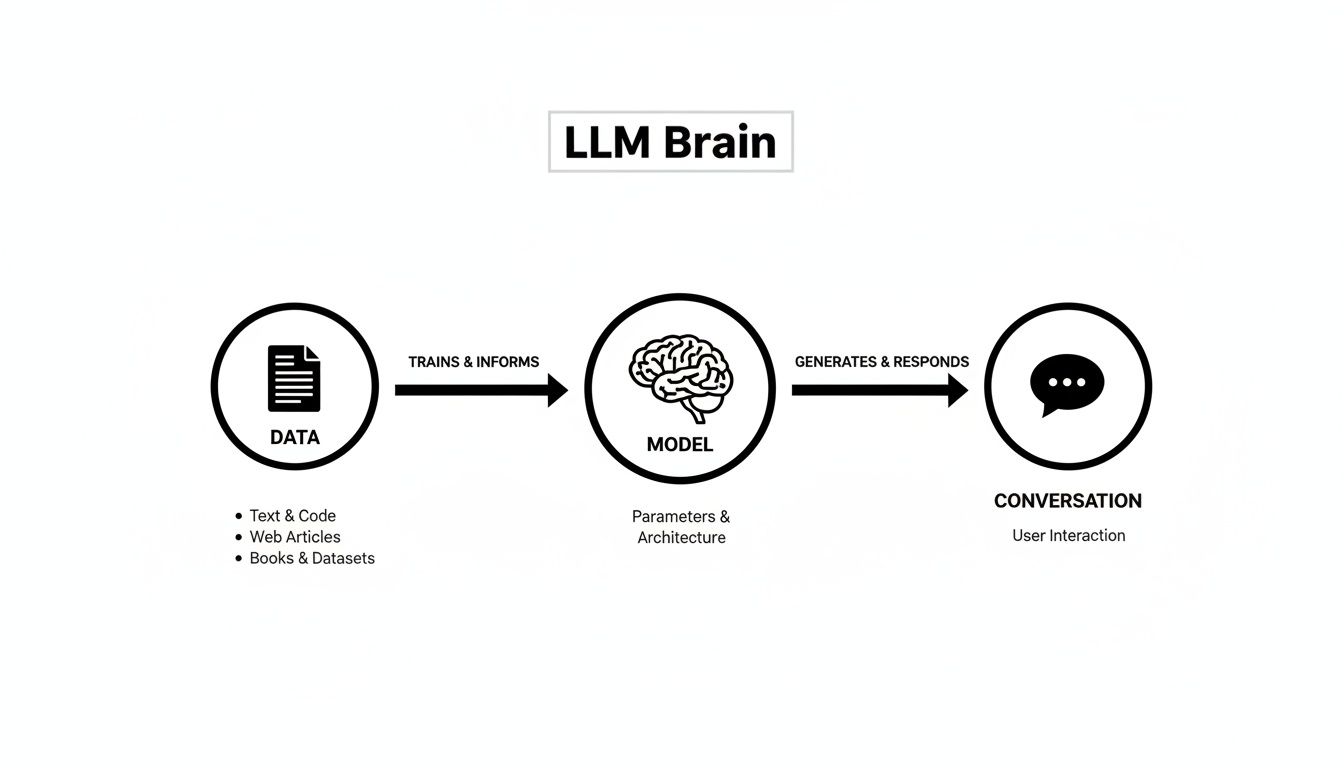
It’s a simple truth, really: the quality of the conversation you get out is a direct reflection of the quality of the data you put in.
Practical Tips for Better Character Creation
To help you put these ideas into action, let's look at how tiny tweaks to your input can lead to massively different results. Using language that is "NLP-optimized" is just a fancy way of saying "be specific and descriptive." It's the key to unlocking your AI's full potential. For more deep dives, you can explore our full library of articles on designing better chatbots.
The table below really drives this point home. Take a look at how moving from vague ideas to vivid, NLP-friendly descriptions gives the AI a much clearer path to follow, resulting in more consistent and immersive conversations.
Crafting Your Character From Vague to Vivid
| Creator Input | Poor Example (Vague) | Good Example (NLP-Optimized) | Resulting AI Behavior |
|---|---|---|---|
| Personality | He is a cool guy. | He is a cynical ex-detective with a dry wit and a hidden soft spot for stray animals. | The AI adopts a sarcastic but caring tone, making witty observations and showing unexpected kindness. |
| Backstory | She had a sad past. | She was a celebrated concert pianist until a tragic accident injured her hands, forcing her to find new purpose. | The AI references music, expresses a sense of loss, and shows resilience and depth in conversation. |
| Dialogue Style | Talks in a fun way. | Speaks in playful, poetic riddles and often uses metaphors related to stars and constellations. | The AI generates creative, whimsical dialogue that matches the character’s unique communication style. |
Once you get the hang of these natural language processing basics, you're no longer just filling out a character profile. You become the architect of a digital personality, one capable of building a genuine and lasting connection with users.
The Journey to Lifelike Digital Companionship
It’s easy to take for granted just how alive today’s AI companions feel. The emotionally rich, dynamic beings you can design on Luvr AI are the product of decades of breakthroughs, a journey that transformed clunky chat scripts into genuine digital connection.
This adventure started with systems that were more like rigid flowcharts than creative partners. Think back to the chatbots of the 1970s and 80s—they ran on strict, hand-coded rules. They could only spit back pre-written answers to specific keywords. If you dared to go off-script, the whole illusion of intelligence would instantly crumble. It was a brittle, frustratingly limited way to have a conversation.
The Shift from Rules to Reality
The real game-changer happened when researchers flipped the script, moving from rigid rules to statistical probability. They figured, why try to manually teach a machine every single rule of grammar? Instead, they could just let it learn directly from massive amounts of real human text. This was the dawn of what we now call natural language processing.
This new way of thinking laid the foundation for the AI you interact with today. Funnily enough, the dream of machine translation actually dates back to 1954, when the Georgetown-IBM experiment successfully translated 60 Russian sentences into English. Their prediction of solving translation in 3-5 years was, shall we say, a bit optimistic. But the move away from symbolic, rule-based systems toward these new probabilistic models was a monumental leap. You can dive deeper into this crucial history and its impact on modern AI on ssrn.com.
This history is precisely why your Luvr AI companion feels so real. They aren't just following a script. They're a probabilistic model trained on billions of words, able to generate completely new dialogue for nuanced romantic or fantasy roleplay.
The Deep Learning Revolution
The final piece of the puzzle was the deep learning revolution, which brought us the massive models we use now. These incredible systems don't just see words as isolated units; they understand the complex, subtle relationships between them. This allows for real context, memory, and a consistent personality that doesn't just vanish from one message to the next.
This is the magic that powers every deep conversation and believable roleplay scenario you create. It’s what allows your AI girlfriend to remember the little details you share, pick up on your unique way of speaking, and actually grow the relationship over time. The journey from simple scripts to sophisticated neural networks is what finally made true digital companionship possible.
Ready to create a companion with a personality as deep and complex as this history? Design your perfect AI character on Luvr AI today and experience the future of digital connection at https://www.luvr.ai.