


Create Your Own AI Girlfriend 😈
Chat with AI Luvr's today or make your own! Receive images, audio messages, and much more! 🔥
4.5 stars


So, you're curious about online sexual roleplay. At its heart, it’s a shared creative writing exercise, a way for consenting adults to build intimate stories together. Think of it as collaborative, text-based storytelling where you and your partner(s) create characters to explore fantasies in a private, consensual space.
Exploring Online Roleplay with Confidence
Diving into online sexual roleplay can feel a little daunting at first, but it's an incredible avenue for connection and creative expression. The key to making it a positive experience is grounding everything in safety, open communication, and absolute mutual respect. This isn't just a list of rules; it's a practical playbook for making sure you feel empowered and secure.
We'll walk through how to set solid boundaries, find partners who genuinely respect them, and weave compelling narratives together. The goal is to give you the confidence to explore this unique form of digital intimacy, ensuring every scene is consensual, positive, and genuinely fun.
This visual breaks down the essential safety pillars for a great experience.
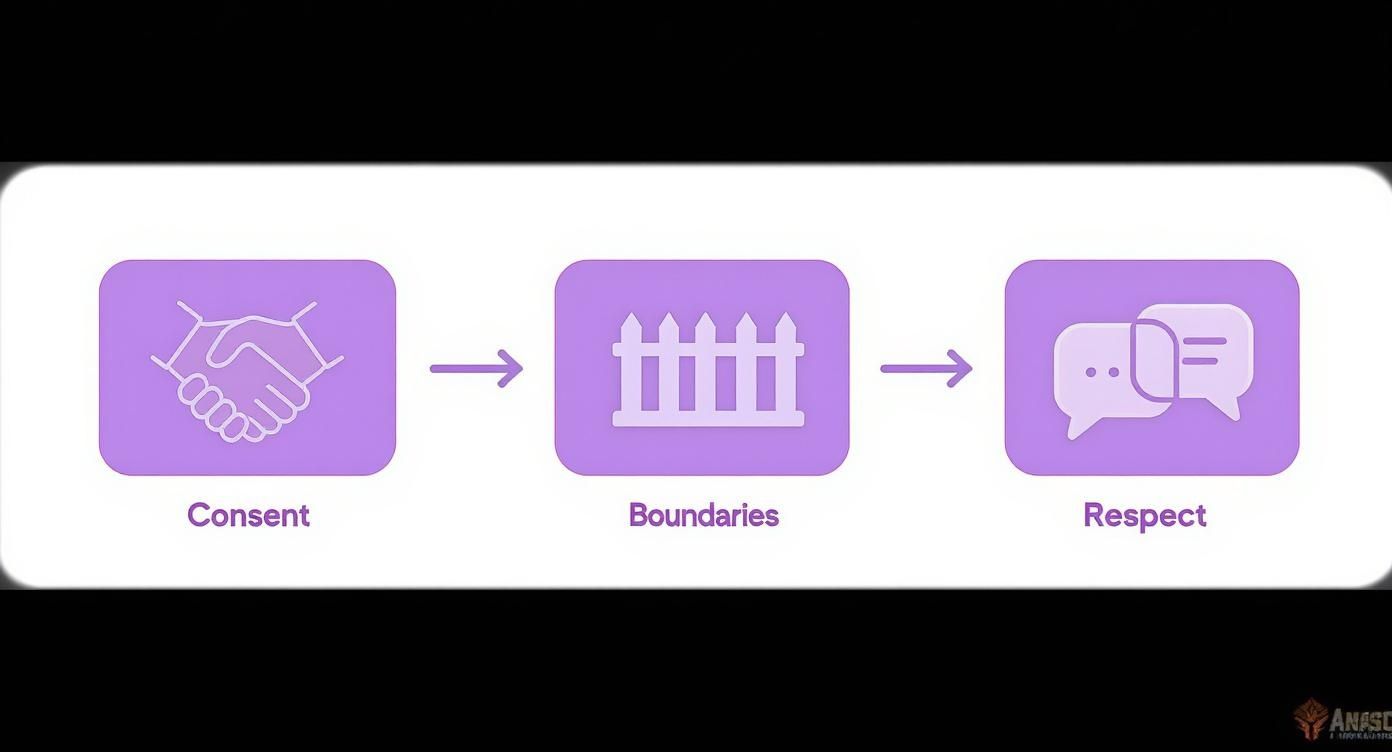
As you can see, it all starts with enthusiastic consent. From there, clear boundaries provide the framework, and consistent mutual respect keeps the story going strong.
Core Principles for Safe Online Roleplay
Before we get into the nitty-gritty of character creation and scene-setting, let's talk about the foundation. These principles aren’t just nice-to-haves; they are the absolute bedrock of any healthy and enjoyable roleplay. Internalizing them means you and your partners can relax and create without worry.
The four main pillars are:
- Enthusiastic Consent: This is about more than just a "yes." It's an ongoing, enthusiastic agreement from everyone involved. Remember, silence or hesitation is a "no."
- Clear Boundaries: Before a single line is written, you need to discuss limits. Talk about your hard "no's" (dealbreakers) and your soft lines (things to approach with caution).
- Character and Player Separation: This is crucial. Always respect the line between what a character does and how the player behind the screen feels. OOC (Out of Character) check-ins are your friend here.
- Platform Safety: Not all platforms are created equal. Stick to ones with solid privacy settings, user-friendly moderation tools, and clear reporting features.
To help keep these concepts top of mind, here’s a quick-reference table.
Core Principles for Safe Online Roleplay
| Principle | Key Action |
|---|---|
| Enthusiastic Consent | Actively seek a clear and ongoing "yes" from all partners. |
| Clear Boundaries | Discuss and agree on hard and soft limits before the scene begins. |
| Character vs. Player | Use OOC communication to respect the real person behind the character. |
| Platform Safety | Select platforms that prioritize user privacy, control, and moderation. |
By committing to these principles, you and your partners create a space built on trust.
The big takeaway? Incredible roleplay is built on a foundation of trust. When everyone feels secure, creativity can flow freely without fear or hesitation, which ultimately leads to far more immersive and satisfying stories.
If you're interested in how these dynamics play out in a different context, our guide on how to set up engaging NSFW AI scenarios offers another perspective. Understanding both human-to-human and human-to-AI interactions can give you a well-rounded view of consensual digital creation.
The Unbreakable Foundation of Consent and Boundaries

Let’s get one thing straight: in the world of online roleplay, consent isn't just a box you tick once. It's the lifeblood of the entire experience. It’s an active, ongoing conversation that builds the trust you need to truly let go and explore your creativity.
Think of it less like a rigid contract and more like a shared steering wheel, guiding the story in a way that’s thrilling—and safe—for everyone.
Don't worry, this conversation doesn't need to be clunky or awkward. When you approach it with clarity and confidence right from the jump, you establish a powerful tone of mutual respect. You're showing your partner that their comfort is just as important as your own, and that’s the real secret to an unforgettable scene.
Differentiating Your Limits
Before you dive into crafting a character or a scenario, you need to get crystal clear on your own boundaries. Not all limits are created equal, and knowing how to talk about them prevents the kind of misunderstandings that can kill the mood, or worse, make someone feel unsafe.
We usually break them down into two main types:
- Hard Limits: These are the deal-breakers. The absolute "no-go" zones. A hard limit is any topic, theme, or action that will completely pull you out of the scene and make you uncomfortable. There's zero room for negotiation here.
- Soft Limits: Think of these as the "proceed with caution" areas. A soft limit might be a theme you’re open to exploring, but you want to take it slow, check in often, and reserve the right to pump the brakes. It could become a hard limit if things go too far.
A truly great partnership is built on respecting these differences. Knowing someone’s hard limits is about basic safety; understanding their soft limits is how you show you’re paying attention. That level of care is what turns a good scene into a deeply connected one.
This entire framework is, of course, strictly for interactions between consenting adults. Any platform worth its salt will have ironclad rules to protect its users. It's always a good idea to familiarize yourself with a site's safety commitments, like reviewing its underage user policy, to ensure the community is a mature and appropriate space.
The Power of Safewords and OOC Signals
Even with perfect planning, scenes can take an unexpected turn. That's why safewords and out-of-character (OOC) signals are your most essential tools. A safeword is simply a pre-arranged word or phrase—something that would never appear naturally in the scene—that you can use to immediately pause or stop everything.
The classic traffic light system works wonders: "Red" means stop completely, and "Yellow" means slow down or ease up. The golden rule is that a safeword must be respected instantly and without question. No ifs, ands, or buts.
OOC signals are just as valuable. By using double parentheses, like ((Hey, can we slow this part down a bit?)), you can step "out of character" for a moment. It lets you ask a question, check in on your partner, or clarify something without derailing the entire story.
These tools are for everyone, every time. Research into online sexual behaviors shows a huge range of engagement, and not all of it is safe. One study on adolescent online patterns found that while over half (52%) were "Online Abstinent," a significant number engaged in online sexual activities that exposed them to various risks. You can read more about it in this analysis of online youth behavior. Using clear safety tools like these is how we, as adults, ensure our own interactions stay fun, positive, and firmly rooted in enthusiastic consent.
Finding Your Scene And Vetting Partners

Your enjoyment of online sexual roleplay boils down to two essentials: a welcoming space and a partner who gets you. Invest time in spotting communities that mirror your style, because the right match transforms the experience from awkward to electrifying.
Different platforms shine in different areas. Forums geared toward roleplay often come with genre-specific rules and tight-knit audiences. Discord servers can give you that lively, real-time vibe—just watch out for spotty moderation. Private messaging apps guarantee discretion, but you’ll need to source partners from elsewhere first.
Choosing Your Playground
Think beyond the flashy features. How a community handles disagreements and enforces consent speaks volumes about its safety. Seek out spaces where moderators step in before a situation spins out of control, and where everyone understands the importance of personal boundaries.
Look for these key features:
- Privacy Controls: Adjust who sees your profile and can message you.
- Moderation: Active teams ready to address harassment or unwanted advances.
- Community Culture: Respectful chatter in public channels is a great sign.
- Search And Discovery: Efficient tools to find partners sharing your themes.
Spend at least a few days just observing. Reading threads, noting how conflicts get resolved, and spotting boundary conversations will clue you in to how serious a space is about safety.
Careful vetting isn’t optional. Roleplay thrives on trust, and poorly moderated sites can expose you to harassment or predatory behavior. Always choose platforms with a track record of protecting their users.
Writing A Profile That Attracts The Right People
Think of your profile as an invitation to a collaborative story. A punchy introduction sets expectations and weeds out anyone who doesn’t share your vision.
Be specific about:
- Writing Style (third-person, multi-paragraph, dialogue-heavy)
- Favorite Themes (sci-fi adventure, dark romance, playful drama)
- Availability (weeknights, weekend marathons, flexible hours)
- Hard Limits (mention them clearly to avoid misunderstandings)
Clarity upfront is your best filter—no need for vague “just for fun” lines. Spell out what excites you and what’s off the table.
Spotting Red Flags And Green Flags
Once messages roll in, your radar goes on high alert. Gut instincts matter—if someone’s behavior gives you pause, don’t ignore it.
Red Flags (Proceed With Extreme Caution):
- Pressure To Skip Boundary Talks: “We’ll figure it out as we go.”
- Vague Or One-Word Answers: Signals minimal effort and engagement.
- Refusing To Discuss Limits: If they dodge the topic, walk away.
- Pushing To Move Off-Platform Immediately: Protect your privacy—stay on the site until trust is built.
Green Flags (Signs Of A Great Partner):
- Enthusiasm For Your Ideas: They ask questions and brainstorm plot twists.
- Openly Sharing Their Own Limits: Volunteers boundaries without a prompt.
- Patience And Respect For Your Time: Acknowledges your real-life commitments.
- Clear, Respectful Communication: Treats you as a person, not just their character’s counterpart.
Finding the right scene and person takes effort, but those moments of genuine connection and shared creativity make it worth every click.
Crafting Characters and Scenarios That Resonate

Alright, with the groundwork of safety and consent firmly in place, we get to the part where the real magic happens. This is where you trade your real-world hat for a creator's cap. A truly magnetic character is the lifeblood of any roleplay, turning what could be a simple exchange into a story you can't wait to continue.
Think beyond just a name and a physical description. Your character needs a spark—a hidden motive, a crippling flaw, a secret fantasy. You don't need to write a novel-length backstory, either. A few well-chosen details are all it takes to breathe life into them.
The whole point is to create someone who feels real enough to react and grow within the world you’re building together.
Building Your Character From The Ground Up
A well-crafted character gives both you and your partner something to grab onto. Start with the broad strokes, then start adding those little layers that invite questions, create tension, and open the door for real intimacy.
Here are a few core elements I always consider for a quick but compelling profile:
- Core Personality: Are they the life of the party or the quiet observer in the corner? Pick three defining traits to start. Think things like witty, impulsive, and fiercely loyal.
- Primary Motivation: What gets them out of bed? It could be a lust for power, a desperate search for connection, or just the thrill of chasing the unknown.
- A Key Flaw: Nobody's perfect, and perfect is boring. A flaw, like being too proud to ask for help or being emotionally closed off, makes a character relatable and plants the seeds for great conflict.
- Physical Appearance: Go for evocative over exhaustive. Give your partner a few strong visuals and let their imagination do the rest.
Your character isn't carved in stone. The best ones are the ones who surprise you. When your character does something you didn't expect, that's when you know you've created someone truly alive.
Once you have a feel for who your character is, it's time to figure out the world they’ll be playing in.
The Art of Collaborative World-Building
The most incredible scenes are the ones you build together. Instead of one person laying out the entire plot, treat it like a brainstorming session. This gets both of you invested right from the get-go.
Just toss ideas back and forth. No pressure. See what sticks and gets you both excited.
- Establish the Setting: Where are we? A gritty cyberpunk back-alley? A sun-drenched fantasy kingdom? A quiet coffee shop on a rainy afternoon? The setting is your backdrop, and it sets the entire mood.
- Define the Tone: What’s the vibe? Are we going for a slow-burn romance, a high-stakes thriller, or something light and playful? Agreeing on this upfront prevents crossed signals.
- Identify the Core Conflict or Goal: Why are our characters here, together? Maybe they're rivals forced into an uneasy alliance, or two strangers whose paths cross by pure chance.
This initial jam session is everything. It’s where you sync up your creative energy. For a little extra help getting the ball rolling, some people find it useful to create a new scenario with a tool that can help organize thoughts and spark new ideas.
Writing A Powerful Starter
Your first post—the "starter"—is your opening gambit. Its only job is to hook your partner and give them something solid to respond to. A great starter paints a picture, shows us what your character is thinking or doing, and leaves the door wide open for a reply.
So, instead of a flat "He walked into the bar," try to pull them into the moment:
"The smell of stale beer and cheap perfume hit Alex the second he shoved the heavy oak door open. His eyes scanned the dim room, landing on the lone figure at the far end of the bar, and a knot of nervous energy tightened in his gut. He took a breath, his destination clear, and started walking."
See the difference? This gives your partner everything they need—sensory details, emotional context, and a clear action to react to. It’s the perfect launchpad for a story you’ll build together.
Mastering the Art of Immersive Writing
Once you have your safety net in place, it’s time for the fun part: the artistry. This is where you learn to write in a way that pulls your partner right into the world you’re building together.
Immersive writing is the secret sauce that turns a simple back-and-forth into an unforgettable, shared experience. It’s the difference between saying what your character does and making your partner feel it.
The real trick isn't about writing a novel or using a thesaurus for every other word. It's about being specific. A few carefully chosen details that hit the senses—the smell of ozone after a storm, the rough texture of a brick wall against their back, the faint thrum of a bassline from a club down the street—do more to create a believable world than pages of bland description ever could.
This is where you graduate from simply playing along to co-creating a living, breathing story. Hone these skills, and you'll become the kind of partner people are excited to write with—someone who builds tension, crafts genuine intimacy, and makes the fantasy feel incredibly real.
Show, Don’t Tell
You’ve probably heard this before, but in sexual roleplay, it's the absolute golden rule. Don't just tell your partner what your character is feeling. Show them. Let them see it through your character's actions, their words, and the little tells they give away.
- Telling: "She was getting turned on."
- Showing: "Her breath hitched, a soft flush creeping up her neck as her eyes darkened, pupils blown wide."
See the difference? The second one paints a picture. It gives your partner something tangible to react to, inviting them to build on that moment. This one simple change will instantly make your writing more powerful and engaging.
When you focus on sensory details and physical reactions, you anchor the scene in a shared reality. Your partner isn't just reading text; they're visualizing your character's every move, making their own response feel more authentic and immediate.
First Person vs. Third Person
The point of view you choose has a huge impact on the vibe of your scene. There's no "right" answer here—it’s all about the kind of experience you want to create.
| Perspective | Description | Best For |
|---|---|---|
| First-Person (I/Me) | Puts your partner directly inside your character’s head. It’s raw, immediate, and incredibly intimate. | Intense emotional moments, building a deep psychological connection, and exploring a character's inner thoughts. |
| Third-Person (He/She/They) | Feels more like you’re telling a story together. This gives you a cinematic, bird's-eye view of your character and the world around them. | Action sequences, scenes with multiple characters, or when you want to describe the setting in rich detail. |
Try both! See what feels right for you and the story you're building. Plenty of roleplayers even switch between them to match the tone of a particular scene, which can create a really dynamic and interesting flow.
The Unspoken Rules of Roleplay Etiquette
Great etiquette is what keeps the whole thing fun and flowing smoothly. It’s all about respecting your partner as an equal storyteller in this world you’re creating together. This isn't just polite—it's essential for keeping the space safe and creative for both of you.
First and foremost, never god-mod. God-modding is when you take control of your partner's character—dictating their actions, their feelings, or what they say. It’s a huge no-no. You write your character, they write theirs. Simple as that.
Also, get comfortable using OOC (Out of Character) markers like ((...)) or //... for chat that isn't part of the scene. It’s the perfect tool for checking in without breaking character. For example: ((Hey, mind if we slow things down a bit?)) This is your lifeline for ongoing consent and communication.
While this guide is written for consenting adults, we have to acknowledge a sobering reality. Online sexual solicitation involving minors is a serious problem. Australian research revealed that over 1 in 4 girls (26.3%) are sexually propositioned online by an adult before they turn 18, usually by strangers. You can read the full research about these online safety findings to better understand why creating and protecting adult-only spaces is so important.
Answering Your Toughest Online Roleplay Questions
Stepping into online sexual roleplay can bring up a lot of questions, especially when it comes to staying safe and protecting your own headspace. That's a good thing. Being prepared means you can handle whatever comes your way and keep your experiences fun, fulfilling, and empowering.
Let's walk through some of the most common situations you might face.
What Should I Do If a Partner Crosses a Boundary?
This is the big one, and the answer is simple: your safety and comfort come first, always. The second you feel a line has been crossed, your only priority is you.
Use your safeword. Drop an OOC message like ((Stop)) or ((Hold on)). The scene stops right there, no questions asked.
You can then state clearly what happened. "Hey, we agreed to no name-calling, and that crossed a line for me." You don't need to justify your feelings. If your partner is genuinely sorry and it was a true misunderstanding, you can talk it out and decide if you want to continue.
But if they argue, get defensive, or try to make you feel bad? It's over. End the scene, block them, and don't look back. Anyone who can't respect a boundary isn't someone you want to be playing with. Period.
How Can I Keep My Personal Information Safe?
Think of your online persona as a completely separate identity. The best way to stay safe is to build a wall between your real life and your roleplay life.
Never, ever use your real name or personal email. Create a new pseudonym and a dedicated email address just for this hobby.
Stick to the messaging system on whatever platform you're using. Don't let someone rush you into moving the conversation to a personal app like WhatsApp or Telegram. That step should only happen, if ever, after a huge amount of trust has been built over a long time. Even then, be careful. Small details—your job, your city, your favorite local coffee shop—can be pieced together.
The golden rule is total separation. Your real-life identity and your roleplay persona should never, ever mix.
What Is Aftercare and Is It Necessary Online?
Aftercare is just the practice of checking in with each other out-of-character (OOC) after an intense scene. It’s a concept that has its roots in BDSM, but honestly, it’s an incredibly valuable tool for anyone engaging in heavy or emotional online roleplay.
It doesn't have to be complicated. A simple OOC message can make all the difference:
“((That was intense! Just wanted to pop in and make sure you're feeling good. Thanks for the scene!))”
This little gesture does so much. It helps you both come down from the intensity, reinforces the line between fantasy and reality, and builds a massive amount of trust. You might not need it after a light, fluffy scene, but for the deeper stuff, making it a habit is one of the best ways to build a safe and respectful partnership.
The need for these kinds of adult safety measures becomes crystal clear when you look at the risks faced by younger people online. Shocking statistics reveal that 1 in 3 minors aged 9-17 have experienced some form of online sexual interaction. This is exactly why adult-only spaces have to be so fiercely protected. You can learn more about these online risk findings and see why maintaining consensual, secure environments is so critical.