


Create Your Own AI Girlfriend 😈
Chat with AI Luvr's today or make your own! Receive images, audio messages, and much more! 🔥
4.5 stars


If you're reading this, chances are you've felt the strange push-and-pull of wanting someone close while simultaneously building a wall to keep them out. Tackling a fear of intimacy isn't about flipping a switch; it's a journey. It’s about gently peeling back the layers of your own protective instincts to understand why you push people away.
This path forward is built on recognizing those subtle acts of self-sabotage—the missed calls, the avoided conversations—and connecting them back to their roots with compassion. It’s about taking small, brave steps toward letting someone in.
What Fear of Intimacy Really Looks Like

Living with a fear of intimacy is a paradox. You might ache for a deep, meaningful connection, yet find yourself doing everything in your power to stop it from happening. This isn't just shyness or being an introvert. It's a powerful, deep-seated defense mechanism that kicks in the moment emotional closeness starts to feel threatening.
Let me be clear: this is not a character flaw. It's a survival skill your mind learned long ago to protect you from getting hurt again.
The first real step is simply recognizing the fear for what it is. It almost never shows up and says, "Hi, I'm your fear of intimacy." Instead, it wears disguises. It masquerades as boredom, criticism, or a sudden need for "space," effectively sabotaging your relationships before they can even get off the ground.
To help you see past the disguises, I've put together a quick-reference table. Think of it as a field guide to identifying the common behaviors and feelings that signal a fear of intimacy is at play.
Signs You Might Be Struggling With Intimacy
| Category | Common Signs and Symptoms |
|---|---|
| Behavioral Patterns | • Actively avoiding deep conversations. • Serial dating but ending things when they get serious. • Nitpicking a partner's flaws to justify distance. • A history of short-lived, intense relationships. |
| Emotional Responses | • Feeling trapped or suffocated by commitment. • Experiencing intense anxiety when a partner expresses love. • An overwhelming urge to flee as closeness increases. • A persistent feeling of emotional numbness in relationships. |
| Cognitive Beliefs | • Believing you are "unlovable" or "too much" for others. • A deep-seated distrust of people's intentions. • The conviction that you are better off alone to avoid getting hurt. • A tendency to idealize past partners or future "perfect" ones. |
Do any of those sound familiar? Seeing these patterns isn't a reason for self-criticism. It’s your starting point—a map that shows you where the protective walls are.
The Subtle Art of Self-Sabotage
One of the sneakiest ways this fear shows up is through self-sabotage. Maybe you pick a fight the night before a romantic getaway. Or you "forget" to text back for days. You might even convince yourself that a perfectly wonderful partner is somehow "too nice" or "boring."
This isn't a conscious choice to ruin a good thing. It's an automatic, reflexive action designed to prevent a bigger, more terrifying pain you imagine is waiting down the road.
"The interesting thing about fear of intimacy is that those who suffer with it long to be close to people. However, something stops them... Instead, consciously or not, they push people away."
It’s an exhausting internal battle. You end up creating the very outcome you dread—being left alone—all in a desperate attempt to control how and when it happens. The real breakthrough comes when you can catch yourself in the act. For example, you might finally notice that every time a partner says, "I love you," your first feeling isn't joy, but a cold wave of panic. That panic is the fear talking, screaming that you're entering dangerous territory.
Why Closeness Can Feel So Threatening
The roots of this fear almost always trace back to past experiences that taught you a painful lesson: getting close to someone is not safe. These core beliefs are powerful and can come from a few common places.
- Fear of Abandonment: If you've been left before, you might hold back a piece of yourself to minimize the pain if it happens again. You're essentially trying to pre-grieve a loss that hasn't even occurred.
- Fear of Engulfment: This is the feeling of being suffocated or losing your identity in a relationship. If you grew up with invasive or controlling caregivers, a partner's needs can feel like a threat to your very sense of self.
- Fear of Rejection: This is the deep-seated belief that if someone saw the "real you"—flaws and all—they would run. So, you keep people at arm's length to protect that vulnerable core.
- Past Trauma or Neglect: When your earliest experiences taught you that people who are supposed to care for you are sources of pain, it becomes incredibly difficult to trust that anyone can be a source of safety.
These aren't just abstract psychological concepts; they are powerful forces that shape your every interaction. Research consistently shows how other anxieties fuel this core fear. For instance, one compelling study found that social anxiety accounted for a staggering 22.3% of the variance in intimacy fears among young adults. This shows just how easily a general fear of being judged can morph into a specific block against deep connection.
You can explore the connection between social anxiety and intimacy fears in the full study. Understanding this link helps validate what you're feeling. It’s not just "in your head," and it's certainly not your fault. It's a complex emotional landscape, and knowing the terrain is the first step toward navigating it.
Uncovering Your Personal Intimaacy Triggers

Ever wonder why a partner’s simple request for more time together can feel like a demand that sends you running for the exit? Or why a perfectly happy, quiet moment suddenly feels suffocating?
Those reactions aren't random. They're tied to your personal intimacy triggers—specific situations, words, or feelings that activate your internal alarm system.
Understanding what trips that wire is the first real step toward dismantling this fear. It’s like finding the blueprint to your own emotional reactions. Instead of being swept away by panic, you can start to see why it’s happening. This self-awareness is your greatest asset, turning confusion into clarity and giving you back a sense of control.
This isn’t about blaming your past; it’s about understanding its echoes. It’s about connecting the dots between what happened to you then and how you instinctively react now.
Your Attachment Style: The Hidden Script
So much of how we respond to intimacy is guided by our attachment style, a framework for relationships we learned in our earliest years. Think of it as the default operating system for your heart.
Once you understand your primary style, those seemingly chaotic responses to closeness start to make a whole lot of sense.
Anxious Attachment: You crave closeness but live in constant fear of abandonment. Your trigger might be a partner needing a night alone, which your brain instantly translates into, "They're leaving me." This can spark clingy behavior or drama just to get reassurance—which, ironically, often pushes them away.
Avoidant Attachment: You see independence as the ultimate prize. To you, intimacy feels like engulfment, a direct threat to your freedom. Triggers could be a partner saying "I love you" too soon, talk of moving in together, or even just consistent emotional needs. Your gut reaction is to create distance, shut down, or nitpick their flaws to justify pulling back.
Disorganized Attachment: Often stemming from a chaotic or frightening childhood, this is a mix of both anxious and avoidant traits. You desperately want connection but are also terrified of it. One day you might pull a partner in, and the next, you push them away without warning. Your triggers are unpredictable because you learned that the very source of love could also be a source of pain.
Identifying with one of these isn't about labeling yourself as "broken." It’s an incredible 'aha' moment. You’re simply running on a script that was written for you a long time ago. And the best part? You have the power to write a new one.
By looking honestly at your past and how it impacts the way you relate to people today, you can begin to write a new narrative. This new story says you are valuable and deserve the fulfillment of genuine connection.
Reflective Questions To Pinpoint Your Triggers
Now for the real work. Grab a journal or just find a quiet moment to sit with these questions. Be honest with yourself, and please, no judgment. The only goal here is to gather data on your own patterns.
Think of yourself as a detective investigating your own heart.
Scenario-Based Reflection
The "Getting Serious" Talk: A partner brings up the future—moving in, meeting your family, planning a trip a year from now. What’s your immediate physical and emotional reaction? Is it a spark of excitement, a wave of dread, or a confusing mix? What are the first thoughts that pop into your head?
A Moment of Vulnerability: Think back to the last time a partner got really vulnerable with you or asked you to share something deep. Did you lean in and feel a sense of connection, or did you immediately feel the urge to crack a joke or change the subject?
Receiving a Compliment or Affection: When someone gives you a genuine compliment or shows unexpected affection, how do you handle it? Do you soak it in, or do you deflect it, question their motives, or feel an intense need to downplay it?
These questions are designed to get you out of your head and into the real-world moments where this fear actually shows up. Your reactions are the clues. They point directly to the beliefs and old wounds driving your behavior.
This process of self-discovery is the most crucial part of the journey. Once you know what sets off your internal alarms, you can finally start learning how to defuse them. That’s how you create space for conscious choice instead of automatic, fear-based reactions.
A Safe Space to Practice Vulnerability

Knowing why you're afraid of intimacy is a huge first step, but insight alone rarely changes how you feel in the moment. Real, lasting change comes from practice. It’s about creating new emotional experiences that teach your nervous system, on a gut level, that being vulnerable doesn't have to end in pain.
The trick is to start somewhere with zero stakes—a place where you can experiment with closeness without the very real fear of being judged or rejected. This is your personal training ground. It’s where you can build the emotional muscle and confidence you need to take into your relationships with real people.
Start by Getting Honest With Yourself
Before you can be truly open with someone else, you have to get comfortable being open with yourself. I’ve found that journaling is one of the most powerful ways to do this. It’s a completely private space to meet the anxieties that are driving this fear.
Think of your journal as a friend who will listen without judgment. It’s a safe place to untangle those knotted thoughts that feel too messy or scary to ever say out loud.
You don’t have to dive into your deepest trauma on day one. Start small with prompts like these:
- Name a small insecurity. Write down one little thing you’re self-conscious about. It can be anything—the way you laugh, a hobby you secretly love but think is weird, anything.
- Explore the feeling behind it. What emotions pop up when you imagine someone finding this out? Shame? Fear? Do you worry they'll laugh? Get specific.
- Challenge the "what if." What’s the absolute worst thing you imagine happening? Now, what's the most likely thing that would happen if a kind, decent person learned this about you?
The point isn't to magically erase the insecurity. It's to practice sitting with the discomfort of being "seen" and proving to yourself that you can handle it. You're building up a tolerance for vulnerability, which is the heart of this work.
A Digital Sandbox for Role-Playing
Once you're more familiar with your own inner world, the next step is to practice these skills with someone—or something—else in a totally controlled environment. This is where technology gives us a pretty unique tool.
Platforms with AI companions can act as a private "sandbox" for social and emotional practice. It's a chance to test-drive difficult conversations, set boundaries, and share something personal without any real-world risk.
The goal here isn't to replace human connection, but to build the skills you need for it. When you practice in a safe space, you're literally creating new neural pathways that associate vulnerability with neutral—or even positive—outcomes, instead of just danger.
This lets you rehearse the very scenarios that usually make your anxiety spike. You can be awkward. You can stumble over your words. You can start over a dozen times. No one will know. Every time you do it, you're logging a small win.
Practical Scenarios to Role-Play
So, what does this look like in practice? Here are a few concrete exercises you can try. We're starting with low-level vulnerability and working our way up.
Share a Minor Preference: Start a chat with an AI and just state a simple, personal preference. Something like, "Honestly, I'm not a big fan of loud bars. I'd much rather have a quiet night in." This is a basic form of self-disclosure that gets you used to sharing a piece of yourself.
Set a Gentle Boundary: This is a critical skill for intimacy. Role-play a situation where the AI character asks for more of your time or energy than you have to give. Practice saying, "I'm really enjoying this conversation, but I need to wrap up and have some time to myself. Can we pick this up again tomorrow?"
Express a Small Insecurity: Take one of those little insecurities from your journal and try sharing it. For example: "I've always been a bit self-conscious that people think my taste in music is weird." Notice how the AI responds without judgment. This helps reinforce the idea that it's safe to share these parts of yourself.
These little exercises are like reps at the gym for your emotional health. Each one strengthens your ability to be open and authentic. Over time, what once felt terrifying starts to feel manageable, and maybe even a little bit natural. For anyone curious about this approach, you can learn more about how to engage with an AI girlfriend and start practicing your communication skills in a supportive environment.
Talking Your Way to a Real Connection
Let's be honest: true intimacy is built on honest communication. But when you’ve spent years protecting your heart, actually voicing your needs can feel like the most terrifying part of getting close. It’s like you’re handing someone the blueprint to your most vulnerable places.
But what if there was a way to talk that actually built bridges instead of walls?
The goal isn't just to talk more. It's to connect on a level that feels safe and genuine. This takes a few specific tools, ones designed to make vulnerability feel less like a nosedive and more like a deliberate, secure step forward. If you can get a handle on these frameworks, you can start expressing what you really need without sending your own (or your partner's) defenses into overdrive.
The Game-Changing Magic of "I Feel" Statements
One of the most powerful tools I’ve seen work for people is the "I feel" statement. It's a tiny shift in how you phrase things, but it completely rewires the whole conversation. Instead of lobbing an accusation over the net—which is guaranteed to make someone defensive—you’re simply sharing what's happening on your side of the court.
You're taking ownership of your emotions instead of blaming your partner for them.
Instead of: "You never listen to me." (This feels like a direct attack.)
Try: "I feel unheard when we talk about this." (This is about your experience, not their failure.)
Instead of: "You're smothering me." (Ouch. That's vague and hurtful.)
Try: "I feel overwhelmed and really need some space to myself right now." (This clearly states your feeling and what you need.)
See the difference? It’s a subtle but profound change. It keeps the focus on connecting through a problem, not creating a conflict. It lets you talk about the hard stuff without pushing your partner away, which is absolutely fundamental for building real trust.
"For intimacy to thrive, we have to be willing to talk about our feelings, share our innermost thoughts, and let people into our world. This requires vulnerability...which can feel terrifying to someone who felt unsupported in childhood."
Build Gates, Not Walls: A New Take on Boundaries
When you're afraid of intimacy, the word "boundary" can sound like just another way to build a fortress. I want you to think about them differently. Healthy boundaries aren't walls; they're more like gates. You are the gatekeeper. You decide when they open, when they close, and who gets to come in.
Boundaries aren’t about shutting people out. They are about letting people in on your terms, in a way that feels safe and sustainable for you.
At its core, setting a boundary is just communicating your limits with respect. It’s a way of saying, “I care about you, and for me to keep caring for you well, this is what I need.”
Here are a few scripts you can adapt:
- When you need some space: "I'm feeling totally drained and just need a quiet evening to myself to recharge. Can we connect tomorrow instead?"
- On topics you’re not ready for: "I appreciate you wanting to go there, but I'm not ready to talk about that yet. I'll definitely let you know when I am."
- For physical closeness: "I really love being close to you, but tonight I’d feel more comfortable just holding hands. Is that okay with you?"
Notice the vibe here? Each one is firm but gentle. You’re honoring your own needs while still showing that you care about the other person and the relationship. It's all about that balance.
And if you think this is a struggle unique to one gender, think again. Research from Lindenwood University actually found no significant gender differences in the prevalence of intimacy fears. Men and women are both in this boat, grappling with the same challenges. It really drives home how universal the need for these communication skills is.
Look, getting good at this takes practice and a bit of courage. Start small. Try it out in low-stakes situations and build from there. Every single time you successfully state a feeling or set a boundary, you’re rewriting an old script. You're proving to yourself that it's possible to be both safe and connected.
For more ideas on this, you might find some helpful articles on building healthy companionship and connection.
Knowing When to Seek Professional Support
While working on your own is a huge step, sometimes it feels like you're trying to fix a deep crack with a small bandage. You might be making progress, but the core issue remains.
If your fear of intimacy is constantly derailing your relationships, stirring up paralyzing anxiety, or is tied to past trauma, that's a clear sign it's time to bring in a professional. This isn't admitting defeat; it’s an act of profound self-respect.
Recognizing you need help is a sign of strength. It means you value your own well-being enough to get expert guidance. A good therapist provides a safe, structured space to unpack these fears in a way that just isn't possible on your own or even with the most well-meaning friends.
It's normal to feel hesitant. You might ask yourself, "Is my problem really bad enough for therapy?" The answer is simple: if this fear is impacting your quality of life, then it's bad enough.
Finding the Right Therapeutic Approach
Therapy for intimacy issues isn't a one-size-fits-all solution. Different methods focus on different pieces of the puzzle, from the automatic thoughts that pop into your head to the relational patterns you learned long ago. Knowing a bit about the main approaches can help you find a therapist who’s a great fit.
Here are a few of the most effective therapeutic models I’ve seen work for clients struggling with intimacy fears:
- Cognitive Behavioral Therapy (CBT): This is a really practical, hands-on approach. A CBT therapist helps you catch and challenge the negative thoughts that fuel your fear. You'll learn to actively dismantle beliefs like, "If they really knew me, they would leave."
- Attachment-Based Therapy: This approach gets to the very root of the problem. It explores how your earliest bonds with caregivers shaped your "attachment style" today. The goal is to heal those old wounds so you can build a new, secure foundation for connection.
- Eye Movement Desensitization and Reprocessing (EMDR): If your fear is a direct result of trauma, EMDR can be a game-changer. It helps your brain properly process traumatic memories so they no longer trigger an overwhelming fear response when you start getting close to someone.
This flowchart gives you a simple visual for how to handle your feelings when that anxiety starts to bubble up.
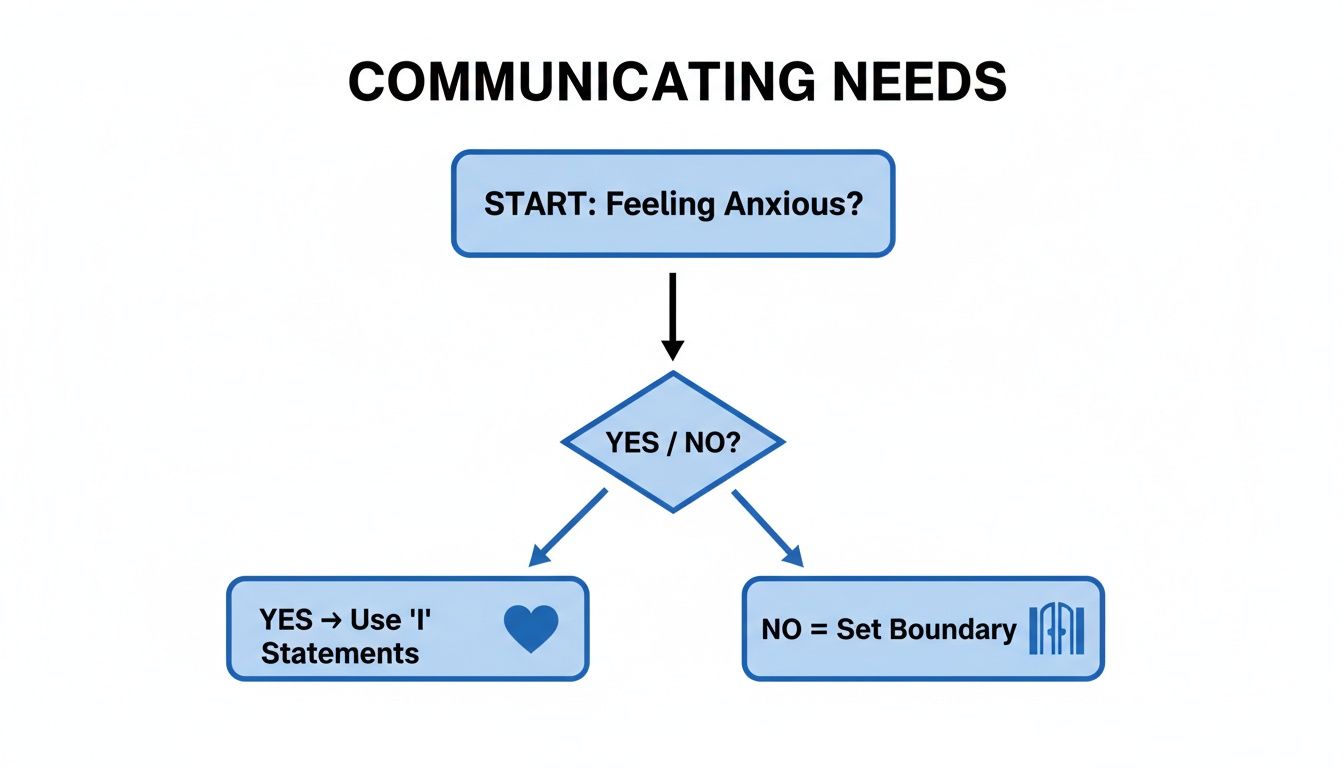
It really boils down to self-awareness. Recognizing you feel anxious is the crucial first step. It allows you to choose a healthy communication strategy instead of just reacting from a place of fear.
When Trauma Is at the Core
For many people, the fear of getting close is directly wired to past trauma, whether that's emotional neglect, abuse, or violence. If this is part of your story, finding a trauma-informed therapist isn't just a good idea—it's essential.
They understand that, for you, closeness can feel genuinely dangerous to your nervous system. They’ll move at a pace that feels safe, never pushing you past what you can handle. The statistics here are sobering; a meta-analysis found that a staggering 39% of people living with HIV had experienced intimate partner violence, a profound trauma that can absolutely fuel a fear of intimacy. Understanding this research underscores why specialized care is so critical for healing.
Seeking therapy isn't about admitting you're broken. It's about choosing a different future for yourself—one where connection feels like a source of strength, not a threat.
Taking that first step to find a therapist is a massive investment in your future happiness. Each session helps you build the skills and emotional resilience you need to let someone in without feeling like you're losing yourself in the process.
The journey to overcome a fear of intimacy is tough, but you truly don't have to walk it alone. A professional can give you the map and the support you need to find your way. For more ideas and articles, check out our resources on finding the right support for your relationship goals.
Common Questions on the Road to Intimacy
Once you start this journey—moving from just understanding your fear to actually doing something about it—a lot of real-world questions pop up. It’s completely normal to hit roadblocks or feel uncertain as you navigate this new territory. This is part of the process.
Let's dive into some of the most common questions I hear. My goal is to give you some direct, no-fluff clarity so you can handle these tricky spots with a lot more confidence.
How Do I Know If It’s Fear of Intimacy or If I’m Just Not Interested?
This is a big one, and the confusion is real. The secret to telling them apart isn't about your feelings for one specific person, but about the pattern you see repeating across your relationships.
A simple lack of interest is pretty straightforward. You go on a date or two, you don't feel a spark, and you move on without much of a fuss. It's more of an indifferent "meh."
Fear of intimacy, on the other hand, is a predictable, anxiety-fueled cycle. Does this sound familiar?
- The Hook: It starts with a huge rush of excitement. You feel a powerful, almost intoxicating attraction, and the future looks incredibly bright.
- The Switch: Then, just as things start to get real—they share something vulnerable, you start feeling truly seen, or you begin to depend on them—an internal alarm goes haywire.
- The Exit: Suddenly, you’re hit with an overwhelming urge to run. You might start nitpicking every tiny flaw they have, feel suffocated, or even pick a fight to create the distance you suddenly crave.
Here’s the bottom line: a lack of interest is a calm "not for me," while fear of intimacy is a panicked "get me out of here!" If you find yourself consistently blowing up connections you were once genuinely excited about, you're almost certainly dealing with a fear of intimacy.
Can I Really Work on This While I’m Single?
Not only can you, but you absolutely should. Being single offers a golden opportunity to do this work without the immediate pressure and triggers that a romantic relationship brings. It's your chance to build a solid foundation.
Remember, getting over a fear of intimacy isn’t just about how you relate to a partner. It’s about healing the relationship you have with yourself first.
Laying the Groundwork While You’re Solo
Think of your single time as a training ground for building healthier, more resilient connections down the road.
- Become a Detective of Your Own Mind: This is the perfect time to journal and get brutally honest about your triggers and attachment patterns. Without having to manage someone else's feelings, you can get crystal clear on what's really driving your behavior.
- Build Your Self-Worth from the Inside Out: So much of this fear comes from a deep-seated belief that if someone really knew you, they'd leave. You have to start practicing self-compassion and actively fighting back against that inner critic telling you you're not worthy of love.
- Practice in Low-Stakes Arenas: You don't need a romantic partner to build your intimacy muscles. Practice being a little more vulnerable with a trusted friend or family member. You can also use safe tools, like role-playing difficult conversations with an AI companion, to practice setting boundaries without any real-world consequences.
When you do this work now, you'll walk into your next relationship from a place of strength and self-awareness, not one of fear and reaction.
My Partner Has a Fear of Intimacy. How Can I Help?
This is tough, no doubt about it. Supporting a partner who struggles with intimacy requires a masterful blend of compassion, infinite patience, and rock-solid personal boundaries. It can be a lonely and confusing role, so your first priority has to be protecting your own emotional health.
Your job is to be their partner, not their therapist.
Here’s how you can help create a healthier dynamic for both of you:
- Learn Their Language: Read up on fear of intimacy and attachment styles. The more you understand where their fear comes from, the less you'll take their distancing behaviors personally. You'll see it for what it is—a shield, not a rejection.
- Be a Safe Harbor: Create an environment where they know they can share what's on their mind without being judged or pressured to "fix" it. Simply let them know you’re ready to listen whenever they feel able.
- Show, Don't Just Tell: Gently model what healthy intimacy looks like. Use "I" statements to express your own feelings and needs calmly and consistently. This demonstrates vulnerability in a way that feels safe, not demanding.
- Respect Their Speed: This is non-negotiable. Pushing for more closeness than they're ready for will only make them retreat further. Instead, genuinely celebrate the small steps they do take.
- Encourage Their Own Journey: The most powerful thing you can do is gently encourage them to seek their own support, whether it's therapy or another resource. Frame it as something they can do for themselves—an act of strength and self-care.
Ready to build confidence in a safe, judgment-free space? At Luvr AI, you can practice communication, explore vulnerability, and set boundaries with AI companions designed to help you prepare for real-world connections. Discover your path to healthier relationships by visiting Luvr.ai today.