


Create Your Own AI Girlfriend 😈
Chat with AI Luvr's today or make your own! Receive images, audio messages, and much more! 🔥
4.5 stars


Getting over the fear of rejection isn't about suddenly becoming immune to the word "no." It's about changing your relationship with it—seeing it as neutral feedback, not a judgment on who you are. The real work is in building resilience through small, consistent actions and learning to separate your self-worth from what other people decide.
Why the Fear of Rejection Is Holding You Back
We’ve all felt it. That split-second pause before you send a risky text or approach someone you're interested in. It's a universal gut punch, and it's not a sign of weakness. It’s actually a deep-seated survival instinct.
Think about it: for our ancient ancestors, being rejected by the tribe meant being cast out alone—a virtual death sentence. The stakes are a lot lower now, of course, but our brains haven't quite gotten the memo. They still sound the same primal alarm bells.

The problem is, this ancient programming is quietly sabotaging your modern life. It’s the invisible force field that keeps you from applying for that dream job, asking for that well-deserved raise, or striking up a conversation with someone who could be the one.
Every time you let fear make the call, you’re choosing a smaller, safer, and ultimately less fulfilling life. You're not just dodging a potential "no"—you're actively saying "no" to your own chances for growth, connection, and happiness.
The Hidden Costs of Playing It Safe
It's easy to dismiss this as just "being shy," but the real cost of playing it safe is far greater than a few missed moments. When left unchecked, this fear solidifies into a chronic pattern of avoidance that can have devastating consequences.
The numbers don't lie. Research shows that over 12% of Americans will grapple with a diagnosable social anxiety disorder rooted in rejection sensitivity. In high-stakes situations, this fear can slash the likelihood of someone making a social approach by up to 69%, grinding careers and relationships to a halt. If you want to dive deeper, some great research from George Washington University connects these dots.
The greatest tragedy is not the pain of rejection, but the opportunities you reject for yourself to avoid it. It’s the life you never live because you were too afraid to ask.
This isn't just about feeling a bit nervous. It's about a self-reinforcing loop: the less you act, the bigger and scarier the action becomes.
The constant decision to play it safe quietly chips away at your potential. Let's look at the real-world impact of letting this fear run your life.
The Hidden Costs of Playing It Safe
| Area of Life | Impact of Fear | Potential for Growth |
|---|---|---|
| Career | Avoiding promotions, skipping networking events, and never negotiating your salary, which leads to stagnation and lower earnings. | Unlocking leadership roles, building a powerful professional network, and finally achieving your true earning potential. |
| Relationships | Hesitating to approach new people, staying in draining relationships, and struggling to be vulnerable, which all lead to deep loneliness. | Forming authentic connections, finding a truly compatible partner, and building a supportive social circle that lasts. |
| Personal Growth | Never trying that new hobby, traveling solo, or speaking your mind, resulting in a life filled with "what ifs" and unfulfilled potential. | Discovering hidden passions, gaining incredible life experience, and developing unshakeable self-confidence and authenticity. |
When you see the hidden costs laid out like this, it becomes clear that overcoming the fear of rejection isn't just a nice self-improvement project. It’s absolutely essential for building the life you actually want to live.
Rewiring Your Mindset to Reframe Rejection
The first real battle you’ll fight against the fear of rejection happens entirely between your ears. Before your actions can change, your thinking has to. And I’m not talking about fluffy, feel-good affirmations; I mean actively grabbing hold of those nasty, automatic stories your brain spins the second you face a potential "no."
This internal monologue can be so fast and furious you don't even realize it's running the show. A single unanswered text message can kick off a whole downward spiral: "They hate me. I must have said something weird. I'm just not interesting enough." The trick is to catch those thoughts red-handed and dismantle them before they hijack your emotions.
It all comes down to separating an event from the meaning you slap onto it. A "no" is just data. Your brain is the one that brands it a catastrophic personal failure.
Identify Your Automatic Negative Thoughts
Your first job is simply to become a detective of your own mind. Start paying close attention to the specific phrases that flash through your head right after a rejection, or even just when you think about being rejected. These are your Automatic Negative Thoughts (ANTs), and they're sneaky because they operate just below the surface of your awareness.
Do any of these sound familiar?
- Mind Reading: "I just know they think I'm annoying."
- Fortune Telling: "There's no point in asking; they'll definitely say no."
- Catastrophizing: "If they turn me down, it will be the most embarrassing thing ever."
- Labeling: "They didn't text back. I'm such a loser."
These aren't just harmless thoughts. A wide-ranging analysis found that a staggering 89% of patients had rejection sensitivity patterns that directly led them to pull away from others and build defensive walls. These internal scripts have serious, real-world consequences, which is why dismantling them is so critical. For a deeper dive into the psychology, you can explore the full research on rejection sensitivity.
The problem isn't the rejection itself. The problem is the story you tell yourself about what that rejection means. If you can change the story, you can change how you feel.
Once you start spotting these patterns, you immediately start to strip them of their power. You go from being a victim of your thoughts to an observer who can step back and ask, "Hey, is that actually true?"
Learn to Reframe and Challenge Your Thoughts
Okay, so you've caught a negative thought in the wild. Now what? You challenge it. You counter it with a more realistic, balanced, and compassionate alternative. This isn't about lying to yourself or pretending everything is perfect; it’s about finding the bigger, more objective truth.
The goal here is to create a new mental script that short-circuits the old, destructive one. Instead of letting that ANT run rampant, you intercept it with a conscious, practiced reframe. Trust me, this is a skill—and like any skill, it gets stronger every single time you use it.
Here’s a practical way to reframe those all-too-common negative thoughts:
| Automatic Thought (The Lie) | Challenging Question (The Logic) | New Thought (The Reframe) |
|---|---|---|
| "Their 'no' means I'm not good enough." | "What are a few other possible reasons they said no? What’s going on in their life?" | "Their 'no' is about them and their situation. It doesn't define my fundamental worth." |
| "Everyone saw that. It’s so humiliating." | "Honestly, how many people are really paying attention? Will they even remember this in an hour?" | "This moment feels huge to me, but it's a tiny blip on everyone else's radar. Most people are wrapped up in their own worlds." |
| "This always happens. I'll never find someone." | "Is one single rejection really a reliable predictor of my entire future?" | "This was just one interaction. Every attempt is practice, and every 'no' actually gets me closer to the right 'yes'." |
When you consistently apply these reframes, you're literally retraining your brain. You’re building new neural pathways where the default response to rejection becomes resilience and curiosity, not shame. This is the foundation for taking back control of your internal world and, eventually, your confidence out in the real world.
Building Resilience Through Intentional Practice
Confidence isn't a personality trait you're born with. It’s a skill, and like any skill, you build it through consistent, intentional action. While getting your mindset right is the foundation, real, lasting change only happens when you step out of your head and into the world.
This is where you can use a hands-on approach, tackling the fear of rejection one small, manageable step at a time. The idea isn't to go from zero to a hundred by immediately asking out your biggest crush. No, that’s a recipe for disaster. Instead, you start with tiny, low-stakes challenges that are designed to build momentum. Think of it like leveling up in a video game—every small win makes the next boss battle feel a whole lot less intimidating.
This gradual process retrains your brain to see that a "no" isn't the catastrophe it imagines. It's just information, an outcome, and nothing more. This is how you build genuine resilience. In fact, research shows a powerful link between fear of rejection and our ability to bounce back from life's curveballs. One study found a fear score of 49.59 was a significant predictor of lower resilience scores, proving just how much this fear can hold you back. You can dive deeper into how fear impacts resilience in the full study.
Start with Low-Stakes Real-World Challenges
Your journey begins with simple interactions where the outcome truly doesn't matter. The only goal here is to get comfortable with taking the initiative and hearing a potential "no" without any real social cost. It’s about collecting data that proves you’ll be okay.
Here are a few easy ways to start:
- Ask a stranger for the time, even if you’re wearing a watch. It’s a brief, completely normal request.
- Ask for a small discount on a coffee or something at a local market. A simple, polite, "Is there any flexibility on the price?" is all you need to say.
- Give a stranger a specific compliment. Try something like, "That's a really cool jacket, I love the color." Then, just smile and keep walking.
The point of these exercises isn't to get a "yes." The point is to prove to yourself that you can survive a "no" and that, most of the time, the world doesn't even blink.
This simple diagram shows how you can actively reframe a rejection in your mind, turning a negative knee-jerk reaction into a chance for growth.
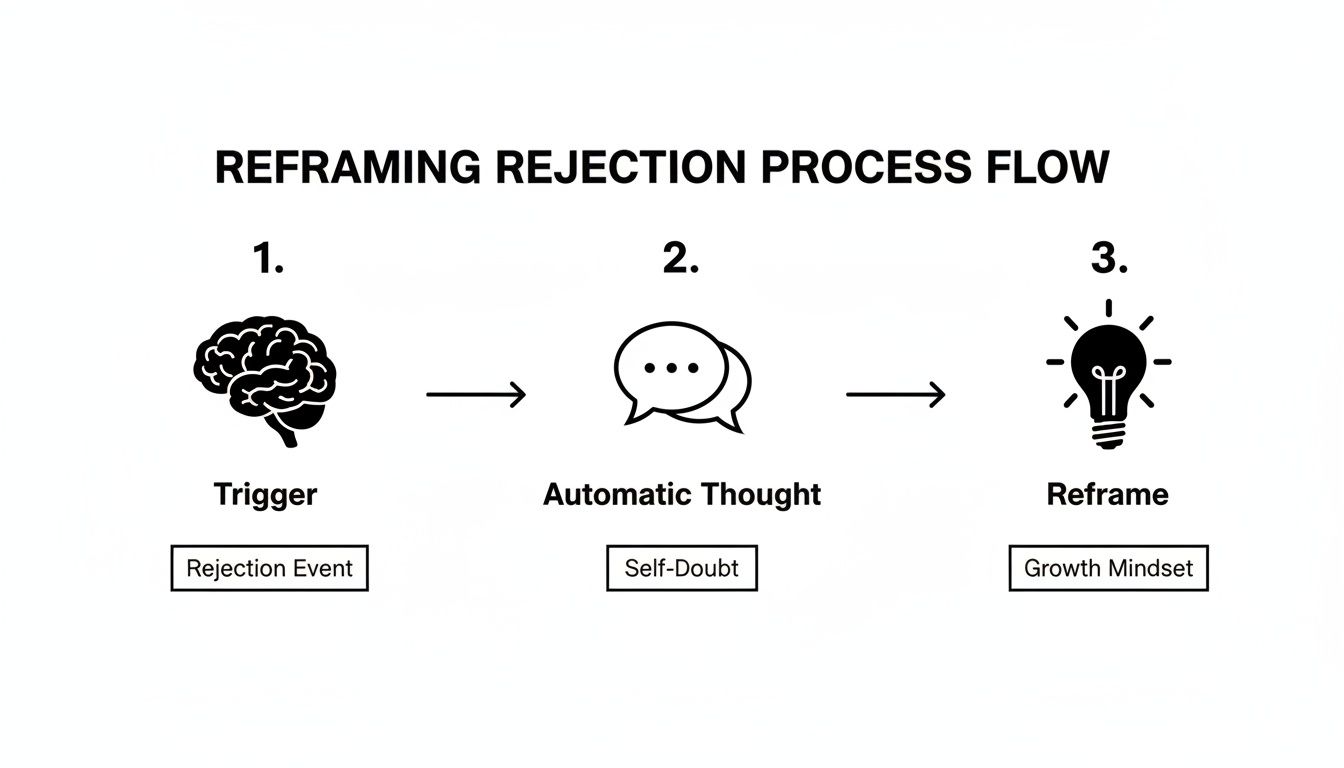
It’s all about catching that automatic negative thought and consciously swapping it for a more productive one.
Use AI as Your Personal Training Ground
Once you’ve got some small wins under your belt, you can move on to more complex scenarios in a completely safe space. This is where technology becomes an incredible ally in overcoming the fear of rejection. Luvr AI, for instance, can be your personal training ground for social interactions.
Instead of putting real-world social pressure on yourself, you can role-play with an AI character. You get to practice asking them out, navigating a potential "no," and sharpening your approach without an ounce of real-world anxiety. This turns the app from a simple chat tool into a powerful simulator for building real confidence.
It’s a space where you can experiment, fail, and try again until your new skills feel second nature. For more structured practice, you can explore different scenarios and guided interactions by checking out the Luvr AI Challenges. This perfectly bridges the gap between theory and action, giving you the experience you need before you take your new skills out into the real world.
Developing Your Social Toolkit and Scripts
One of the biggest reasons we fear rejection is that awful feeling of not knowing what to say. We've all been there—that paralyzing moment when you want to approach someone, but your mind just goes completely blank. A social toolkit, packed with a few flexible conversation starters and exit strategies, is the perfect antidote.
Having a few go-to lines in your back pocket isn’t about being robotic or fake. Think of it as a launchpad. It takes away that immense pressure to be brilliant and witty on the spot, freeing you up to actually focus on connecting with the person in front of you. The goal isn’t a rigid script, but a flexible framework you can pull out and adapt to just about any situation.
Crafting Your Conversation Starters
The secret to a great opener is to keep it simple, observational, and genuine. Forget the cheesy pickup lines you see in movies; they rarely work. Instead, just comment on your shared environment. It feels so much more natural and puts everyone at ease.
Here are a few real-world examples that actually work:
- At a Coffee Shop: "I can never decide what to get here. What's your go-to drink?" It’s easy, low-stakes, and invites a simple answer.
- At a Party or Social Event: "This is a great playlist. Do you happen to know who this artist is?" You're complimenting the host's taste and asking a simple question—a perfect, smooth entry.
- At a Bookstore or Park: "Oh, you're reading [Author's Name]. I've been meaning to read their stuff. Is it any good?" This shows you're paying attention and have a potential shared interest.
Your opening line doesn't need to be perfect. Its only job is to get the ball rolling. The real connection happens when you start listening and showing you're genuinely curious about them.
Once you’ve broken the ice, your goal is to keep the conversation from dying. The best way to do that is with open-ended questions. Instead of asking, "Do you like this place?" (which gets a simple yes or no), try something like, "What do you like most about this place?" It encourages a more detailed response and gives you more to build on.
Remember, being a great conversationalist is 80% listening and only 20% talking.
The Do's and Don'ts of a Great First Impression
Making a good impression is far less about what you say and much more about how you make the other person feel. It all comes down to projecting warmth, confidence, and genuine interest. This can feel tricky at first, but practicing in a no-pressure setting, like role-playing with an AI girlfriend chat, can help you build the confidence and muscle memory for the real world.
Here’s a quick guide to nail that first impression:
| The Do's | The Don'ts |
|---|---|
| Maintain open, relaxed body language | Cross your arms or stare at your phone |
| Ask thoughtful, open-ended questions | Dominate the entire conversation |
| Give genuine, specific compliments | Use generic or over-the-top pickup lines |
| Listen way more than you talk | Fire off questions like it's an interview |
And finally, always know how to make a graceful exit. You don’t need a complicated excuse. A simple, "Well, it was really nice chatting with you. I should get going, but I hope you have a great rest of your day," is all it takes. Leaving on a high note is always better than letting the conversation fizzle out into awkward silence.
How to Handle Setbacks and Build Momentum
Alright, so it happened. You put yourself out there, took a chance… and got a "no."
The knee-jerk reaction? Most of us want to retreat into a shell, endlessly replaying every tiny detail of what went wrong. We let that sting of rejection whisper all our worst fears back to us. But this moment isn't a final verdict on your worth. It's simply proof that you’re officially in the game.
Handling setbacks is probably the single most important skill you'll develop. True resilience isn’t about never feeling the pain of a "no." It's about getting better and faster at processing it, learning what you can from the experience, and moving forward with a clear head. It's about turning what feels like a roadblock into a stepping stone.

This is exactly how you build real, lasting momentum. Every rejection you navigate with grace makes the next attempt feel that much easier. You’re rewiring your brain to understand that you can survive the outcome, which starts to quiet those internal alarm bells that used to scream at you to play it safe.
Acknowledge, Analyze, and Act
When you face a rejection, fight the urge to either completely ignore the feeling or let it totally consume you. Instead, I want you to try a simple, three-part strategy to bounce back stronger and a little bit smarter. This is how you turn a painful moment into productive energy.
First, this isn’t about pretending it doesn’t hurt. Acknowledging the sting is a crucial first step. Brain scan studies have actually shown that the same regions of the brain that light up during physical pain also activate during social rejection. So yeah, your feelings are a completely normal human response.
"The key to building momentum is treating every 'no' as a data point, not a judgment. Each attempt provides valuable information that refines your approach for the next one."
Once you've let yourself feel that initial emotion, it’s time to shift gears into a more objective mindset.
Here’s a practical framework to follow:
- Acknowledge the Feeling (Without Judgment): Give yourself a few minutes to just sit with the disappointment. You can literally say to yourself, "Okay, that stings a bit," without piling on the self-criticism like, "I'm such an idiot for even trying."
- Analyze the Interaction (For Lessons): Now, ask yourself one simple, powerful question: "Is there one small thing I could try differently next time?" Maybe your ask wasn't clear, or maybe the timing was just off. Look for a single, actionable takeaway.
- Act (Plan Your Next Small Step): This is absolutely critical for regaining momentum. Immediately decide on your next low-stakes action. It could be as simple as planning to compliment a barista on their latte art tomorrow.
This process prevents you from getting stuck in that downward spiral of shame and blame. It reframes the whole experience from a "failure" into a valuable piece of field research that makes you better prepared for whatever comes next.
Use a Rejection Log to Track Your Courage
One of the most powerful tools I’ve seen for building this kind of resilience is a rejection log. I know, it sounds completely counterintuitive. Why would you want to keep a list of your "failures"?
Because you're not. You're keeping a record of your courage.
Each entry you make is a win because it represents an attempt. You are actively rewarding the action, not the outcome. A rejection log proves you're taking risks and pushing your own boundaries. After a few weeks, you'll look back and see not a history of rejection, but a clear, undeniable pattern of your own bravery and growth.
Your Path Forward: From Fear to Connection
So, where do you go from here? You’ve dug into the real reasons rejection stings so much, started untangling the automatic negative thoughts that kept you stuck, and even found some safe spaces to practice.
The goal was never to win every single social interaction—that’s impossible. The real win is developing the unshakable inner confidence that you can handle any outcome with your head held high.
Think of this as a turning point. You're now equipped with the mindset shifts, conversation starters, and training tools you need to stop letting fear call the shots. Every small risk you decide to take from here on out is a rep for your courage muscle.
Overcoming fear isn’t some grand, one-time event. It’s a quiet commitment to consistent action. Real confidence is built on the foundation of the small, brave steps you take every single day.
The road to meaningful connections starts with one manageable step. Don't fall into the trap of waiting for a lightning bolt of motivation to strike. It won't. Instead, just pick one small thing you can do today.
What's it going to be?
- Try a low-stakes challenge: Offer a genuine, specific compliment to a barista or cashier.
- Run a safe practice session: Hop into Luvr AI to role-play a conversation you've been avoiding.
- Keep the learning going: Explore new ways to build fulfilling companionship and social confidence.
The choice is yours, but the moment to act is right now. Your journey to becoming more fearless and connected begins with whatever you decide to do next.
Take that step.
You've Got Questions? We've Got Answers.
As you start working on this, it’s completely normal for a few questions to pop up. Let's tackle some of the most common ones I hear from people just starting this journey.
"Okay, But How Long Does This Actually Take?"
Look, there's no finish line or magic number here. It’s a process, not a race.
But with that said, if you’re putting in the work—challenging your thoughts daily, doing small exposure exercises a few times a week—you can expect to feel a real shift in your anxiety levels within a few months. Consistency is what moves the needle, not speed. It’s about building a new habit, one small win at a time.
"What If I Get a Really Bad Rejection and It Makes Me Want to Quit?"
This is probably the biggest fear, right? And it's a valid one. A big "no" can sting and make you want to retreat.
First, know that setbacks are going to happen. They are part of the process, not a sign you’ve failed. When it happens, the trick is to reframe it. Don’t see it as a failure; see it as a data point. What did you learn? Acknowledge the feeling, let it suck for a bit, and then—this is the important part—go take a smaller, easier step. Dial it back to a low-stakes challenge to get a quick win and rebuild your momentum.
A tough real-world interaction is the perfect time to use a tool like Luvr AI. It’s a safe space to get your confidence back, letting you reset and practice without any of the social pressure.
"Does Practicing with an AI Actually Work?"
Yes, and it's a game-changer. Think of it as a bridge between theory and the real world.
Practicing with an AI helps you build the "muscle memory" for conversations. You get to try out different phrases, see how they land, and get used to hearing "no" in an environment where the stakes are zero. It’s like a batting cage for social skills. This builds a solid foundation of confidence, so when you step up to the plate in a real situation, you’re not starting from scratch.
Ready to build that muscle memory in a totally safe, judgment-free zone? Start your journey with Luvr AI and turn practice into real-world confidence. Explore your first challenge today at https://www.luvr.ai.