


Create Your Own AI Girlfriend 😈
Chat with AI Luvr's today or make your own! Receive images, audio messages, and much more! 🔥
4.5 stars


Think of role-playing for communication skills as a dress rehearsal for life’s most important conversations. It’s not about acting or putting on a show. It's about practicing those high-stakes moments—like asking for a raise, navigating a tough client conversation, or giving critical feedback—in a controlled setting. This builds the mental muscle memory you need when the pressure is really on.
It's a hands-on way to try out different responses, get a feel for the flow of a conversation, and get feedback without any real-world risk.
Why Role-Playing Is a Communication Superpower

Most of us learn about communication by reading books or watching videos. That's all fine, but that kind of passive learning often evaporates the second we're in a stressful, real-world situation. Role-playing flips the script by focusing on experiential learning—the simple truth that we learn best by doing.
It’s a lot like a flight simulator for a pilot. They don’t just read the manual; they log hours practicing how to handle engine trouble and bad weather in a safe environment. When a real crisis hits, their training kicks in instinctively. That's exactly what role-playing does for your communication skills. It prepares your brain to manage the stress and unpredictability of a real conversation.
Building Communication Muscle Memory
Every single time you run through a role-play scenario, you're literally carving out new neural pathways in your brain. You’re not just reciting lines; you're internalizing what a successful interaction feels like from start to finish. It’s this repetition that builds muscle memory for social skills.
Eventually, this practice shifts your abilities from something you have to consciously think about to an automatic, natural response. The next time a client throws a curveball objection your way, you won't freeze up. You'll tap right into the tone and phrasing that felt right during your practice runs.
Here's the secret: The point of role-playing isn't to be perfect. It's to give yourself permission to be awkward, to experiment, and to fail in a place where it doesn't count. Every clumsy attempt is just another piece of data helping you get better.
A Safe Harbor for Experimentation
Let's be honest: one of the biggest things holding us back is the fear of saying the wrong thing. Role-playing completely removes that fear from the equation. It creates a judgment-free zone where you can test out different tactics without consequence.
Ever wanted to see what happens if you’re a bit more assertive? Or maybe you need to work on listening with more empathy? This is your lab. You can play around with different communication styles and figure out what actually works for you and feels authentic.
This is especially powerful when practicing with AI. The stakes are literally zero. You can create unique AI characters for role-playing to perfectly match who you need to practice with—from a skeptical boss to a brand new acquaintance—making sure every rehearsal is geared specifically to what you want to achieve.
Defining Your Goals for Effective Practice
Before you even think about starting a role-play, you have to know what you’re aiming for. Just jumping into random scenarios without a clear objective is like driving without a destination—sure, you're moving, but you're not actually getting anywhere. Building real communication skills with role-play starts with setting sharp, specific goals.
"I want to be a better communicator" is a nice thought, but it's far too vague to be useful. It gives you nothing to grab onto. A much more powerful goal sounds like this: "I want to confidently handle pricing objections from a skeptical client without getting defensive." See the difference? It’s specific, it’s actionable, and it gives you a clear finish line to cross.
Pinpoint Your Communication Gaps
First things first, take a hard look at recent conversations that went sideways. Where did you feel flustered, misunderstood, or like you just couldn't get your point across? Nailing down these specific moments is the secret to creating practice sessions that actually work.
Most communication struggles tend to fall into a few common buckets:
- Managing Conflict: Do you shy away from tough conversations? Or maybe you get a little too aggressive when someone challenges you? A solid goal here could be, "I will state my perspective calmly when a colleague disagrees with my project plan."
- Public Speaking Anxiety: Does the idea of presenting to a group make your heart pound? Try this objective: "I will deliver the first 2 minutes of my presentation without using filler words like 'um' or 'like'."
- Giving Effective Feedback: Do you find it hard to give constructive criticism without sounding like a jerk? Your goal might be, "I will provide actionable feedback to a team member using a supportive and clear tone."
When you break down a huge, fuzzy goal like "be better at feedback" into these smaller, bite-sized missions, the whole thing feels less intimidating. Every small win builds the momentum you need to keep going.
The real power of setting goals is that it forces you to become an active participant in your own growth. You're no longer just hoping to improve; you're building a specific roadmap to get there.
Create a Psychologically Safe Practice Space
Once you have your goals locked in, creating a safe practice environment is absolutely non-negotiable. This needs to be a space where you can experiment, make a mess, and learn from it without fear of judgment. Without psychological safety, you'll hold back, and that's the enemy of real progress.
Whether you're practicing with a friend, a coach, or an AI character on a platform like Luvr AI, lay down some ground rules.
- Make it a Judgment-Free Zone: Agree upfront that every attempt is just an experiment. The point isn't a flawless performance; it's honest effort.
- Use Clear Start and Stop Signals: Simple cues like "Okay, let's start the role-play" and "End scene" create a clean break between the exercise and reality.
- Focus on the Process, Not the Outcome: Remind yourself that the goal is to try new things, not to "win" the conversation. This shift in mindset is what turns practice into genuine skill-building.
Crafting Scenarios That Build Real-World Confidence
The secret to getting good at role-playing for communication skills? It all comes down to the quality of your scenarios. Throwing out a generic prompt like "practice a difficult conversation" just leads to vague, unhelpful run-throughs. If you want to build real confidence, you have to practice against challenges that feel just as complex, emotional, and unpredictable as the real thing.
Specificity is your best friend here. A thoughtfully designed scenario makes you wrestle with the little details that trip people up in real life. Instead of just a broad goal, you're stepping into a full-blown simulation with context, motivations, and roadblocks. This is how you build the mental agility to handle the pressure when it actually counts.
From Vague Ideas to Powerful Prompts
Let’s get practical. A weak scenario is flat and one-dimensional. A powerful one has layers that force you to think on your feet, listen carefully, and change your approach on the fly.
It’s a night-and-day difference:
- Weak Prompt: "Practice asking for a raise."
- Strong Prompt: "You need to ask your boss for a 10% raise. She’s notoriously budget-conscious and stressed about hitting Q4 targets. You have data showing you boosted team efficiency by 15%, but you know she’ll probably push back by mentioning the recent company-wide hiring freeze."
See the difference? The second prompt gives you a personality to navigate, a clear goal, solid evidence to present, and an obstacle you can anticipate. That's a scenario you can actually sink your teeth into. It’s no surprise that verbal communication skills are the top priority for 55% of global recruiters—after all, poor communication wastes time for 63% of employees. Building this kind of "muscle memory" through targeted practice is the perfect antidote. If you're interested in the data, you can explore the latest communication statistics here.
To help you get started, here are some adaptable blueprints you can use to design scenarios targeting specific communication challenges, whether at work or at home.
Role Play Scenario Blueprints for Key Communication Skills
| Skill to Develop | Professional Scenario Example | Personal Scenario Example |
|---|---|---|
| Negotiation | You're a project manager trying to secure a 20% budget increase from a skeptical finance director. The project is behind schedule but critical for a major client. | You and your partner are deciding on a vacation destination. You want an adventurous trip, but they prefer a relaxing beach holiday, and you have a limited budget. |
| Giving Feedback | You need to tell a talented but consistently late team member that their tardiness is impacting team morale and project timelines, without demotivating them. | You need to talk to a close friend about a habit they have that makes you uncomfortable, but you're worried about hurting their feelings and damaging the friendship. |
| Conflict Resolution | Two of your direct reports are clashing over creative differences on a key project, and it's causing delays. You need to mediate a conversation to find a path forward. | You and a sibling disagree on how to care for an aging parent. Tensions are high, and you need to find a compromise that prioritizes your parent's well-being. |
| Setting Boundaries | A colleague repeatedly asks you to help with their work, causing you to fall behind on your own tasks. You need to politely but firmly say no. | A family member often makes last-minute demands on your time. You need to set a clear boundary about your availability without causing a major family conflict. |
These are just starting points, of course. The real magic happens when you customize them with details from your own life to make the practice as realistic as possible.
Adding Unpredictable Twists
Let's be honest, real conversations rarely stick to the script. People get emotional, go off on tangents, or react in ways you could never have predicted. Your practice scenarios should do the same thing. Including a "wild card" or an unexpected twist is what truly prepares you to pivot.
Think about that raise scenario. What if, mid-conversation, your boss gets an urgent, stressful phone call? Or what if she agrees almost immediately, making you wonder if there’s a catch? Adding these variables trains your brain to stay present and responsive—the true hallmark of a great communicator.
A great role-play scenario shouldn't feel like a test you can pass or fail. It should feel like a sandbox where you can explore different paths and see what happens, all without real-world consequences.
This is where practicing with an AI partner is a game-changer. You can whip up and tweak prompts in seconds, without needing to find a willing human for every single practice run. You could start with a basic conflict and then ask the AI to throw in new challenges as you go. Better yet, you can build a custom scenario from scratch to perfectly mirror the exact situation you're facing, getting hyper-targeted practice that sharpens your skills with surgical precision.
How to Give and Receive Feedback That Actually Drives Growth
If you practice without getting feedback, you're just rehearsing—not learning. The real magic happens after the role-play. The debrief is where you connect the dots, find those "aha!" moments, and figure out exactly what to do differently next time. Honestly, it’s probably more important than the scenario itself.
We have to move beyond vague comments like "good job." The aim is to get specific and actionable feedback that doesn't put people on the defensive. When you create a tight, psychologically safe feedback loop, you unlock the true power of using role-playing for communication skills. Every session builds on the last, leading to real, measurable improvement.
And this isn't just a "nice-to-have." In today's world, nine out of ten executives believe soft skills like collaboration and leadership are more critical than ever before. As workplaces change, skills like social influence and resilience are what set people apart. You can learn more about the rising importance of human skills in the workplace. Role-playing gives you a direct path to building them in a controlled environment.
A Simple Framework for Better Feedback: Observe-Impact-Suggest
I’ve found that one of the best ways to structure feedback is the Observe-Impact-Suggest model. It’s a game-changer because it keeps the conversation objective and focused on the future, which helps strip out the emotion and defensiveness that can kill a learning moment.
Here’s how it works:
- Observe: Stick to the facts. Start with a neutral observation. "I noticed when the client brought up their budget, you immediately started listing product features."
- Impact: Explain the consequence of that action. "Because of that, we didn't get a chance to really understand their budget issues first. It made our solution feel a little disconnected from their core problem."
- Suggest: Offer a concrete alternative for the future. "Next time, maybe try asking, 'Could you walk me through your budget constraints?' That would show you're listening and help us shape the pitch to their reality."
This simple structure turns what could feel like criticism into genuine coaching. It feels supportive, not judgmental.
The point of feedback isn’t to catalogue what went 'wrong.' It’s to light up a different path that could lead to a better result next time.
The Art of Looking in the Mirror: Self-Reflection
The person giving the feedback isn't the only one with homework. Learning to analyze your own performance is where deep growth happens. As soon as the role-play ends, take a quiet moment to process it yourself before anyone else chimes in.
A good feedback session always starts with a good scenario. This simple process below is key—it creates the foundation for a meaningful debrief later.
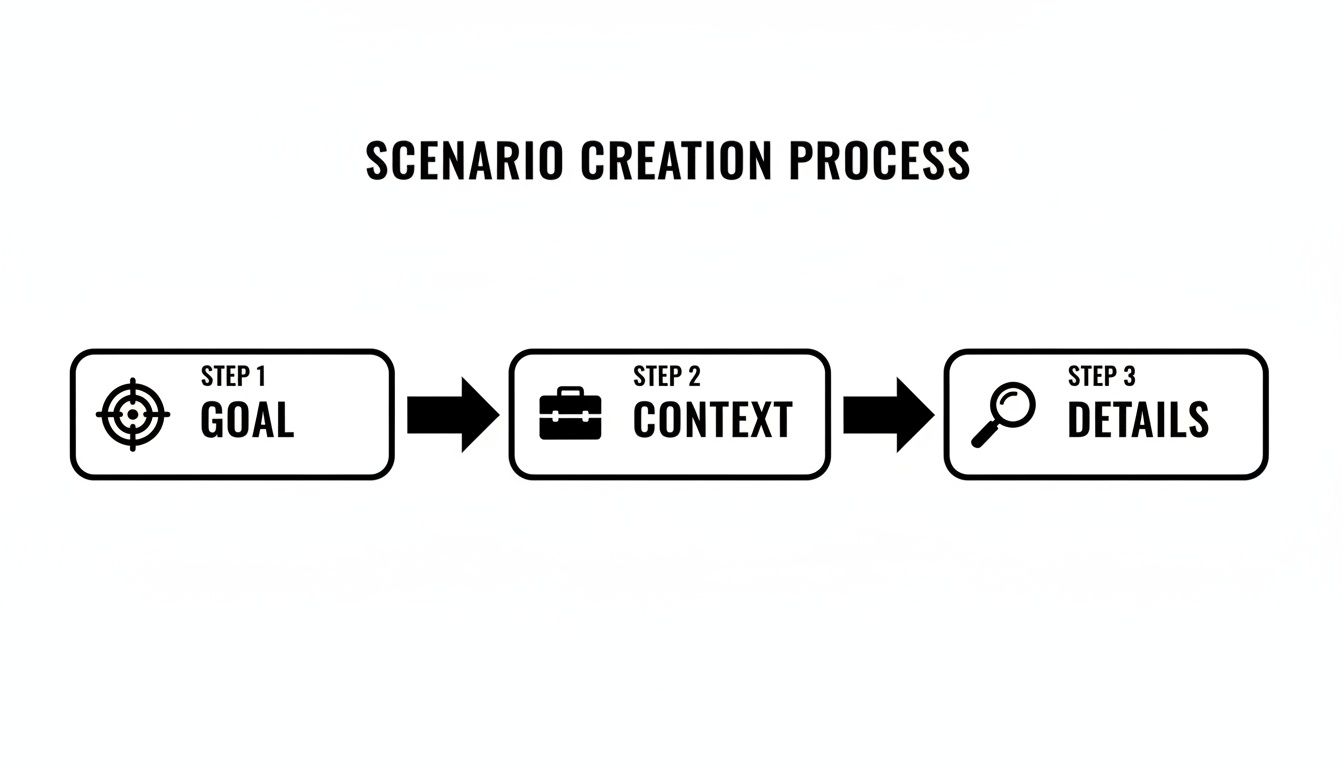
When you start with a clear goal and flesh it out with context and details, you have a clear target to measure your performance against.
After your next role-play, ask yourself these three questions:
- When did I feel most in control or confident? What was happening at that moment?
- Where did I get flustered or uncertain? What specifically triggered that feeling?
- Did I hit the goal I set for this conversation? If not, what was the single biggest thing that got in my way?
Answering these honestly gives you the raw material you need to improve. It helps you pinpoint exactly what to work on in your next practice session.
Your 24/7 Communication Coach: Practicing with AI

Let’s be honest—finding a willing practice partner is often the biggest hurdle in communication training. Schedules clash, friends aren't always in the mood, and the fear of judgment can be paralyzing.
This is where AI steps in as a game-changer. It’s your tireless, non-judgmental partner, ready to go whenever you are, day or night.
The real magic is in the freedom to repeat. Stumbled through a tough negotiation scenario? With a person, asking for a do-over can feel awkward. With an AI, you can run that same scene a hundred times at 3 AM if you want, fine-tuning your words until they feel natural and confident.
Crafting Your Perfect Practice Partner
The true power of AI role-play comes from its incredible adaptability. You're in the director's chair, able to mold the AI into any personality you need for a specific challenge. This isn't about aimless chatting; it's about building custom conversational workouts.
You can feed the AI simple prompts to create remarkably realistic situations:
- Practice with a Demanding Boss: "You are my boss, Mark. You're stressed about deadlines and skeptical of new ideas. I'm about to pitch a new project. I need you to push back hard on my budget and timeline."
- Rehearse with an Undecided Customer: "You're a potential customer who likes our product but is worried about the price. Be polite but hesitant. Your goal is to see if I can demonstrate the value without coming off as pushy."
Using AI creates a safe sandbox for social skills. You can explore difficult conversations without real-world consequences, turning every mistake into a lesson for growth.
This kind of targeted practice isn't just a nice-to-have; it's essential. The 2025 workplace statistics show that a staggering 81% of global recruiters now consider cross-cultural competence a critical communication skill. What’s more, companies with effective internal communication—which often involves role-play training—are 3.5 times more likely to outperform their peers. You can find more data on how communication impacts business performance.
Putting the AI Advantage into Action
The key is to think of AI not just as a sparring partner but as a precision tool for building specific skills. Platforms like Luvr AI are built for this, giving you the ability to create custom characters and scenarios from scratch.
By exploring different AI character chat features, you can design the exact conversational dynamic you need, whether you're prepping for a job interview, a big client pitch, or a sensitive personal talk.
Ultimately, AI offers a patient, private, and incredibly powerful way to rehearse. It ensures you walk into the real conversation feeling practiced, prepared, and ready for whatever comes your way.
Got Questions About Using Role-Play? You're Not Alone.
Jumping into role-play to sharpen your communication skills can feel a little weird at first. It’s an incredibly effective technique, but let's be honest—it’s not exactly a typical Tuesday afternoon activity for most people. Getting past those initial hurdles is the secret to unlocking its real power.
Here are some of the most common questions that come up and how to think about them.
"I Feel So Awkward Doing This. How Do I Get Over It?"
Feeling self-conscious is hands-down the biggest roadblock, but it's totally normal. The key is to start somewhere safe, where there’s no pressure to be perfect.
This is where practicing with an AI partner really shines. There's zero judgment. You can stumble over your words, try out a ridiculous opening line, or completely blank on what to say, and it doesn't matter one bit. You can also start with a trusted friend who's in on your goal.
Pro Tip: Create a clear on/off switch. Saying "Let's start the role-play now" and "Okay, end of role-play" creates a mental boundary. It frames the interaction as a structured exercise, not a cringey improv scene. The more you do it, the less strange it feels.
"How Do I Know If I'm Actually Getting Better?"
Tracking progress with something as nuanced as communication isn't like checking a test score, but you can absolutely see your growth if you're intentional about it. It’s about mixing self-reflection with clear goals.
After each practice session, jot down your answers to two simple questions:
- What felt easier or more natural this time?
- What was still a bit of a struggle?
If you're comfortable with it, record your sessions (even just audio) and listen back. You'll be amazed at what you notice about your own tone, word choice, and pacing. But the best way to see real progress is to define what "success" looks like before you even start. Maybe your goal is to state your main point without using "um" or "like." Or perhaps it’s to successfully navigate an interruption without getting flustered. Tracking how often you hit those specific targets gives you cold, hard proof that you're improving.
"Should I Practice With an AI or a Real Person?"
That’s a great question, and the answer isn't one or the other—it's both. Each offers a unique advantage for honing your role-playing communication skills.
A human partner gives you something an AI can't: genuine, unpredictable human emotion. They provide immediate feedback, react in unexpected ways, and can comment on the subtle non-verbal cues you might be sending. This is invaluable for building real-world adaptability.
On the other hand, an AI partner like Luvr AI offers 24/7 availability and endless patience. It's a completely judgment-free sandbox where you can rehearse a tough conversation 50 times in a row if you want. It's perfect for drilling the basics and building that core confidence without feeling like you're bugging someone.
The best approach? Use them together. Build your foundation and experiment with phrasing in the safe space of AI. Then, take those polished skills and test them in the dynamic, nuanced world of human interaction.
"What Are the Biggest Mistakes People Make When Role-Playing?"
The most common pitfall is diving in without a clear, specific goal. Just "practicing a tough conversation" is too vague. This leads to aimless chats that don't build specific skills. Another huge mistake is skipping the debrief. The feedback and reflection after the scenario is where the learning really cements itself.
People also tend to break character the second things get a little awkward, which kills the realism and ruins the practice. And finally, a big one: trying to be perfect. The whole point of role-play is to mess up in a safe environment so you don't do it when the stakes are high. Embrace the clumsy attempts—they’re just data for your next round.
Ready to build unstoppable confidence in any conversation? With Luvr AI, you can create custom characters and scenarios to practice any interaction, anytime. Start your free trial today and discover your 24/7 communication coach at https://www.luvr.ai.