


Create Your Own AI Girlfriend 😈
Chat with AI Luvr's today or make your own! Receive images, audio messages, and much more! 🔥
4.5 stars


Subscription pricing is all about how you charge customers on a recurring basis. The most common flavors you'll see are tiered pricing (offering different packages at set prices), usage-based pricing (charging for what you use), and hybrid models that mix a little bit of both.
Choosing Your Foundational Pricing Strategy
Nailing your subscription pricing strategy is probably the single most important decision you'll make for your business. This isn't just about picking a number; it's the engine that powers everything—predictable revenue, customer loyalty, and sustainable growth.
Get this right, and you create a brilliant, frictionless path for users to see the value in what you offer and for your company to scale. Get it wrong, and you'll confuse your customers, leave a ton of money on the table, and kill your momentum before you've even had a chance to get started.
Think of it like building the foundation of a house. You wouldn't pour a tiny concrete slab meant for a shed if you plan on building a mansion. In the same way, the pricing model you choose has to support the unique value of your product and where you want to take your company.
The Core Pricing Models Explained
At the end of the day, your decision really boils down to how you want to connect your price to the value a customer gets. There are three core models that nearly every subscription business, including an AI companion service like Luvr AI, will build upon. Each one speaks to different customer habits and business goals.
Let's break them down with a simple restaurant analogy to make it stick:
Tiered Pricing (The Set Menu): This is the one you see everywhere. You offer a few distinct packages (your tiers) at fixed prices, with each tier unlocking more features or higher limits. It's just like a restaurant offering a three-course meal for one price—everyone knows exactly what they’re getting and what it costs. It's simple, predictable, and fantastic for segmenting your audience.
Usage-Based Pricing (The À La Carte Menu): With this model, customers only pay for what they actually use. This could be per message sent, per hour of conversation, or per API call. Just like ordering individual dishes from an à la carte menu, the final bill perfectly reflects what was consumed. Customers often see this as the fairest model, and it's a great way to make sure your heaviest users pay their fair share.
Hybrid Pricing (The Combo Meal): This approach gives you the best of both worlds, blending the predictability of tiers with the flexibility of usage. A classic example is a base subscription fee that includes a certain allowance, with extra charges if a customer goes over that limit. It’s like getting a combo meal with a burger and fries, but with the option to add extra bacon for a small fee.
Why This Choice Is So Critical for Luvr AI
For an immersive, conversational platform like Luvr AI, this foundational choice shapes the entire user experience. Should a user pay one flat fee for unlimited access to every AI companion and all the features? That’s the tiered approach—super simple and straightforward.
Or, maybe they should pay based on how much they interact. A small fee per message, perhaps, or a token system for unlocking premium role-play scenarios. That’s the usage-based model, which ensures that casual users don't feel overcharged while power users contribute in proportion to the server resources they use.
The best subscription pricing strategies create a win-win: The customer feels the price is fair for the value they’re getting, and the business builds a sustainable revenue stream that grows right alongside its user base.
Ultimately, this decision is about more than just revenue; it's about psychology, how users perceive value, and the kind of long-term relationship you want to build with them. Getting a firm grip on the pros and cons of each foundational strategy is the first and most critical step. From here, we can start to build a pricing structure that truly fuels your growth.
How Tiered Pricing Helps You Serve Everyone (and Grow Faster)
Tiered pricing isn't just a list of prices; it's one of the smartest ways to segment your market and meet different users exactly where they are. Think of it like buying a ticket to a concert. Some fans are perfectly happy with a general admission spot, while others will gladly pay more for a closer seat. Then there are the die-hards who will jump at the chance for a VIP backstage pass.
Each ticket serves a different kind of fan, and each price captures the maximum value that specific group is willing to pay. This is how you cater to a massive audience without leaving money on the table. For Luvr AI, it means you can attract casual users looking for simple companionship, dedicated creators eager to build unique AI personas, and power users who want the most immersive, all-access experience possible. The trick is to design your tiers so they feel like a natural ladder of value.
Creating a Clear and Tempting Upgrade Path
The real genius of tiered pricing comes from creating clear "feature gates"—the specific features or usage limits that define what you get at each level. A great feature gate makes the next tier up feel like a necessary and exciting upgrade, not just a random price hike.
For Luvr AI, a logical path could look like this:
- Basic Tier: Gives users access to a curated library of standard AI companions for everyday chats.
- Creator Tier: Unlocks the ability to design and share your own custom AI personas, a huge draw for creative users.
- VIP Tier: Grants unlimited access to everything, including advanced and explicit NSFW role-play, for your most engaged and dedicated fans.
Each step up the ladder offers a powerful reason to upgrade, gently guiding users from casual curiosity to deep investment in the platform. This structure naturally sorts your audience by their needs and what they're willing to spend, maximizing your revenue from each group. You want every user to feel like their tier is a perfect fit, while always dangling an enticing reason to see what the next level offers.
This decision tree gives you a bird's-eye view of how tiered pricing fits within the broader world of subscription models.
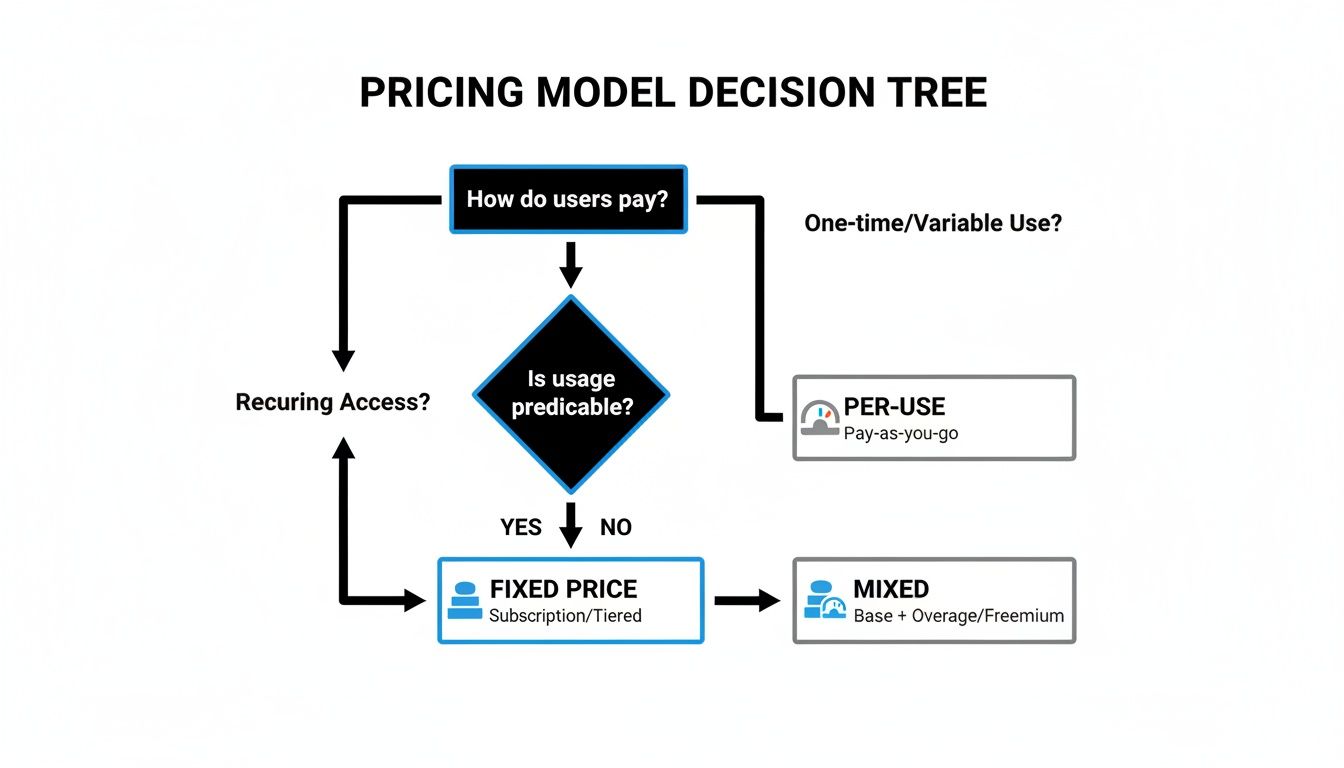
It breaks down different payment structures, showing whether a fixed-price tier, a pay-per-use model, or a hybrid approach makes the most sense.
What We Can Learn from the Big Players
You don't have to reinvent the wheel; some of the biggest names in the subscription world have already perfected this. Just look at Netflix. In January 2022, they bumped their prices, with the basic plan rising to $9.99, standard to $15.49, and premium to $19.99. That could have been a disaster, but their revenue actually jumped. Why? Because the value of each tier was crystal clear—better streaming quality, more screens, etc.
Platforms like Luvr AI can absolutely follow that playbook. By offering obvious value distinctions—like a basic tier for standard chats, a creator tier for building custom AIs, and a premium tier for uncensored NSFW content—you're using a proven strategy. In fact, research shows that offering plan customization has a 26% adoption rate, which can translate into millions in extra revenue. To see how we’ve applied these ideas, feel free to explore the options on our Luvr AI subscription page.
To help visualize this, here’s a sample tiered structure we could implement for Luvr AI. This table shows how features can be strategically distributed across different plans to create clear value for each user segment.
Example Luvr AI Tiered Pricing Structure
| Feature | Free Trial | Basic Tier ($9.99/mo) | Creator Tier ($19.99/mo) | VIP Tier ($29.99/mo) |
|---|---|---|---|---|
| Daily Message Limit | 50 messages | 500 messages | Unlimited | Unlimited |
| Access to Standard AIs | Limited selection | Full library | Full library | Full library |
| Custom AI Persona Creation | No | No | Yes (up to 5 personas) | Yes (unlimited personas) |
| Advanced AI Memory | Basic | Standard | Enhanced | God-mode |
| NSFW/Explicit Content | No | No | Limited | Unrestricted |
| Priority Support | No | No | Yes | Yes |
This kind of clear, logical progression makes the decision to upgrade feel like a natural next step for the user, rather than a hard sell from us.
By clearly defining the value at each level, you empower customers to self-select into the tier that best meets their needs. This not only increases Average Revenue Per User (ARPU) but also improves customer satisfaction and long-term retention.
At the end of the day, a well-designed tiered model isn't about locking features away. It's about creating a clear and logical journey for your users. It lets you welcome a huge range of people at an easy entry point while building a scalable path for them to grow right alongside your product. This is how you turn curious free-trial users into loyal, high-value subscribers who feel like you get them every step of the way.
Using Flexible Pricing to Beat Subscription Fatigue
Let's be honest: customers are getting sick of paying for subscriptions they barely use. We’ve all been there. This feeling has a name—subscription fatigue—and it's one of the biggest reasons people cancel. A fixed monthly fee can feel like a raw deal for someone who only logs in a few times. They start wondering if it’s worth it, and before you know it, they've churned.
This is where flexible pricing models come in as your secret weapon. When you tie the price directly to how much someone actually uses your service, you completely change the conversation. It’s no longer a one-size-fits-all charge. Instead, you're offering something that feels fair and transparent, building a level of trust that can make a huge difference in customer loyalty.

This isn't just a niche preference; it's a massive shift in how people want to pay for services. A recent survey found that a whopping 78% of customers would use more services if they only had to pay for what they consume. And get this: 67% admitted to canceling subscriptions simply because they weren't using them enough.
For a platform like Luvr AI, a hybrid model could be the perfect solution. Imagine a base tier with pay-as-you-go tokens for those extra-long, immersive role-play sessions. This directly tackles that fatigue head-on. You can even let people experience this value first-hand with a free day trial on Luvr.ai.
Implementing Usage-Based and Hybrid Models
Moving away from simple, flat-rate tiers means you have to think a little differently. You're not just selling access anymore; you're selling units of value. For Luvr AI, that value can be measured in a few creative ways:
- Pay-Per-Message: Simple and effective. After a free daily limit, users pay a tiny amount for each extra message. It’s directly tied to their engagement.
- Token Packs: This gamifies the experience. Users buy bundles of "tokens" to unlock premium features, like creating a custom AI personality or kicking off a unique role-play scenario. It puts them in control of their spending.
- Hybrid Tiers: This is often the sweet spot. Offer a base subscription with a healthy number of messages or tokens included, but give users the option to buy more if they run out. You get predictable revenue while still offering flexibility.
This kind of strategy is a fantastic way to monetize your power users. Casual folks can stick around at a low cost, while your most passionate fans have a clear path to get more of what they love, happily paying for the premium experience they're actually consuming.
When you align price with consumption, you shift the relationship from a simple transaction to a fair value exchange. This builds incredible goodwill and makes your service feel essential to your most active users.
Preventing Bill Shock and Building Trust
The single biggest danger with any usage-based model is "bill shock." It’s that awful moment when a customer sees an invoice that’s way higher than they expected. It destroys trust in an instant and is a fast track to cancellation. To keep that from happening, total transparency and user control are non-negotiable.
Here are the guardrails you absolutely must have in place:
- Transparent Usage Dashboards: Give users a simple, clear dashboard where they can see their consumption in real-time. No one should ever have to guess how close they are to a limit.
- Spending Caps and Alerts: Let users set their own monthly spending caps. As they get close, send a friendly notification. This puts them in the driver's seat and removes any anxiety.
- Clear Overages: If you're using a hybrid model, be crystal clear about what it costs to go over the included allowance. No fine print, no hidden fees. Ever.
The data backs this up completely. Recent studies show an 11% drop in sign-ups for services with confusing or opaque pricing. On the flip side, platforms that clearly show their value can see incredible conversion rates. By giving your customers control and clarity, you're not just picking a pricing model—you're building a long-term, trusting relationship that will keep them coming back for more.
The Art of Pricing Psychology and Positioning
The number on your price tag is only half the story. The way you present that number can make all the difference, and this is where a little human psychology comes into play. We're not talking about manipulation or cheap tricks. This is about framing your offer so a potential customer immediately grasps the value they're getting.
For a service like Luvr AI, you have to remember what you’re really selling. It's not just API calls or access to a model. You're selling an experience: immersive role-play, the creative thrill of building a unique companion, and a private world for fantasy. Your pricing page needs to sell that dream, not just list a set of features.
Anchoring Expectations to Highlight Value
One of the most powerful psychological tools at your disposal is price anchoring. It’s simple: the first price someone sees sets a mental benchmark—an "anchor"—that colors their perception of every other price they encounter.
Think about it for Luvr AI. If the first thing a user sees on your pricing page is a premium “VIP Tier” for $49.99/month, you’ve just anchored their expectations high. Even if almost no one buys it, that price is now stuck in their head. So, when they scroll down and see the “Creator Tier” at $19.99/month, it doesn’t just look like a twenty-dollar expense. It feels like a fantastic deal. You’ve reframed the entire decision in your favor just by ordering the plans strategically.
Guiding Choices with Smart Design
Beyond anchoring, you can gently nudge users toward your most popular or profitable plan. These aren't dark patterns; they're ways to make the decision-making process feel easier and more logical for the customer.
The Decoy Effect: This is a fascinating one. You introduce a third, slightly less appealing option specifically to make your target plan look like a no-brainer. Imagine Luvr AI offers a Basic Tier ($9.99 for 500 messages) and your ideal Creator Tier ($19.99 for unlimited messages and persona creation). Now, add a decoy: a "Plus" Tier at $17.99 for 2,000 messages but no persona creation. Suddenly, the Creator Tier's "unlimited everything for just $2 more" value proposition becomes impossible to ignore.
Charm Pricing: We’ve all seen this—ending prices in .99. It might feel a bit old-school, but it works for a reason. Our brains are wired to read from left to right, so we process $19.99 as being significantly cheaper than $20.00, even though it’s just a penny. That first digit, the "1", anchors our perception in the "teens," making the price feel lower.
The goal here isn't to be tricky, but to provide clarity. When you structure choices this way, you're actually helping users quickly spot the best value for what they want, which reduces their hesitation and boosts their confidence to hit that subscribe button.
Designing a Frictionless Checkout Experience
You can have the most brilliantly positioned pricing page in the world, but if your checkout process is clunky, confusing, or feels sketchy, you’ll lose the sale. Every single field a user has to fill out is another chance for them to second-guess their decision and leave. Cart abandonment is the silent killer of online conversions, and it's often caused by surprise fees, long forms, or a lack of trust.
Your mission is to turn a hesitant visitor into a confident buyer by making the final step seamless. Be completely transparent about costs. Only ask for the information you absolutely need. Most importantly, display trust signals loud and clear—security badges, privacy policy links, maybe even a customer testimonial. For a platform like Luvr AI, where the entire experience is built on privacy and trust, this is non-negotiable. The checkout needs to feel as safe and private as the service itself, removing any final barriers standing between you and a new subscriber.
How to Measure and Optimize Your Pricing Strategy
Let's get one thing straight: your pricing strategy isn't something you carve in stone. You don’t just pick a number, launch, and hope for the best. That’s a recipe for leaving money on the table, or worse, going out of business.
Think of it more like tuning a high-performance engine. You wouldn't just set it and forget it. You’d be constantly monitoring the gauges—speed, fuel efficiency, temperature—and making tiny adjustments to squeeze out every last drop of performance. Pricing works the same way. The real growth comes from continuously measuring, learning, and tweaking.

The Three Core Metrics of Subscription Health
To know if your pricing is actually working, you have to look beyond the surface-level revenue figures. The true health of your subscription model really comes down to the relationship between three critical metrics.
Customer Lifetime Value (LTV): This is the big one. It’s the total revenue you can realistically expect to earn from a single customer over their entire time with you. A high LTV is a fantastic sign that people are sticking around because they see real, continuous value in what you offer.
Customer Acquisition Cost (CAC): This tells you exactly what you’re spending, on average, to get a new paying customer in the door. It rolls up all your marketing and sales costs into one simple number. The name of the game is to keep this as low as you can without kneecapping your growth.
Churn Rate: This is the percentage of subscribers who hit the cancel button in a given period. High churn is the ultimate red flag—it screams that there's a disconnect between the price and the perceived value. Digging into why people leave is non-negotiable. You can see how we handle this openly in our Luvr AI cancellation policy.
Now, here’s the key: these metrics don't live on separate islands. They tell a story together. The magic formula for a sustainable business is making sure your LTV is significantly higher than your CAC. The gold standard is an LTV/CAC ratio of 3:1 or better. That’s when you know you have a model that’s not just working, but ready to scale.
Running Pricing Experiments the Smart Way
Once you’re tracking your core metrics, it’s time to start experimenting. This isn't about throwing spaghetti at the wall to see what sticks. It's about forming a smart hypothesis, testing it with a small slice of your audience, and letting the data tell you what to do next. It takes the guesswork and emotion out of the equation.
The go-to method for this is A/B testing. In simple terms, you show two different versions of your pricing page to two similar groups of people and see which one converts better.
A/B testing isn't just a hunt for a "winning" price. It's a masterclass in understanding what your customers truly value. Every single test, whether it wins or loses, hands you a valuable piece of the puzzle about their motivations.
Ready to get started? Here are a few simple experiments you can run right away:
- Test Different Price Points: Is the Creator Tier more compelling at $19.99 or $24.99? Run a test and see how it impacts not just sign-ups, but LTV down the road.
- Adjust Feature Bundles: What happens if you move a fan-favorite feature from a premium tier to a lower one? Does it drive a flood of upgrades, or does it accidentally devalue your top-tier plan? Only one way to find out.
- Experiment with Annual Discounts: Try offering a juicy discount—like two months free—for customers who commit to a full year. This can be a game-changer for your cash flow and is a proven way to lock in customers and slash your churn rate.
By treating your pricing as a living, breathing part of your product, you create a powerful feedback loop. This cycle of testing and learning is what ensures your pricing stays competitive, profitable, and perfectly in sync with the value you deliver.
Your Actionable Roadmap to Better Pricing
Alright, let's turn all this theory into real-world results. Getting your pricing right isn't a "set it and forget it" task. Think of it as a living process—a constant conversation between you, your customers, and your data. This roadmap will help you move from where you are now to a smarter, more profitable pricing model that just clicks with your users.
For a platform like Luvr AI, this means building a culture of experimentation. It’s about ditching guesswork and letting actual user behavior guide your decisions. This is how you build a subscription business that doesn’t just get by but genuinely thrives because it’s perfectly aligned with what people actually want and value.
Step 1: Audit Your Current Model
Before you can build something better, you have to get brutally honest about what you have right now. This audit is your deep dive into the data to see what’s working, what’s falling flat, and why. Don't just glance at the top-line revenue; you need to slice and dice it by customer segment and pricing tier to uncover the real story.
Here’s where you should focus your flashlight:
- Segment Profitability: Who are your rockstars? Pinpoint which customer groups are the most profitable and figure out what your highest LTV users have in common.
- Feature Adoption: Are you offering premium features that are gathering dust? This is a huge red flag. It could mean they’re buried in the wrong tier or that users just don't care about them as much as you thought.
- Churn Triggers: When are people hitting the "cancel" button? Is it right after a price hike, at a specific point in their billing cycle, or maybe when they bump up against a usage cap? Find the pattern.
Step 2: Redefine Your Customer Segments
Armed with fresh data from your audit, it's time to rethink your customer personas. The assumptions you made about who uses Luvr AI when you first launched might be completely off by now. You’re looking for distinct behavioral clusters that can become the foundation for new, hyper-relevant pricing tiers.
The most successful subscription pricing strategies are built on a deep, almost obsessive, understanding of customer segments. When you know who you're selling to, you can craft offers that feel tailor-made.
Step 3: Design and Test New Tiers
This is where the fun begins. It's time to design your first pricing experiment. Based on your newly defined segments, form a clear hypothesis. For example: "We believe a new 'Creator' tier with unlimited custom persona slots will increase ARPU by 15% without alienating our core user base."
Now, launch an A/B test. Don't roll it out to everyone—just a small, controlled percentage of new visitors. You'll need to meticulously track conversions, how users engage in their first few sessions, and any early churn signals for each pricing variation. Your goal here is simple: gather enough hard data to prove your new strategy works in the real world, not just on a whiteboard. This continuous feedback loop is what will fuel your growth from here on out.
Your Top Pricing Questions, Answered
Let's be honest, pricing can feel like a bit of a dark art. You're not alone if you've got questions swirling around. I've pulled together the most common questions I hear from founders and product managers to give you some straight answers.
What’s the “Best” Subscription Pricing Model?
I get this one all the time, and the truth is, there’s no magic bullet. The "best" model is the one that fits your product and your customers like a glove.
If you have a straightforward, one-size-fits-all product, flat-rate pricing is beautifully simple. But for a nuanced platform like Luvr AI, where you have different types of users with different needs, tiered pricing is almost always the way to go.
And when value is directly tied to how much someone uses your service—which is definitely the case for an AI chat platform—a usage-based or hybrid model can be a real winner. The golden rule is simple: your price should feel like a fair exchange for the value you're delivering.
How Often Should I Revisit My Prices?
Pricing is not a "set it and forget it" task. Think of it more like tuning an instrument. You should be taking a hard look at your pricing strategy at least every six to twelve months.
Now, that doesn't mean you have to jack up prices every year. It just means you need to be constantly asking, "Does our pricing still make sense for the value we're providing?"
A smart way to do this is by running small A/B tests on new cohorts of users. This gives you fresh data on what the market will bear without upsetting your loyal, existing customers. It keeps you sharp and aligned with reality.
The best pricing strategies are living, breathing things. Treat your pricing like you treat your product—something you constantly test, listen to feedback on, and iterate to make it better for everyone.
How Do I Announce a Price Increase Without a Customer Revolt?
Ah, the million-dollar question. The key here is to over-communicate and be radically transparent. When you have to raise prices, get out ahead of it and tell people why. Frame it around the new features, better performance, and all the value you’ve added since they first signed up.
One of the most effective tactics I've seen is rewarding loyalty. Give your existing customers a generous window to lock in their old rate for another six months or even a full year. It shows you value their business, softens the impact, and can dramatically cut down on churn.
Ready to see what a thoughtfully designed AI companion experience feels like? Dive into immersive role-play and build the AI character you've always imagined with Luvr AI. Find the perfect plan for you at https://www.luvr.ai.