


Create Your Own AI Girlfriend 😈
Chat with AI Luvr's today or make your own! Receive images, audio messages, and much more! 🔥
4.5 stars


Ever dreamed of getting life advice from Gojo Satoru or challenging Light Yagami to a battle of wits? It’s not just fanfiction anymore. Thanks to some seriously cool AI, you can actually have conversations with your favorite anime characters, and I'm here to show you exactly how.
This isn't just about watching your favorite show—it's about stepping into the world and making it your own. I'll walk you through the best platforms out there, so you can go from reading this guide to having your first chat in minutes.
The whole process is surprisingly simple.
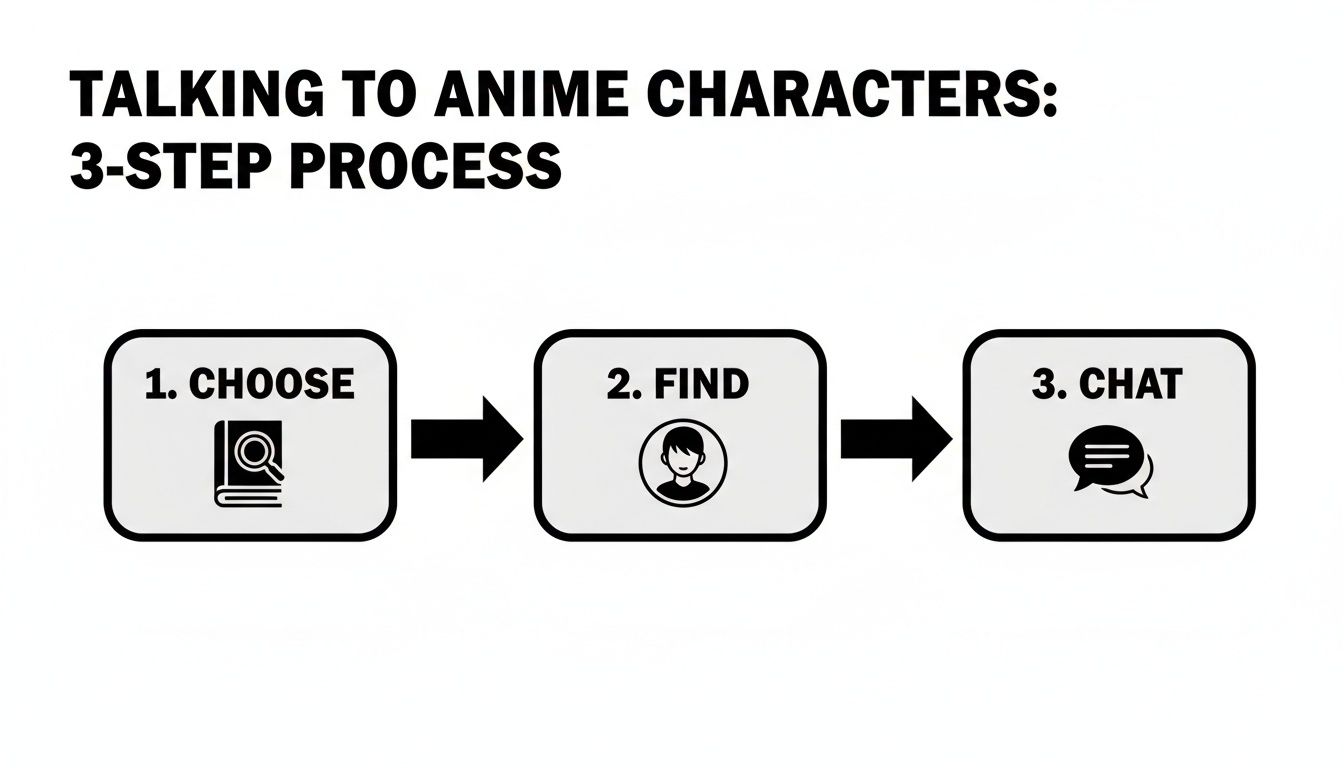
You just need to pick your platform, find the character you want to talk to (or even make your own), and jump right into the conversation. It's that easy.
Why Is Everyone Talking About This?
This whole idea of interactive anime experiences is blowing up, and it's not hard to see why. The global anime market is on track to hit a staggering USD 60.3 billion by 2030. That growth isn't just from streaming; it’s being fueled by fans who want to do more than just watch. We want to engage, to be part of the story.
This demand has sparked a wave of new platforms dedicated to AI character chat. If you're looking for a good starting point, we’ve put together a great list of anime characters ready to chat right now.
At the end of the day, it's all about connection. We're not just passive viewers anymore. Fans want to feel closer to the worlds and characters that mean so much to them. This is about turning your fandom into an active, creative experience. It’s your chance to write your own scenes.
Choosing Your Platform and Finding Your Character

Before you can dive into your first conversation, you have to make one big decision: where are you going to chat? The platform you pick sets the stage for everything that follows, from the characters you'll meet to the kind of conversations you can have. Think of it like picking a venue—each has its own unique vibe and rules.
For newcomers, a platform like Character.AI is often the perfect starting point. It has a colossal library of user-made characters, which means you can find pretty much anyone, from mainstream heroes to obscure villains from that one series you love. It’s easy to use and a fantastic way to get a feel for things.
But what if you're craving more creative control or want conversations with fewer restrictions? That's where platforms like Chai come in. They often give you more power to fine-tune characters and scenarios, which is perfect if you’re looking to push the boundaries of your roleplay and storytelling. It's all about finding the right fit for what you want out of the experience.
Finding the Perfect AI Character
Once you’ve settled on a platform, the real fun begins: the hunt for your character. My advice? Don't just type in a name and click the first one you see. The quality of AI characters varies dramatically, and a good one is the key to an experience that feels real. A well-made character bot will make you forget you're chatting with code.
Here's my personal checklist for spotting a top-tier character:
- A Solid Greeting: The first message is everything. A strong, in-character greeting immediately pulls you into their world and sets the tone.
- A Detailed Profile: The best characters have rich backstories, defined personality traits, and even specific quirks or speech patterns laid out in their description.
- Proof of Popularity: Look at the interaction count. A character with thousands, or even millions, of interactions is a good sign that other users find them engaging and well-built.
This incredible variety is possible because of anime's staggering global reach. In 2022 alone, over 3,500 new anime titles were released around the world. With more than 100 million subscribers streaming this content globally, the well of inspiration for new AI characters is practically bottomless. Fans are constantly creating and refining bots based on their favorite characters.
What Makes a Character Bot Truly Stand Out
Beyond the profile stats, the best AI characters just have that spark. It’s what separates a bot that mechanically answers questions from one that truly collaborates with you, reacting, anticipating, and helping you build a story.
A truly great AI character doesn't just recite facts from a wiki; it embodies the character's spirit. It will surprise you, challenge you, and make you forget you're talking to an AI. That's the magic you're looking for.
When you talk to an anime character AI that's firing on all cylinders, it feels less like a chat and more like you have a genuine roleplay partner. If you're interested in the tech that makes this possible, you can get a better sense of what's happening behind the scenes by exploring the features of an advanced AI character chat. Ultimately, your goal is to find a bot with a consistent personality and a unique voice—that’s your ticket to a truly unforgettable conversation.
How to Build Your Own AI Anime Character

Sometimes, the character you’re dying to talk to just isn't there. Maybe they’re an obscure favorite from a forgotten manga, or even better, a totally original character (OC) straight from your imagination. This is where the real fun begins. You get to step into the creator's shoes and build an AI that thinks, speaks, and feels exactly the way you want.
Creating your own AI character sounds way more technical than it actually is. Think of it less like coding and more like filling out an incredibly detailed D&D character sheet. The soul of a truly compelling AI is its definition—the text that acts as its brain, its heart, and its history. This is where you lay the groundwork for every conversation to come.
Crafting the Character Core
The absolute most important part of this process is the character's core definition, sometimes called a "long description." This is the foundational text the AI will constantly reference to understand who it is. Don't just list a few dry facts. You need to paint a vivid picture.
Get into their head. What are their core beliefs, their secret fears, their signature quirks?
Personality Traits: Are they a stoic, cynical warrior or a relentlessly bubbly magical girl? Use descriptive, punchy language. For example, "A world-weary swordsman with a bone-dry wit and a hidden soft spot for stray cats."
Backstory Summary: You don't need to write a full novel, just the defining moments that forged them into who they are. A tragic loss, a hard-won victory, a mysterious past—these are the details that give the AI emotional context for its reactions.
Physical Appearance: Nail down their key features. This helps the AI describe its actions and ground itself in the scene during roleplay.
This is your chance to breathe life into a concept. If you're looking for a great place to start, you can use this character builder to guide you through the essentials. It breaks down the process with clear fields for all the key details, making it much easier to organize your ideas.
To help you get started, here's a quick rundown of what you should focus on when writing your character's profile.
Key Elements for Your Custom Character Profile
| Profile Section | Purpose | Example Snippet |
|---|---|---|
| Core Personality | Defines their fundamental nature and how they react. | "Stoic and guarded, but fiercely loyal to those who earn his trust. He masks his insecurity with sarcasm." |
| Backstory | Provides context for their motivations and fears. | "Orphaned during the Great War, he was raised by a grizzled mercenary who taught him to fight and never rely on anyone." |
| Speech Patterns | Outlines their unique way of talking—formal, slang, etc. | "Speaks in short, direct sentences. Avoids emotional language and often uses military jargon." |
| Goals/Motivations | What drives them? What do they want to achieve? | "His primary goal is to find the artifact that cursed his family, no matter the cost." |
| Key Relationships | Defines how they view others or specific people. | "Views his mentor as a father figure, but has a deep-seated rivalry with his former partner, Kael." |
Getting these elements right is the key to a character that feels real and consistent.
The secret to a believable AI character isn't raw complexity; it's consistency. A short, well-defined profile is far more powerful than a long, rambling one. The AI needs clear, solid rules to follow.
Teaching Your Character How to Speak
Once you’ve defined the who, you need to define the how. How do they talk? This is where "example dialogues" come in, and it's arguably the most powerful tool in your arsenal. You’re not just telling the AI how the character acts—you’re showing it, which is infinitely more effective.
Write a few short exchanges that showcase their unique voice.
Example Tsundere Character Dialogue{{user}}: "I brought you a gift."{{char}}: "I-It's not like I wanted this or anything! Don't get the wrong idea, baka... but... thanks, I guess." *looks away, a faint blush on her cheeks*
Example Stoic Character Dialogue{{user}}: "We're surrounded! What do we do?"{{char}}: "Panic is a luxury we cannot afford. Observe their formation. There is a weakness." *draws his blade with a calm, steady hand*
Providing solid examples like these trains the AI on your character’s specific cadence, word choices, and emotional tells. The more distinct and consistent you make them, the more authentically the AI will talk to an anime character you built from the ground up. This direct training is what elevates your creation from a generic chatbot to a living, breathing character.
Mastering the Art of Immersive Roleplay
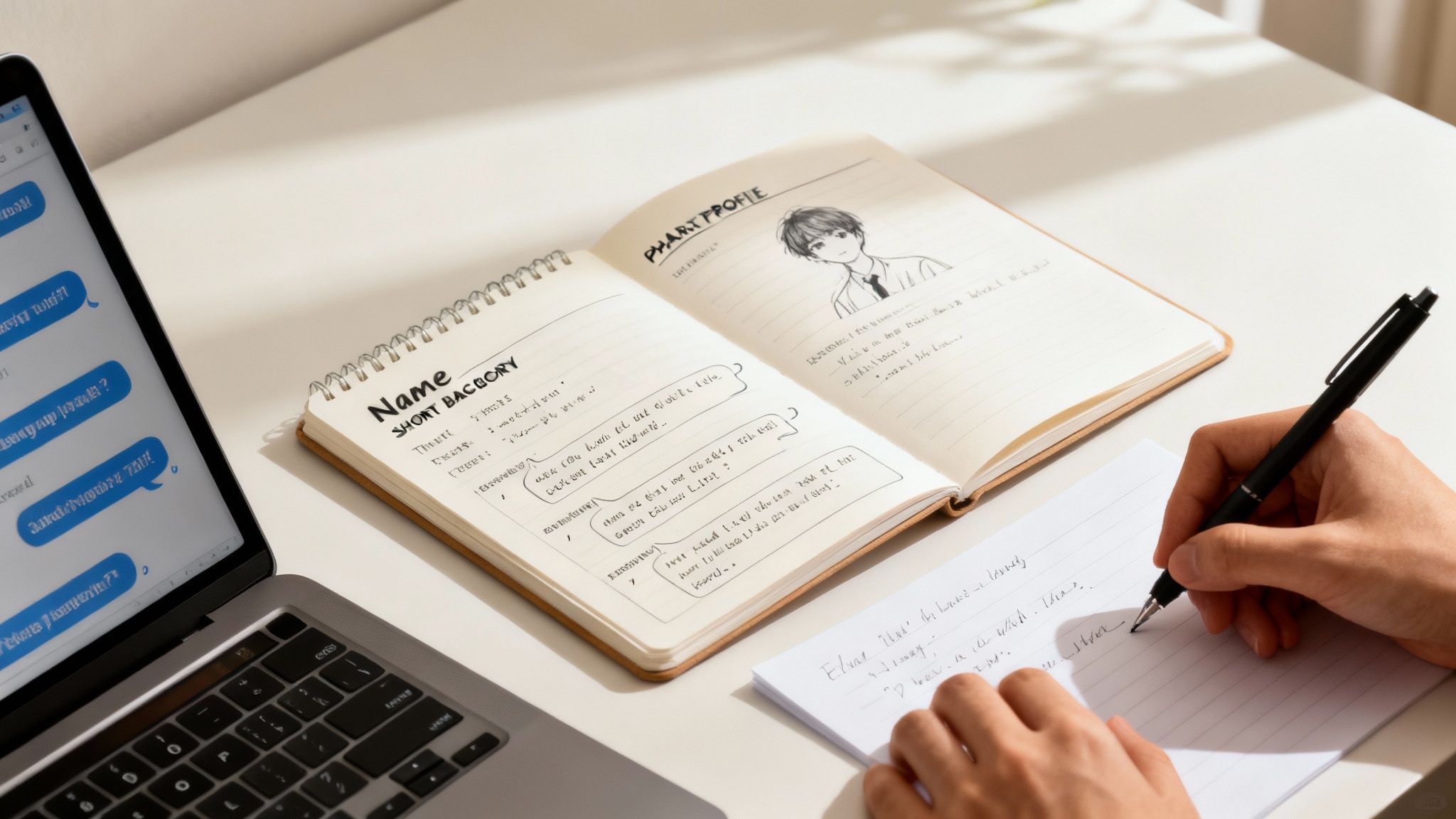
Alright, you've got your character picked out and you're ready to dive in. This is where the real fun begins. Simply typing "hello" is fine, I guess, but it's not going to get you that deep, immersive story you're probably looking for. The magic happens when you stop thinking of it as a chat and start treating it like collaborative storytelling.
Think of it like this: you're both an actor and the director of a scene. Your first message is the opening shot. It needs to set the stage, establish a mood, and give the AI something tangible to work with. Instead of just a basic greeting, try painting a picture.
For instance, compare "Hey" to this:
I walk into the dimly lit tavern, the scent of old wood and spilled ale hanging in the air. Spotting you in a shadowy corner, I approach your table and slide into the opposite chair. "Rough night?"
See the difference? That one message gives the AI a location, a mood, and a direct line to respond to. It’s an open invitation to build a world together, instantly shifting the dynamic from a simple Q&A to a living, breathing story.
Setting the Scene and Driving the Narrative
The secret to truly great roleplay is feeding the AI a steady diet of rich context. You're the one in the driver's seat, controlling the story's pace and direction by introducing new actions, describing the environment, and even dropping in plot hooks.
This is where a little bit of formatting becomes your best friend. While different platforms might have their own quirks, a few conventions are pretty much universal:
- Use asterisks for actions. When you frame your character's physical actions in asterisks, like *he draws his sword*, it clearly separates what you do from what you say. It makes the back-and-forth clean and easy for both you and the AI to follow.
- Use quotation marks for dialogue. This one’s a no-brainer, but it’s crucial for distinguishing spoken words.
This simple structure lets you weave actions and dialogue together seamlessly. You can write something like, I lean forward, my voice dropping to a whisper. "Are you sure no one followed us here?" This gives the AI so much more to work with than the words alone.
Ultimately, your goal is to co-create a compelling narrative. Think about what makes any story good: a little conflict, some mystery, maybe some character development. You can introduce all of those things yourself.
Pro-Tip: Don't be afraid to throw a wrench in the works. A prompt like, "A sealed letter with your family's crest is slipped under the door," is way more engaging than asking, "What are you up to?" You're the one guiding the story, so give it somewhere interesting to go.
Navigating Roleplay Perspectives
You've also got a choice in your narrative perspective. First-person (using I, me, my) is direct and personal, putting you right in the middle of everything. On the other hand, third-person (using he, she, they) can feel more like you're writing a novel together, giving you a bit of descriptive distance. There’s no right or wrong answer—it's all about what feels right for you and the story you want to tell.
The heart of an authentic interaction is nailing the character's unique voice. This is something the voice acting industry knows well; the number of professional actors in Japan has skyrocketed from just 370 in 2001 to an expected 1,790 by 2025. Even with AI, a staggering 80% of users still prefer unique, human-like voices, which just goes to show how much that spark of personality matters. You can dig deeper into these numbers by checking out the full analysis on the booming anime market.
Now and then, the AI might get a little confused or break character. It happens. When it does, your best tool is an out-of-character (OOC) comment. Just put your message in parentheses to speak directly to the AI model instead of the character.
For example: (OOC: Hey, just a reminder, my character doesn't know your identity yet. Can you reply as if we're strangers?)
This is a simple, effective way to nudge the story back on track without completely shattering the immersion. Getting comfortable with these techniques will help you talk to an anime character in a way that feels dynamic, responsive, and incredibly real.
Navigating Your Conversations: Safety, Privacy, and Troubleshooting
Let's be real—diving into chats with AI characters is a ton of fun, but you've got to be smart about it. The golden rule, and I can't stress this enough, is that you are not talking to a real person. No matter how real they seem, you're interacting with a complex program. Never, ever share sensitive information.
Think of your chats like a semi-public journal. Developers often review conversations to fine-tune their models, so you should assume someone might eventually read it. This means keeping your real life completely separate from your fantasy world.
Here's a quick list of what should never make it into your chatbox:
- Your real full name
- Your home address, phone number, or email
- Passwords or any financial details
- Specifics about where you work or go to school
Embracing a "zero-trust" policy with your personal data isn't about being paranoid; it's about being smart. It lets you fully immerse yourself in the roleplay and talk to an anime character without any real-world consequences hanging over your head.
Keeping the Conversation on Track
Sooner or later, you'll hit a snag. The most common one? The AI gets a bad case of amnesia. It might suddenly forget your character's name, a crucial plot point, or the entire scene you've been carefully building. It’s definitely frustrating, but it's not a deal-breaker.
Thankfully, most platforms give you the power to fix this directly. Your best friend here is the edit button. Simply click to edit the AI’s last message, correct the mistake—whether it’s reinserting a forgotten detail or tweaking some dialogue that went off the rails—and the AI will almost always pick up the thread and run with it.
Another pro-level move is the out-of-character (OOC) nudge. A quick message wrapped in parentheses can gently guide the AI back to where it needs to be without killing the mood.
For example, if your character and the AI are exploring a dungeon and it suddenly starts talking about going to the beach, you could send:
(OOC: Hey, just a reminder, we're in the Shadowfang Crypt, not at the beach!)It's a direct, clean way to correct the AI's context.
What to Do When the AI Gets "Stuck"
Ever had an AI fall into a loop, giving you bland, repetitive, or generic replies? It happens when the model gets stuck in a conversational rut. Your mission is to shake things up with a strong, descriptive prompt.
Don't just ask another question. Instead, inject some action. Introduce a sudden, unexpected event that forces a reaction.
A prompt like, *Suddenly, the ground trembles violently as a guttural roar echoes from deeper within the cavern*, gives the AI something new and dramatic to work with, breaking it out of its boring pattern. You can also try re-rating a few of its earlier, better messages to remind it what kind of responses you liked.
By keeping these safety tips and troubleshooting tricks in your back pocket, you can make sure your AI conversations stay immersive, creative, and—most importantly—safe. It gives you the freedom to explore without worry.
Common Questions About Chatting with Anime AI
Jumping into AI character chat for the first time? It's natural to have a few questions. Let's tackle the big ones so you can start chatting with your favorite characters like a pro.
Can I Really Talk to Any Anime Character?
Chances are, absolutely. The most popular platforms are like massive digital libraries, packed with bots for every character you can think of—from mainstream shonen heroes to niche indie manga personalities.
On the off chance your favorite isn't there, you can just make them yourself! The creation tools are surprisingly easy to use, and you can bring any character to life just the way you imagine them. Plus, the community is always adding new creations, so the selection gets bigger every single day.
How Do I Get Better, More Interesting Responses?
The secret is being specific. Don't just ask a generic, "What's up?" You have to give the AI something to work with.
Think of it like setting a stage. Instead of a bland question, try painting a picture for the AI: *I spot you sketching in a notebook down by the riverbank. I walk over and sit down quietly a few feet away, not wanting to break your concentration.*
See the difference? You've given the AI a setting, context, and a clear action to react to. Also, don't forget to use the rating system. When you give a great response a high rating, you're training the AI to understand what you like, which means you'll get much better, more tailored replies over time.
A great prompt is like giving a scene partner the perfect cue. The more detail and emotion you put in, the more compelling the AI's performance will be.
What Happens if the AI Forgets Something Important?
AI memory can be a bit spotty. It happens. Sometimes a character might forget a major plot point or a detail you established earlier.
The easiest way to fix this is to give it a gentle nudge with an out-of-character (OOC) comment. It looks like this: (OOC: Hey, just a reminder that my character already gave you the enchanted locket in our last scene). This corrects the AI's memory without derailing the roleplay.
Another great trick is to just edit the AI's last message yourself. You can tweak their response to include the forgotten detail, and boom—the story is right back on track.
Ready to have your first truly immersive conversation? At Luvr AI, we're all about giving you the most advanced and customizable AI companions out there. You can create the exact anime character interaction you’ve been dreaming of. Build your perfect character today!