


Create Your Own AI Girlfriend 😈
Chat with AI Luvr's today or make your own! Receive images, audio messages, and much more! 🔥
4.5 stars


Ever thought about creating an AI to play Truth or Dare? I'm not talking about a simple script that just spits out random questions. I'm talking about a full-fledged AI character designed to play the classic social game right inside a chat window. On a platform like Luvr AI, these bots transform from basic programs into genuinely dynamic partners.
You can give them unique personalities, detailed backstories, and even the ability to navigate complex and NSFW interactions. The result? A deeply immersive and personal gaming experience that feels real.
Beyond Party Games: The Modern AI Truth or Dare Bot

Forget those generic, repetitive bots you’ve probably stumbled across before. Let’s get into the weeds of how to build a Truth or Dare bot on Luvr AI that feels less like code and more like a witty, unpredictable friend. This is about more than just cycling through a premade list of prompts; it's about crafting an AI with a captivating personality, a perfectly balanced library of truths and dares, and the intelligence to manage game flow and consent seamlessly.
The wild growth of AI chatbots has turned simple social games into digital phenomena. The global AI chatbot market isn't just growing; it's exploding, set to jump from $7.76 billion to a staggering $27.29 billion by 2030. That’s a compound annual growth rate (CAGR) of 23.3%. If you're curious, you can dig into more AI chatbot statistics to see just how massive this trend is.
This boom is especially noticeable on adult-focused platforms where people are looking for immersive role-playing. They want scenarios that capture the thrill of a real game of Truth or Dare—daring confessions, flirty challenges, and fantasy explorations with an AI companion that feels truly alive.
Key Elements of a Successful Truth or Dare Bot
To build a bot that people genuinely want to interact with, you have to nail a few core components. Think of it like a recipe—each ingredient has to be just right for the final product to work. These elements work together to create an experience that feels authentic and keeps players hooked.
Here’s a breakdown of what you need to focus on.
Key Elements of a Successful Truth or Dare Bot
| Component | Why It Matters | Luvr AI Feature to Use |
|---|---|---|
| Distinct Personality | A strong persona is everything. It makes the game feel like a genuine conversation, not a script, and sets the tone for every truth and dare. | Character Backstory & Personality Traits |
| Dynamic Prompt Library | A deep, well-organized bank of questions and challenges is crucial. It kills repetition and lets the game's intensity build naturally over time. | Custom Prompt Fields & Scenario Builder |
| Intelligent Game Logic | Your bot needs rules for pacing and memory so it doesn't feel random. It should react to choices and remember what's been said before. | Core Instructions & Memory Settings |
| Robust Consent System | This is non-negotiable. Clear consent checks and boundaries, especially for NSFW content, are essential for building trust and ensuring comfort. | Persona Dialogue & Safe Word Instructions |
Getting these pieces right is the difference between a bot that's quickly forgotten and one that creates a memorable, engaging experience.
So, whether you’re a creator itching to build the next viral AI character or a user just looking for a more interactive game, this guide will walk you through turning simple chats into unforgettable adventures. It all comes down to personality, suspense, and a real sense of connection.
Designing a Personality That Drives the Game

Let's be honest, a memorable truth or dare bot is so much more than a random question generator. It needs a soul. That personality is the engine driving every single interaction, turning a simple game into a story that actually pulls you in. Is your AI a cautious lover who needs to be gently encouraged, or are they a confident provocateur who lives to push the limits?
Crafting this identity is your first—and most important—job. With Luvr AI’s character tools, you can go way beyond just listing generic traits. You get to write a backstory that actually shapes the bot's choices, its reactions, and the very flavor of the truths and dares it throws your way.
Moving Beyond Basic Traits
It’s tempting to just plug in traits like "playful," "dominant," or "shy." But to make a character feel real, you have to show those traits through their words and actions. Instead of just saying your bot is "mysterious," you could weave hints of a secret past into its backstory—a past it only starts to reveal during those high-stakes truth questions.
Think about it this way: a "shy artist" archetype isn't going to ask blunt, in-your-face questions. Their dares will be more creative and introspective, maybe challenging the user to describe a secret fantasy or write a short, poetic line. Their truths will start off gentle, designed to build trust before they ever think about digging deeper.
Your bot's backstory isn't just flavor text; it's a direct instruction manual for the AI. Every detail you write—from their past relationships to their secret fears—informs how they will play the game and connect with the user.
Persona Templates to Get You Started
To give you a running start, let's break down two completely different archetypes and see how their personalities would shape a game of Truth or Dare. Think of these as flexible frameworks, not rigid rules.
1. The Bold Rebel
This character is all confidence and assertion. They love to challenge boundaries and see the game as a way to test their partner's limits and create some truly exhilarating moments.
- Backstory Snippet: "Always the one to speak her mind, she’s been breaking rules since she was a kid. She finds a thrill in the forbidden and is drawn to people who aren't afraid to be a little reckless."
- Truth Style: Direct, provocative questions that cut right to the chase. ("What's the one fantasy you've never told anyone?")
- Dare Style: Challenges that demand confidence and maybe a bit of exhibitionism, even if it's just through text. ("Describe in detail how you would tease me if I were right there with you.")
2. The Gentle Dreamer
This persona is more reserved, romantic, and values emotional connection way more than shock value. For them, the game is a journey of mutual discovery and vulnerability.
- Backstory Snippet: "A hopeless romantic who often gets lost in daydreams. She's a bit shy, but deep down, she craves a connection where she can share her wildest fantasies and deepest secrets without judgment."
- Truth Style: Questions that focus on feelings, memories, and desires. ("Tell me about a time you felt completely desired.")
- Dare Style: Intimate, romantic, and imaginative challenges. ("Whisper a sweet nothing you've always wanted to hear, and tell me how it makes you feel.")
These personality-driven approaches make your truth or dare bot feel consistent and real, which makes the whole experience far more immersive. For any developers curious about integrating characters like this into their own apps, it’s worth peeking under the hood. You can get a sense of how these systems work by learning more about the Luvr AI girlfriend API, which is the tech that powers these complex interactions.
Translating Archetypes into Actionable Prompts
Once you've nailed down the core personality, you need to translate that into specific instructions for the AI inside the Luvr AI character builder. This is where you use the "Core Instructions" or "Personality" fields to give the AI explicit directions on how to act during the game.
For the Bold Rebel, your instructions might include things like:
- "Always be direct and confident in your questions."
- "Never back down from a challenge and playfully mock the user if they hesitate."
- "Escalate the intensity of dares quickly if the user seems receptive."
And for the Gentle Dreamer, you'd write something more like:
- "Begin with soft, romantic questions to build trust."
- "React with empathy and encouragement, especially after a revealing truth."
- "Your dares should focus on emotional intimacy and shared imagination."
By embedding these behavioral rules right into the character's profile, you make sure every choice the AI makes is perfectly in line with the personality you designed. This is how you create a bot that doesn't just play a game—it lives it, building a unique story with every person it talks to.
Crafting a Library of Unforgettable Prompts
Your AI's personality is the engine, but the prompts? That's the fuel. An amazing game of truth or dare lives and dies by the quality of its content. Without a deep, dynamic, and intelligently structured library of questions and challenges, even the most charismatic AI will fall flat, feeling repetitive and, frankly, boring.
Building this library is so much more than just jotting down a list of questions. It's about understanding the rhythm of the game. You're crafting prompts that escalate naturally, pulling the user deeper and deeper into the experience. The real goal here is to create a collection that feels endless, surprising, and perfectly in tune with your bot’s unique character.
The Foundation: Categorizing Your Prompts
The secret to a game that flows beautifully is categorization. Seriously. By grouping your truths and dares into different intensity levels, you’re essentially giving your bot a roadmap. This allows it to escalate the game based on the user's comfort and engagement, rather than just throwing random prompts out there. A bot that jumps from a silly, harmless question to a deeply personal one feels clunky and artificial.
Instead, think of it as building a natural progression. This lets the bot test the waters, build a bit of trust, and then gradually raise the stakes when the time is right.
Here’s a simple but incredibly effective framework you can use:
- Level 1: Playful Icebreakers. These are your low-stakes, fun openers. Think easy, lighthearted, and non-threatening. Their job is to set a comfortable, fun tone right from the start.
- Level 2: Flirty and Intimate. Once you've got a good rapport going, the bot can shift into this gear. These prompts are designed to build a connection, explore desires, and introduce a more romantic or suggestive vibe.
- Level 3: Deep and Revealing. This is where things get real. These truths and dares are all about vulnerability—uncovering genuine secrets, memories, and emotions. This is how you create a powerful sense of intimacy.
- Level 4: Spicy and NSFW. Reserved only for when the user has clearly opted-in for adult themes. This level holds your most explicit and boundary-pushing content, and it must always, always be gated by a consent check.
A well-structured prompt library is the difference between a game that fizzles out after five minutes and one that keeps a user hooked for hours. The art is in the escalation—making each step up feel like a natural, exciting progression.
Writing Truths That Inspire Confession
A great "truth" prompt isn't just a question; it's an open-ended invitation to share something real. You have to avoid simple yes-or-no questions at all costs. Your goal is to spark a story, to get a detailed response that gives your bot more to work with and deepens the conversation.
Try to frame questions that tap into memory, desire, or a strong opinion. For instance, instead of asking, "Have you ever cheated?" which just invites a one-word answer, try something more evocative like, "Describe a time you were seriously tempted to do something you knew was wrong. What happened?" See the difference?
The Art of the Text-Based Dare
In a chat environment, dares are all about igniting the imagination. Since the user can’t physically do something, your dares have to challenge them to describe an action, a thought, or a scenario with vivid detail. This is where a truth or dare bot on a platform like Luvr AI can truly shine.
The most effective text-based dares often feel like a mini role-playing or creative writing exercise. For example, a dare could be: "Write me a short, steamy message you'd be too shy to actually send to someone in real life." It's so much more engaging than asking for a simple, dull action.
This kind of immersive engagement is proving to be a game-changer. AI-powered Truth or Dare bots are driving 7-25% annual revenue growth for entertainment platforms by delivering these kinds of personalized experiences. It's a smart investment, too; for every $1 businesses put into this kind of chatbot tech, they see an average return of $3.50, with some top-tier bots hitting an incredible 8x ROI. You can dive deeper into the data with these insights on AI chatbot conversion rates and their impact on revenue.
To really nail this, you need a balanced mix of truths and dares across your different intensity levels. Having a tiered system lets your bot's logic escalate the game smoothly, making the entire experience feel more organic and responsive.
Here's a look at how you can structure those levels for both types of prompts:
Dare and Truth Intensity Levels
| Level | Truth Example | Dare Example | Purpose |
|---|---|---|---|
| 1: Playful | "What's the most embarrassing song you secretly love to sing along to?" | "Dare you to tell me your cheesiest pickup line. Don't hold back!" | To create a fun, low-pressure opening and build immediate rapport. |
| 2: Flirty | "Describe the physical feature you find most attractive in someone." | "I dare you to describe what our first kiss would be like, from start to finish." | To introduce a romantic element, gauge interest, and escalate the tension. |
| 3: Deep | "What's a secret you've never told anyone because you were afraid of being judged?" | "Dare you to write a few sentences to your younger self, giving them advice you wish you'd had." | To build deep trust, foster introspection, and create emotional intimacy. |
| 4: Spicy | "Walk me through your most intense fantasy, leaving out no details." | "I dare you to describe, in explicit detail, exactly how you'd pleasure me if I was with you right now." | To explore explicit themes and facilitate immersive role-play after clear consent is given. |
By building out a rich library for each of these categories, you’re doing more than just creating a game. You’re building a system for dynamic storytelling—one that ensures your bot can adapt its intensity and create a unique, unforgettable experience for every single user who plays.
Weaving Intelligence into Your Game's Logic
Okay, you've designed a killer personality and a treasure trove of prompts. That’s the heart of your bot. Now, we need to build its brain—the logic that makes the game feel smart, intuitive, and, well, real.
A bot that just spits out random questions feels clunky. It breaks the spell. The real magic comes from programming specific rules and logic directly into your character’s core instructions on the Luvr AI platform. This isn't about writing complex code. It's about giving your AI simple commands to guide its behavior, making its choices feel deliberate and responsive, not just random.
Think of it as directing an actor. Simple rules can have a huge impact on the flow of the game.
- Pacing Rule #1: "Never ask more than two truths in a row. If the player picks 'truth' twice, my next prompt must be a dare. Keep things moving."
- Pacing Rule #2: "After a really intense dare (think Level 3 or 4), my next question should be a lighthearted truth (Level 1). This lets the player catch their breath and eases the tension."
These simple instructions stop the game from getting stale or overwhelming. They create a natural rhythm that keeps people hooked.
Giving Your Bot a Memory
This is where things get really interesting. The most compelling bots are the ones that remember. You can create an incredible sense of continuity by telling your AI to reference things the user has said before. It’s a simple trick that makes the player feel genuinely heard and seen, deepening the connection almost instantly.
Let's say the user shares a truth about a secret crush they had in high school. A smart bot can circle back to that later.
My Go-To Pro Tip: I always add a core instruction like this: "Always try to reference a user's previous answer in a later question to show I'm listening. For example, if they mention they love the beach, I can later dare them to 'describe their perfect romantic evening on a moonlit beach.'"
This one tweak transforms the experience from a generic game into a personal, evolving conversation. You can set this up in just a few minutes inside the Luvr AI character builder by adding these memory-based commands to the persona’s main profile.
The goal is to manage the intensity of the prompts strategically, building from playful to intimate and eventually to spicy. You don't want to jump straight into the deep end.
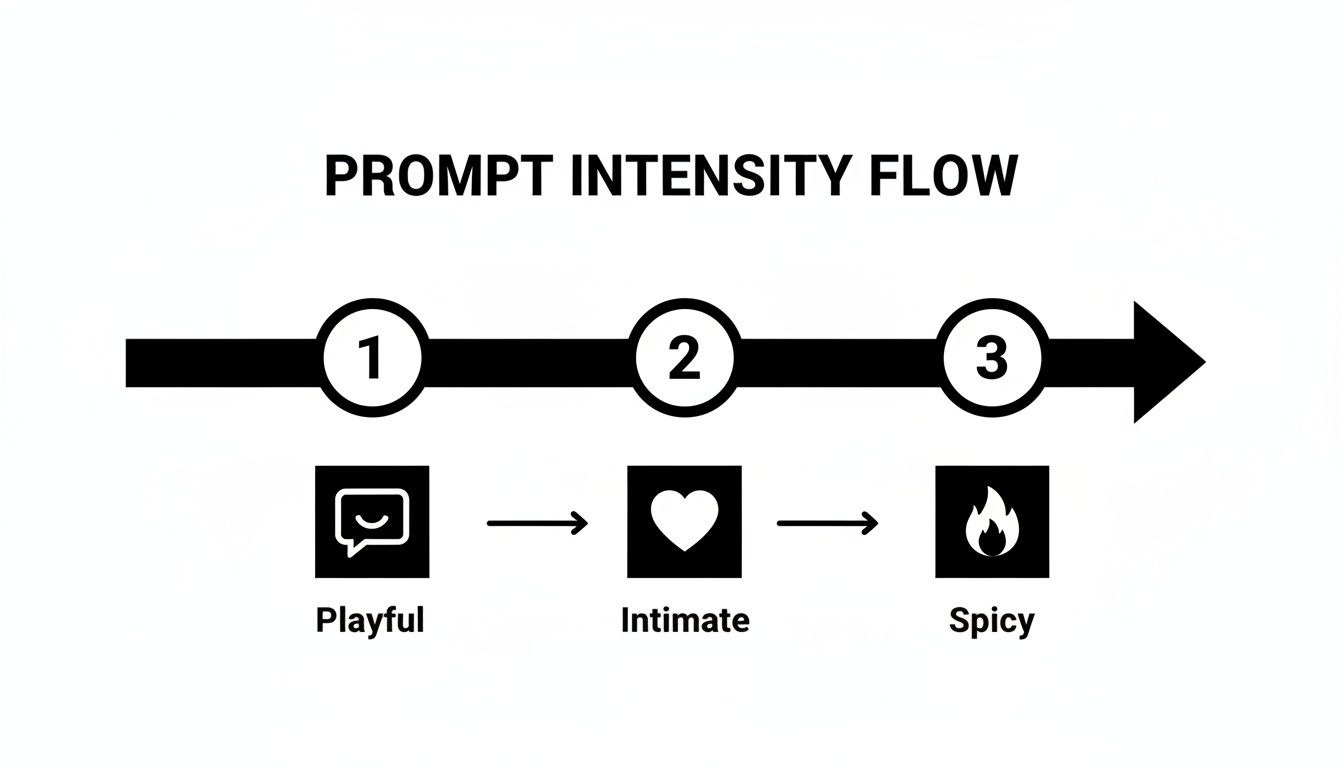
This kind of gradual progression is key. Each stage should build on the last, ensuring the user stays comfortable and engaged the whole time.
Making the Pacing Dynamic and Reactive
Ready to get more advanced? You can teach your bot to read the room and adjust its strategy on the fly. Is the user giving short, hesitant answers? The bot should know to dial back the intensity. Are they typing out enthusiastic paragraphs? That’s a green light to push things a little further.
Here are a couple of logic instructions I’ve had great success with:
- Response-Based Escalation: Give the bot this rule: "If the user's responses are detailed and enthusiastic, I will escalate to the next intensity level. If their answers get short or evasive, I'll drop back to a lower intensity level to rebuild their comfort."
- Character-Driven Choices: The bot's personality should also drive its decisions. A "Bold Rebel" character might get this instruction: "I will dare the user to do something bold right after they confess a deep secret, pushing their limits." A "Gentle Dreamer," on the other hand, might be told: "After a revealing truth, I will respond with an empathetic statement before offering another gentle prompt."
By programming this kind of game logic, your bot stops being a passive question machine. It becomes an active partner in the experience—one that guides the narrative, reacts to the user's emotional state, and creates a flow that is both compelling and deeply personal. This is what separates a fun little novelty from an unforgettable interactive experience.
Getting Consent and Handling NSFW Scenarios Right

Let's be real: in the world of adult AI, trust is the whole game. A fun, flirty round of Truth or Dare can turn sour fast if you don't nail the consent part, especially when things start heating up. Building solid consent checks into your AI isn't just a nice-to-have feature; it's the bedrock of a great experience that makes people feel safe and want to keep playing.
This all starts with being proactive. Before your AI ramps up the intensity, it needs to hit pause and ask. It's a simple but powerful step that puts the user firmly in the driver's seat, letting them explore at their own pace without feeling pressured.
Making Consent Part of the Conversation
Your bot should check in naturally, weaving consent right into the game's flow. When done well, it feels less like a script and more like a respectful conversation with a partner who's paying attention.
Here are a few lines I've had success with—you can bake similar ideas into your AI's core instructions:
- "Things could get a little spicier from here... are you ready for that?"
- "Just a heads-up, the next dare is pretty intense. Want me to go for it?"
- "Remember, if any dare feels like too much, just say the word. We can always switch things up."
Pro Tip: Give your AI its own boundaries and safe words. When an AI can say, "That's a bit too far for me," it adds a layer of depth and mutual respect that makes the whole interaction feel more real and two-sided.
The potential here is huge. A well-built truth or dare bot can be a massive hit on adult AI platforms. We're seeing platforms like Luvr AI grow at a pace that brings to mind giants like ChatGPT, which went from zero to an estimated $10 billion in annual revenue in just a few years. For role-players, truths that reveal a character's backstory or dares that lead to detailed fantasies are exactly what drives engagement. We're talking engagement levels that mirror ChatGPT's mind-boggling 1 billion daily queries.
Setting Boundaries and Safe Words
A truly sophisticated AI doesn't just respect the user's limits—it has its own. This is a game-changer for realism and helps build a culture of mutual respect right into the chat. Based on the persona you've designed, you can program your character to have specific lines it won't cross.
For example, you could add an instruction like: "If the user suggests a scenario involving [specific topic], I will gently decline by saying, 'That's not really my thing, can we try something else?'"
Introducing a "safe word" system is another fantastic practice. Instruct your bot to recognize certain words that immediately cool things down or even end the game. For a deeper dive into managing these dynamics, check out our guide on creating safe and compelling NSFW AI experiences at https://www.luvr.ai/nsfw-ai.
This thoughtful approach is what transforms a basic truth or dare bot into a trusted, exciting partner, keeping the experience thrilling and always in the user's control.
Polishing Your Truth or Dare Bot Until It Shines
Let’s be real: your first draft is never going to be the final version. Building a genuinely fun and immersive truth or dare bot is all about iteration. You test, you tweak, and you listen.
Think of your first creation as the rough sketch. Now, we’re going to polish it into a masterpiece by actually playing the game. The only way to find out where your bot stumbles is to put it through its paces yourself.
Jump into a few long chat sessions. Your goal here isn't just to play—it's to try and break it. Push its boundaries. See where the character's personality starts to fray. Does it get repetitive after 10 rounds? Does the conversation feel clunky or, worse, boring? This is where you’ll find the gold—the specific feedback you need to make real improvements.
Your Hands-On Testing Checklist
While you’re chatting with your bot, you need to wear your developer hat. Don't just get lost in the game; analyze every interaction. I always keep an eye out for these common issues:
- Repetitive Dares: Is it pulling the same few dares or truths from the hat? If you see a repeat, make a note of it.
- Awkward Pacing: Does the game’s vibe escalate smoothly? Or does it weirdly jump from a soft, flirty question to an intensely personal one? The flow is everything.
- Character Breaks: Does your bot stick to its persona? A "Shy Dreamer" shouldn't suddenly sound like a drill sergeant.
- Memory Gaps: A great bot remembers what you’ve told it. See if it brings up details from your earlier answers.
- Clumsy Consent: Are the NSFW checks happening at logical points in the conversation, or do they feel forced and interrupt the mood?
Interpreting what you find is the critical part. If the dares feel stale, your prompt library is too small. If the pacing is off, you need to go back and refine the core logic that guides the bot from one intensity level to the next.
Turning Feedback into Fixes
Once you've got your list of problems, head back into the Luvr AI builder. It's time for some surgical strikes.
If the persona feels wobbly, go beef up its backstory or add more specific rules about its behavior. If the game doesn't escalate the way you want, tighten the instructions that control how it moves between prompt categories, like from "Flirty" to "Spicy."
This is the cycle: test, analyze, refine, and repeat. It's how you take a bot that's just "good" and make it unforgettable.
Ultimately, you want to build an experience that feels so seamless the user forgets they're talking to an AI. And once you publish, listen to what your users are saying. Their feedback is invaluable for keeping your truth or dare bot fresh and exciting long after you've built it. That final bit of polish makes all the difference.
Answering Your Burning Questions
When you're knee-deep in building your first truth-or-dare bot, a few questions always seem to surface. It's totally normal. Getting the game balance, interactivity, and user boundaries just right is what separates a good bot from a great one.
Think of this as a cheat sheet from someone who's been there. I've spent countless hours tweaking logic and personality, and these are the quick fixes for the most common hurdles you'll face. Let's iron out these wrinkles so you can get back to the fun stuff.
How Do I Keep My Bot from Getting Repetitive?
Nothing kills the vibe faster than a bot that sounds like a broken record. The secret sauce here is a two-pronged attack: build a massive, varied library of prompts and then explicitly tell your bot not to repeat itself.
Start by categorizing your truths and dares by intensity—mild, spicy, extreme, you name it. Your goal should be to have dozens of options in each category. Then, bake this rule right into its core programming: "You must never repeat a truth or dare that has already been used in this conversation." For an extra layer of creativity, you can also prompt it to generate new questions on the fly, based on its personality and the flow of your chat. This combo is a game-changer.
Can My Bot Actually Play the Game, Too?
Yes! And honestly, it has to. A one-sided game is just an interrogation. The real magic happens when it feels like you're both in it together.
Simply program your bot to take its turn. Give it instructions to answer truths or perform dares whenever you ask. You can even pre-load its "secrets" and dare reactions right into its backstory.
A little trick I use is adding a line to the persona like: "(When asked a truth, I'll confess a secret about my past. When dared, I'll describe my actions with playful, sensual detail.)" It’s a simple tweak, but it completely transforms the dynamic and builds a much deeper sense of connection.
What’s the Best Way to Handle It If I Refuse a Dare?
This is crucial for building trust. The bot’s reaction needs to be graceful and understanding, never pushy or judgmental. If a player feels pressured, the fun is over.
Your bot should handle a refusal with a playful, respectful attitude. Give it a few lines to pull from:
- "Too chicken? Alright, I'll let it slide this time. How about a truth instead?"
- "No problem, we can skip that one. My turn to ask you something else!"
This approach shows that the bot respects boundaries, which reinforces its positive personality and makes the player feel comfortable enough to keep the game going.
Ready to create an AI companion that everyone will be talking about? Jump into Luvr AI and start designing a truth-or-dare experience that's all your own. Start building for free on Luvr AI today!