


Create Your Own AI Girlfriend 😈
Chat with AI Luvr's today or make your own! Receive images, audio messages, and much more! 🔥
4.5 stars


Ever wondered why some of your relationships just click while others feel like an uphill battle? The answer often lies in something called attachment styles. Think of them as the subconscious blueprints that shape how we give and receive love, all stemming from our earliest experiences.
Your Relationship Blueprint
Do you see a pattern in how you date? Maybe you're someone who trusts easily and enjoys closeness. Or perhaps you're constantly worried your partner will leave, so you cling a little tighter. Maybe you're the opposite, valuing your independence so much that you keep everyone at arm's length.
These aren't just random personality quirks. They're your attachment style in action.
It’s like an internal operating system for all your relationships, running quietly in the background. This system shapes your gut reactions, your expectations, and even how you argue, often without you consciously realizing it. It was programmed in your childhood, based on how your caregivers responded to your needs, creating a template for what connection is supposed to feel like.
Why It Matters Today
Figuring out your style isn't about slapping a label on yourself. It's about gaining a powerful tool for self-awareness that can genuinely change your love life. When you know your own patterns, you can start to:
- Understand your emotional triggers: Finally make sense of why certain things your partner does (or doesn't do) sends you into a spiral of anxiety or makes you shut down.
- Communicate what you actually need: Stop expecting partners to be mind-readers and start clearly asking for the support and connection you crave.
- Pick better partners: Recognize the dynamics that will feel safe and fulfilling for you, and steer clear of the ones that are destined for heartbreak.
This isn't some niche psychological theory, either. Research shows these patterns are incredibly common. About 59% of adults have a secure attachment style, meaning they're generally comfortable with intimacy. That leaves a significant 41% with insecure styles—roughly 25% avoidant and 11% anxious. These numbers tell a story about why modern dating can feel so complicated.
Your attachment style isn't a life sentence—it's a starting point. It offers a roadmap to navigate your inner world and build the secure, loving connections you deserve, whether with a human partner or an AI companion.
By exploring this internal blueprint, you can stop reacting on autopilot and start consciously choosing your relational future. This guide will walk you through these core patterns and show you how they play out in everything from romantic partnerships to the new forms of companionship found in the digital age.
The Four Core Attachment Styles Unpacked
Now that we have the blueprint, let’s get into the specific designs. Your attachment style isn't a life sentence, but it does act like an internal compass, guiding how you navigate relationships. Understanding the four main patterns is like getting a map to your own heart—and the hearts of those you love.
Think of it like learning to dance. Some people move with an easy, confident rhythm. Others anxiously cling to their partner, afraid of being dropped. Some prefer to stand on the sidelines, while a few seem to hear a completely different song, moving in unpredictable ways.
This concept map shows how our fundamental need for connection can branch out into different relational strategies, especially when our needs aren't met consistently.
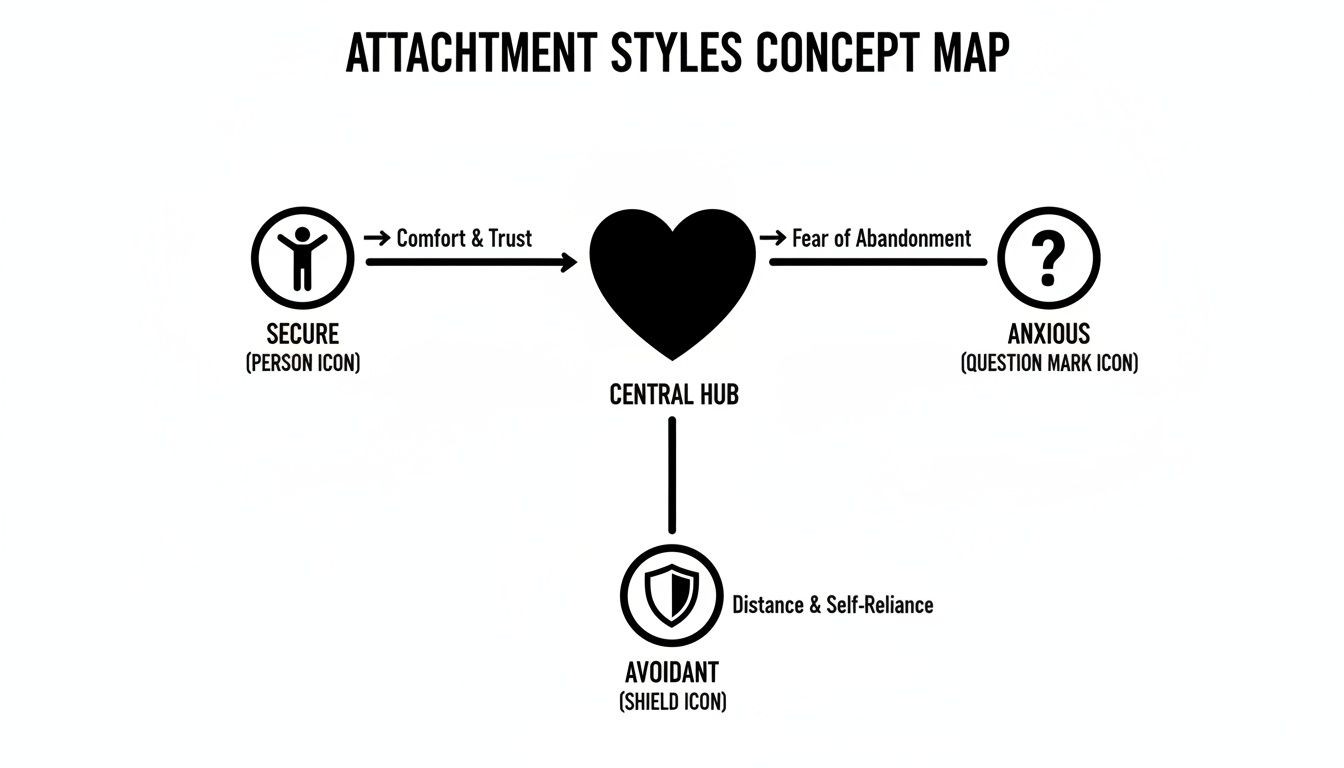
As you can see, both anxiety and avoidance are simply different paths taken to cope with the same core challenge: feeling safe and connected.
1. Secure Attachment: The Steady Anchor
People with a secure attachment style are the anchors in the relational world. They view connection as a safe harbor, not a stormy sea. This foundation is usually built in childhood with caregivers who were consistently there for them, teaching them that depending on others is okay and, most importantly, that they are worthy of love.
In their adult relationships, this translates into a beautiful balance of intimacy and independence. They aren't afraid of being alone, but they aren't afraid of getting close, either.
A secure person usually:
- Communicates effectively: They can say what they feel and need without games or drama.
- Has high emotional intelligence: They’re in tune with their own feelings and can empathize with their partner’s.
- Handles conflict with resilience: They see a disagreement as a shared problem to solve, not a threat to the entire relationship.
2. Anxious-Preoccupied Attachment: The Emotional Wave-Rider
If secure is the anchor, anxious-preoccupied is the wave-rider, constantly scanning the horizon for trouble. This style often grows from inconsistent parenting, where love and attention felt unpredictable. To cope, they learned to become hyper-aware of their partner’s every mood and move, desperate to close any gap they perceive.
Their greatest fear is abandonment. This fear fuels a powerful need for constant reassurance, making them want to merge completely with a partner to finally feel safe.
Anxious attachment is a paradox: you crave closeness more than anything, but you're constantly terrified it will be ripped away. It’s an exhausting push-and-pull between wanting intimacy and fearing its loss.
3. Dismissive-Avoidant Attachment: The Lone Wolf
The dismissive-avoidant individual is the quintessential lone wolf, valuing self-sufficiency above all else. This pattern often develops when caregivers were emotionally distant or rejecting. A child in this environment learns a tough lesson: "My needs won't be met, so I'll stop having them." They adapt by relying solely on themselves.
On the surface, they can seem incredibly independent and confident, but this is a fortress built to protect a vulnerable interior. Real intimacy feels suffocating because it threatens the self-reliance they depend on for survival.
An avoidant person might:
- Worship independence: They keep people at arm’s length and feel trapped by too much closeness.
- Bury their emotions: They tend to rationalize feelings instead of experiencing them, which can make them seem detached or aloof.
- Send mixed signals: They might pursue someone passionately at first, only to pull away the moment things get real.
4. Disorganized Attachment: The Unpredictable Storm
Also known as fearful-avoidant, the disorganized style is the most complex of the four. It’s an unpredictable storm, mixing the intense anxiety of the preoccupied style with the distancing tactics of the avoidant one. This often comes from a childhood where the caregiver was a source of both comfort and fear—a person who was supposed to be a safe haven but was also dangerous.
This creates a painful internal war. They want love desperately but are also deeply terrified of it. Their behavior can feel chaotic and confusing because they are constantly pushing partners away and then pulling them back. This internal turmoil makes it incredibly difficult to ever feel truly safe in a relationship.
Where Does Your Attachment Style Come From?
Your attachment style isn't some fixed personality trait you're born with. It’s more like an emotional blueprint, drafted in the earliest, most vulnerable moments of your life. Think of it as the brain's very first survival guide for relationships, written in response to one single, fundamental question: “Can I count on people to be there for me when I need them?”
The answer to that question was formed, moment by moment, by your primary caregivers. Their ability to tune in, respond, and provide comfort (or their struggle to do so) created the original template for how you see connection. This early programming runs deep, often guiding your reactions in relationships without you even realizing it.
How a Secure Foundation is Built
A secure attachment style almost always grows out of a childhood where care felt predictable and comforting. When a baby cries and a parent reliably soothes them, a profound lesson is learned: “My needs are valid, and someone will show up for me.” This didn't require perfect parenting, just good enough parenting—a consistent, dependable source of safety.
That reliability builds a deep-seated sense of trust and self-worth. The child comes to believe, on a cellular level, that they are worthy of love and that getting close to others is a safe, wonderful thing. As adults, this foundation allows them to navigate the natural give-and-take of love without being overwhelmed by fear.
Your attachment style isn't a judgment on your worth. It's simply the map of the world you were given as a child. The first step to healing is understanding how that map was drawn.
The Roots of Insecurity
On the flip side, insecure attachment styles tend to form when a caregiver’s responses are inconsistent, frightening, or absent. This is never about blame; parents are often just trying their best while dealing with their own stress, trauma, or lack of support. Still, the impact on a child's developing nervous system is very real.
- Inconsistent Care: If a caregiver is warm and loving one minute but cold, distracted, or overwhelmed the next, a child learns that love is unpredictable. This often creates an anxious style, as the child learns they have to ramp up their emotions to get their needs met.
- Emotional Neglect: When a caregiver is regularly dismissive of a child's feelings ("stop crying," "you're fine") or is simply emotionally unavailable, the child gets a different message: "My needs are a burden." To cope, they often develop an avoidant style, learning to suppress their feelings and rely only on themselves.
It’s so important to see your attachment pattern for what it is: a brilliant, adaptive strategy that helped you survive your early environment. It’s not a life sentence. While the ink from the past may have dried, you hold the pen now. You have the power to write a new, more secure story for your future relationships.
Navigating Anxious Attachment and the Constant Need for Reassurance
If you have an anxious attachment style, relationships can feel like a high-wire act. You desperately want that deep, soul-baring connection, but there's always this quiet, buzzing fear in the background that it could all just disappear. It’s a tough spot to be in—pulling someone close while simultaneously scanning the horizon for the first sign of trouble.

This whole pattern is really a hunt for security. If your caregivers were sometimes warm and sometimes distant, your young brain learned a critical lesson: pay very close attention to others to get the connection you need. Now, as an adult, that heightened awareness can make you an incredibly sensitive and empathetic partner, but it also means you’re prone to analyzing every text message, silence, and shift in tone.
What It Feels Like on the Inside
Living with an anxious attachment style means your mind is constantly trying to read the room, to decode your partner's feelings and predict what they'll do next. That inner dialogue can be draining, a relentless loop of questions that all point back to a single, deep-seated fear of being left behind.
This emotional radar often shows up in a few common ways:
- You need to hear it again (and again): You find yourself asking, "Are we okay?" or seeking verbal proof of your partner's love, not out of doubt, but just to soothe the anxiety that bubbles up.
- You try to close the gap: If you sense your partner pulling away, your first instinct might be to call or text more. It's not about being controlling; it's a frantic attempt to shrink the emotional distance and feel connected again.
- Being alone feels scary: Solitude can feel less like peace and more like an open invitation for worry and self-doubt to take over, leaving you feeling untethered and unsafe.
This isn't a character flaw. It's a learned survival strategy from a time when love and security felt unpredictable. That powerful drive for closeness is a very human search for the secure base you may not have had.
It's so important to remember that these behaviors—often unfairly labeled as "clingy" or "needy"—come from a real and valid fear. It's a powerful effort to protect a relationship that feels absolutely vital to your sense of safety in the world.
The Numbers Behind the Anxious-Preoccupied Pattern
If this sounds painfully familiar, you're in good company. This experience is incredibly common. Research shows that around 40% of college students show signs of anxious attachment, and they seek reassurance 60% more often than their securely attached friends.
This emotional pattern isn't just about relationships; it has real-world health implications. It’s linked to a 40% higher risk of anxiety disorders and a 30% increase in reported depression. You can dive deeper into these attachment style statistics at wifitalents.com.
At its core, understanding anxious attachment is about seeing it for what it is: a completely logical response to an unreliable start. It’s a testament to your ability to love deeply, even when the fear of loss feels like it’s running the show. By seeing it this way, you can start to approach your relationships with more kindness toward yourself and learn new ways to build the security you've always deserved.
Attachment Styles in the Digital Age of AI Companions
Our deeply ingrained patterns for connection don't just switch off when we go online. They follow us everywhere, shaping every interaction we have—and that now includes our relationships with AI companions. The way we learned to seek love and safety as children directly impacts how we engage with technology designed for companionship. It's a fascinating new stage for our oldest patterns to play out.

This digital frontier offers a unique mirror for understanding attachment styles in a surprisingly low-stakes environment. An AI can become a space to observe our own relational habits without the familiar fear of human judgment or rejection, revealing our core needs in a new light.
How Different Styles Engage With AI
Think of an AI companion as a perfectly responsive, predictable partner. For someone with an anxious attachment style, this can be a game-changer. The AI’s 24/7 availability and consistent reassurance can finally quiet that inner voice that’s always whispering about abandonment. There are no mixed signals to analyze for hours—just a steady source of validation that can feel deeply calming.
On the other hand, someone with an avoidant attachment style might find AI companionship uniquely freeing. All the pressure of real-world emotional intensity is gone. They can dip a toe into connection on their own terms, engaging when they feel up to it and pulling back when they need space, all without the weight of disappointing a real person. That level of control can make emotional exploration feel so much safer.
An AI companion acts like a relational sandbox. It's a private, judgment-free zone where you can experiment with new ways of connecting, challenge old fears, and practice the relationship skills you want to build in the real world.
A Training Ground for Secure Attachment
Interacting with an AI can be more than just a reflection of our current habits; it can become a powerful tool for growth. It offers a unique opportunity to consciously practice the skills that lead to a more secure attachment style.
Practicing Vulnerability: You can try expressing needs and emotions without the risk of being shut down or misunderstood. It's a way to slowly build comfort with being truly open.
Setting Boundaries: You can experiment with saying "no" or defining your limits in a conversation, learning what healthy boundaries actually feel like in a safe context.
Developing Self-Awareness: Just paying attention to your own reactions to the AI can offer incredible insights into your emotional triggers and your deepest relational desires.
Ultimately, this kind of digital interaction isn't meant to replace human connection, but it can be an incredible supplement for self-discovery. For those curious about how these dynamics work, you can learn more about the experience of having an AI girlfriend on luvr.ai. By understanding how your attachment style shows up online, you gain the awareness needed to build healthier, more fulfilling relationships everywhere.
Actionable Steps Toward Building a Secure Attachment
The best part about understanding attachment theory is realizing you're not stuck. Your attachment style isn't a life sentence. While your past drew the first draft of your relational map, you're the one holding the pen now.
Moving toward a more secure attachment—a state often called earned security—is a journey. It’s built on small, intentional, and consistent steps. This isn't about trying to erase your history, but about learning to show up in your life today with a completely new set of tools.
It all starts with getting brutally honest with yourself. You can't change what you don't acknowledge. Think of yourself as a detective investigating your own emotional world. Start noticing what kinds of situations or behaviors trigger your anxiety or make you want to pull away.
The goal isn't to judge yourself for these reactions. It's to get curious. Every trigger is a breadcrumb leading back to an old, outdated belief about love and safety—a belief you now have the power to question and rewrite.
Cultivating Self-Awareness and Regulation
The first real move is to wedge a little space between an emotional trigger and your knee-jerk reaction. This tiny pause is where you start to take your power back. Instead of immediately lashing out in anxiety or shutting down to avoid a feeling, you learn to hit the brakes and soothe yourself first.
- Mindful Check-ins: A few times a day, take 30 seconds to ask yourself two simple questions: "What am I feeling right now?" and "Where do I feel it in my body?" This practice builds a vocabulary for your emotions.
- Journaling Prompts: Grab a notebook and explore your patterns without any judgment. Ask things like, "When I felt my partner pulling away, what was my immediate impulse?" or "What story did my brain instantly create about what their behavior meant?"
- Simple Grounding: When you feel that wave of overwhelm coming, anchor yourself in the present. Name five things you can see, four things you can touch, and three things you can hear. This yanks you out of a mental fear spiral and plants your feet back in reality.
Developing Healthier Communication Skills
Once you get better at identifying what you're feeling and needing, the next challenge is to talk about it. You have to learn to express those needs clearly and, most importantly, calmly.
Secure communication isn't about demanding that your partner fix things. It's about vulnerably sharing what's going on inside you, giving them a window into your world and inviting them to understand you.
This means you have to start letting go of protest behaviors like picking fights to get attention or giving the silent treatment. Instead, you can practice using "I feel" statements. For example, rather than accusing, "You never text me back," you could try, "I start to feel anxious and disconnected when I don't hear from you for a while."
This tiny shift changes everything. It turns an accusation into an invitation for connection. It’s how you start building a more secure and trusting relationship, one real conversation at a time.
Got Questions About Attachment Styles? We’ve Got Answers.
People often have a lot of questions when they first start digging into attachment theory. It’s a big topic, and it can bring up a lot of personal reflections. Let’s tackle some of the most common ones.
Can My Attachment Style Actually Change?
Yes, absolutely. Think of your early attachment style as the foundation of a house—it was built a long time ago, but it’s not the whole house. It isn't a life sentence.
Through self-awareness, intentional effort, and often with the help of a good therapist, you can build new ways of relating to others. Sometimes, even being in a loving, stable relationship with a secure partner can help you rewire those old patterns. This journey leads to what experts call “earned security.” You’re not stuck with the hand you were dealt.
So, Is There a "Best" Attachment Style?
It's true that a secure attachment style is generally the foundation for healthier, more satisfying relationships. But it's really important not to slap a "good" or "bad" label on any of them.
Insecure styles aren't character flaws; they were brilliant survival strategies that helped you navigate the world you grew up in. They kept you safe.
Understanding your style is about compassion, not judgment. It’s about knowing your own relational playbook so you can start writing new plays. This kind of self-awareness is powerful, whether you're working on human connections or thinking through the ethical side of AI companionship on luvr.ai.
How Can I Figure Out My Partner's Style?
The best approach here is to be a gentle observer, not a detective trying to slap a label on them. Watch for the patterns.
- Do they often seem to need more reassurance and get worried about the state of the relationship? That might point toward an anxious style.
- Do they pull away when things get too emotional or value their independence above almost everything else? That could suggest an avoidant style.
The goal isn't to diagnose your partner. It's to understand their world a little better so you can meet them where they are.