


Create Your Own AI Girlfriend 😈
Chat with AI Luvr's today or make your own! Receive images, audio messages, and much more! 🔥
4.5 stars


Let’s be honest, the phrase "choose your own adventure" probably brings back memories of dog-eared paperbacks and trying to keep your finger on page 27 while you peeked at page 54. But what was once a nostalgic kid's format has grown up. Today, adult choose-your-own-adventure experiences are a seriously compelling genre, blending interactive fiction with mature, complex themes.
This isn't just about passive reading anymore. Fueled by new tech and a real hunger for control, these stories put you in the driver's seat. You make the calls, and those decisions have real, often profound, consequences in a world that feels alive. It's storytelling, reimagined for an audience that wants to do more than just watch.
Why Interactive Stories for Adults Are Back in a Big Way

The idea of interactive fiction isn’t new, but its comeback is definitely powered by a major cultural shift. We've all gotten used to being active participants. Think about it—from escape rooms and immersive theater to the sprawling narratives in video games, the line between the audience and the protagonist has practically vanished. We don't just want to watch the hero's journey; we want to be the hero.
This deep-seated desire for control is exactly why the adult choose your own adventure format is exploding right now. It scratches a fundamental psychological itch for agency—the power to actually influence what happens next. Making a tough call, watching the ripple effects unfold, and knowing you could have chosen differently gives you a sense of ownership that you just can't get from a movie or a traditional novel.
From Childhood Nostalgia to Mature Themes
We've come a long way from the simple "turn to page 42 to fight the dragon" mechanics. Modern interactive stories are tackling sophisticated subjects that actually resonate with adult lives, offering far more than a forking path to a treasure chest.
These aren't your childhood gamebooks. They're diving deep into:
- Complex Relationships: Exploring all the messy, gray areas of romance, friendship, and betrayal.
- Moral Ambiguity: Pushing you into corners where there's no clear right or wrong answer, just tough decisions.
- Personal Growth: Letting you shape a character's evolution based on the challenges you face and the choices you make along the way.
And people are eating it up. Recent survey data shows that about 24% of American adults have engaged with gamebooks. That number skyrockets to 43% among Gen Z adults, which tells you everything you need to know about the demand from a new generation. If you're curious, you can explore more data on the rise of interactive fiction to see just how big this trend is becoming.
Key Takeaway: The modern adult choose your own adventure isn't about finding the one "right" path. It’s about exploring the very real consequences of your personal choices inside a rich, believable world.
To really grasp this evolution, it helps to see the components side-by-side. The old format laid the groundwork, but today's interactive fiction is playing a whole different ballgame.
Key Elements of Modern Adult Interactive Fiction
| Element | Description | Impact on Adult Experience |
|---|---|---|
| Psychological Depth | Characters have complex motivations, fears, and flaws that evolve based on player choices. | Creates relatable and memorable characters, making decisions feel weightier and more personal. |
| Moral Ambiguity | Scenarios rarely have a clear "good" or "evil" option, forcing players to make difficult ethical calls. | Encourages introspection and makes the narrative feel more true-to-life and thought-provoking. |
| Dynamic NPCs | AI-driven characters remember past interactions and adapt their behavior, creating persistent relationships. | Fosters a sense of a living world where your actions have lasting social consequences. |
| Consequential Choices | Decisions have far-reaching ripple effects that can alter entire plotlines, not just the next immediate scene. | Increases replayability and gives the player a genuine sense of authorship over their unique story. |
| Mature Themes | The narrative explores adult subjects like loss, ambition, love, and betrayal with nuance and respect. | Delivers a sophisticated and emotionally resonant experience that connects with an adult worldview. |
This table highlights a crucial point: we've moved beyond simple branching paths into creating truly dynamic, character-driven systems. And the engine behind that leap is AI.
The Impact of AI on Narrative Possibilities
Artificial intelligence is the real game-changer here. Where old-school interactive fiction was stuck with pre-written, finite branches, AI throws the doors wide open to dynamic, unpredictable storytelling. AI-powered characters can remember what you did, react with surprisingly genuine emotion, and generate responses that feel completely unscripted.
What this means is that your story is no longer a rigid, predictable tree of choices. It's a living, breathing world that adapts to you. An ally might bring up a promise you made three chapters ago, or a rival might get suspicious because you keep choosing deceptive dialogue options.
This is what makes the experience so personal and endlessly replayable. AI doesn't just add more branches to the story—it gives the story roots, allowing it to grow in wild and unexpected directions based entirely on your journey.
Designing a Narrative Blueprint That Grips Adults
Before you even think about code or AI prompts, your story needs a soul. For an adult choose-your-own-adventure, that soul is forged in the fires of mature themes, morally gray characters, and a world that feels like it’s actually breathing. This is the groundwork, the foundation for an experience that doesn't just entertain but sticks with someone long after they're done.
This isn't a fairy tale. Forget the clean lines of good versus evil. Adult narratives are at their best when they live in that messy, uncomfortable middle ground. Your entire blueprint should pivot around a central conflict that has no easy answer. Think less "save the world" and more "navigate a brutal divorce," "uncover a corporate conspiracy," or "survive a betrayal that makes you question everything you stand for."
Establish Your Core Pillars
To keep your story from spiraling into a chaotic mess, you need a few non-negotiable pillars. These are the load-bearing walls of your narrative, guiding every branch and decision you design down the line.
- A Relatable Central Conflict: What's the fundamental struggle your player is up against? Is it a desperate grab for redemption? A hunt for a devastating truth? Maybe it’s just trying to protect someone they love. This conflict is the engine that drives every single choice.
- A Dynamic World State: Your world can't be a static backdrop; it has to react. Think about creating a few key "world variables"—things like the city's political stability, a faction's loyalty, or how the public sees the player—that shift and change based on the choices made.
- Complex Character Motivations: Nobody is all good or all bad. Your antagonist needs a believable, even sympathetic, reason for what they do, no matter how twisted. That helpful ally? They should probably have a hidden agenda. Giving your characters this kind of depth makes every interaction feel unpredictable and weighty.
This kind of design taps into the same desires that drive real-world exploration. It's no surprise that the adventure travel market has exploded among adults. A report from the Adventure Travel Trade Association found that this kind of travel made up about 26% of all trips adults took globally. It's proof that we crave active, engaging experiences. You can read the full findings on adventure travel trends here.
Mapping the Major Decision Points
With your pillars in place, it’s time to start mapping the journey. Now, don't try to chart every single possible choice from the get-go—that’s a surefire way to get overwhelmed. Instead, focus on the "tentpole" moments. These are the handful of critical decisions that will violently shove the story in a new direction.
Pro Tip: I always start by designing my endings first. When you know all the possible destinations, it's a thousand times easier to draw the maps that lead there. Aim for three to five distinct, meaningful endings that truly feel like a consequence of the player's journey.
Once you have your endings, work backward. Pinpoint the major inflection points that push the player toward one conclusion over the others. This process naturally creates your primary story branches. It’s like a river delta—one main current that eventually splits into several powerful channels flowing out to sea.
For instance, in a gritty detective story, a tentpole moment might be finding incriminating evidence on your corrupt but incredibly helpful partner. What do you do?
- Choice A (Turn it in): This path sends you down a road toward endings focused on justice and integrity, but you’ve just lost your most powerful ally. Good luck.
- Choice B (Bury it): This branch opens up endings related to compromise and personal loyalty, but now you’re dirty, too. You're compromised.
The Power of State Tracking
Look, not every choice needs to be a cataclysmic, plot-altering event. That would be exhausting. This is where state tracking becomes your secret weapon. State tracking is just a fancy way of saying you're using variables to remember what the player has done and said. These variables don't immediately fork the plot, but they subtly color how the world and its people react to you later on.
Here are a few classic examples of variables to track:
- Relationship Scores: How much does a key character trust you? Or despise you? A high score might unlock a unique dialogue option or get you bailed out of a tough spot. A low score? Expect a knife in the back when you least expect it.
- Reputation: Are you seen as an honorable hero, a ruthless mercenary, or a silver-tongued manipulator? This can change how a stranger greets you on the street or which jobs are even offered to you.
- Knowledge Gained: Did the player find that hidden ledger or overhear that whispered secret? You can use that "flag" later to give them a unique insight or let them solve a puzzle that would otherwise be impossible.
By using state tracking, even the smallest choices feel like they matter. Being kind to a random bartender might not change the fate of the city, but it could tick up your "Compassion" score, and later, that same bartender might slip you a critical piece of information nobody else would. It makes the world feel alive and intelligent. In fact, our own AI character builder lets you set up personality traits that can react directly to these kinds of tracked states, making your narrative truly dynamic.
So, you’ve got your story mapped out. The characters feel real in your head, the world is fleshed out, and the branching paths are set. Now for the fun part: bringing it all to life. This is where AI steps in, transforming your static script into a living, breathing world that actually reacts to the player.
Without this crucial step, even the most brilliantly plotted story is just a fancy flowchart.
The real power of AI in an adult choose-your-own-adventure isn't just about spitting out text. It's about creating non-player characters (NPCs) that feel less like puppets and more like real people. They can get angry. They can be persuaded. They can hold a grudge or even lie to the player's face, all depending on the choices made. This dynamic, unpredictable nature is what creates true immersion and keeps players on the edge of their seats.

Don't worry, you don't need a PhD in machine learning to pull this off. Modern platforms give you access to powerful AI through APIs. The real skill you'll need to develop is prompt engineering—the art of giving the AI the exact right instructions to get the performance you want.
Giving Your Character a Soul: The Core Prompt
Think of the core prompt as your character's DNA. It's a detailed "cheat sheet" you feed the AI that defines every single thing about them. If you write a lazy, generic prompt, you'll get a bland, forgettable character who constantly breaks character. A sharp, detailed prompt, on the other hand, is the bedrock of a believable personality.
Every core prompt needs these key ingredients:
- Who are they? Be specific. Not just "a detective," but "a jaded, cynical detective on the verge of retirement."
- What are they like? List their core personality traits. Are they sarcastic, compassionate, paranoid, ambitious, or reckless?
- Where did they come from? A quick summary of their backstory is essential. What events in their past inform their current worldview?
- What do they want? This is their driving motivation. What are their goals, and how far will they go to achieve them?
- How do they talk? Define their voice. Do they use slang? Speak formally? Ramble in cryptic metaphors? Give a few examples of their dialogue.
This prompt is the AI's north star. Every single time it generates a response, it refers back to these instructions to stay in character.
Setting the Scene with Situational Prompts
Once you've nailed the core personality, you need to guide the AI's performance scene by scene. A character won't act the same way during a tense negotiation as they would during a tender, intimate moment. This is where situational prompts come in.
Pro Tip: A situational prompt temporarily fine-tunes the core prompt. It provides the immediate context and emotional state the AI needs to nail its performance in a specific scene.
Let’s say your player is confronting a rival gangster named Rico. His core prompt says he's arrogant and ruthless.
- For a high-stakes negotiation scene, your situational prompt might be: "You're negotiating from a position of power. Stay calm. Use veiled threats. Never give a straight answer. Your goal is to get information without giving any away."
- But for a scene where the player betrays him, the prompt would be completely different: "The player just exposed your biggest secret. Your arrogance shatters. Explode with pure rage. Lash out, be irrational, and use your words to inflict maximum emotional damage."
These targeted instructions ensure the AI's performance always serves the story, making every interaction feel meaningful. Platforms are getting much better at this. For example, some tools for AI character chat now allow for these kinds of dynamic shifts based on how the story unfolds.
Integrating the AI: Making It Part of Your World
Connecting a conversational AI to your story can be done in a few ways, each with its own trade-offs. You might use a simple no-code tool, a dedicated platform, or go for a full custom build using an API from a provider like OpenAI or Anthropic.
Choosing the right path depends on your technical confidence, budget, and how much control you want over the final experience.
AI Platform Integration Options
| Integration Method | Technical Skill Required | Pros | Cons |
|---|---|---|---|
| No-Code Platforms | Low | Fast setup, no coding needed, good for prototypes. | Limited customization, may have platform branding. |
| Specialized Engines | Medium | Built-in memory management, character creation tools. | Can be expensive, locked into their ecosystem. |
| Direct API Integration | High | Maximum flexibility, full control over the experience. | Requires coding knowledge, more complex to manage. |
No matter which route you choose, the goal is the same: to create a seamless connection between your story logic and the AI's brain.
The Challenge of Memory
Here’s a big hurdle: by default, AI models have the memory of a goldfish. An AI won't remember a promise the player made three scenes ago unless you explicitly remind it.
This is managed through what's called a context window. Each time you ask the AI to respond, you feed it a bundle of information to get it up to speed.
Here’s a simplified breakdown of what the AI "sees" for every single response:
- Core Character Prompt: "Remember, you are a ruthless gangster named Rico."
- Memory Summary: A short, auto-generated summary of key recent events. (e.g., "Player knows about the stolen money. Player just threatened your family.")
- Situational Prompt: Your specific instructions for this very scene.
- Player Input: The player's most recent line of dialogue or action.
This constant loop of information—personality, memory, and immediate context—is what allows the AI to generate a response that feels intelligent, consistent, and perfectly in character. It's this process that elevates your project from a simple branching story to a truly dynamic and unforgettable world.
How to Handle Safety and Consent in Your Story

When you're building an adult choose-your-own-adventure, you're basically making a pact with your user. They're agreeing to step into a world you’ve created, and that requires a massive amount of trust. Exploring mature themes means taking on mature responsibilities, and that starts with putting safety and consent right at the heart of your design.
This isn't just about covering your bases or avoiding problems. It's about crafting an ethical, respectable experience where your audience feels seen and safe enough to truly engage.
Your very first step is being brutally honest upfront. Before a single word of the story is read, the user needs to know exactly what they might be getting into. A vague "this content is for adults" warning just doesn't cut it anymore. You have to give them real, granular control over their own journey, letting them opt in or out of specific types of content.
Implementing Clear Consent Mechanisms
Think of your consent screen as an interactive contract. A simple "I am over 18" button is table stakes—it’s the absolute bare minimum. A truly well-designed, responsible experience goes much, much deeper. It hands the keys to the user right from the get-go.
Your initial consent screen should feel less like a gate and more like a narrative control panel. Use a clean interface with simple checkboxes or toggles for different themes.
- Explicit Language: Let users decide if they're okay with profanity or graphic descriptions.
- Violence and Gore: Give them options to see it all, get a summarized version, or just skip it entirely.
- Intimate Scenarios: Allow control over the level of detail, from fade-to-black suggestiveness to fully explicit encounters.
- Sensitive Topics: Be specific. If your story touches on mental health, substance use, or other potentially heavy themes, list them out.
Taking this proactive approach does more than just protect the user; it builds instant rapport. You're showing them you respect their boundaries before they’ve even made their first choice, which is crucial for immersion. This foundation is especially critical when you're working with AI that can sometimes go off-script. If you want to dig deeper into this specific area, our guide on navigating NSFW AI has some more focused insights.
Engineering Safety into Your AI Prompts
Your job isn’t done once the user clicks "start." You have to weave those same safety principles directly into the AI’s DNA. This is where sharp prompt engineering becomes your best friend and your most powerful safety tool.
Never assume the AI just knows where the lines are. You have to draw them clearly and boldly in its core instructions. An AI without explicit ethical directives is a ticking time bomb.
Your AI's system prompt absolutely must have a dedicated "Safety and Consent" section. I can't stress this enough—it's non-negotiable. This section needs to lay down the law with hard rules the AI must follow in every single interaction, no exceptions. It acts as a constant filter on its behavior.
For instance, you should bake in directives like these:
- "You will never generate content depicting non-consensual acts."
- "You must always adhere to the user's stated boundaries and hard limits."
- "If the user says they are uncomfortable, you must immediately de-escalate the scene and offer them a way out or an alternative path."
This technique, which I call "prompt-level filtering," ensures that even if a user tries to push the story into a genuinely harmful direction, your AI character is hardwired to refuse. It makes consent a core, unshakeable part of its personality.
By combining these two layers—upfront user controls and tough AI guardrails—you create a solid, responsible framework. It’s a framework that allows for rich, mature storytelling without ever compromising on safety, and that’s how you build an audience that trusts you and keeps coming back.
Testing and Refining Your AI-Powered Adventure
An AI-driven story isn't something you just finish and ship. Think of it as a living system that needs to be properly pressure-tested. When you're refining an adult choose your own adventure, you're doing a lot more than just hunting for typos. You’re on the lookout for narrative dead ends, AI characters that go off-script, and emotional moments that just fall flat. This is the crucial stage where your idea evolves from a rough draft into a truly immersive experience.
Your first goal is simply to see how real people move through your world, especially when they do things you didn't expect. You need to track their choices, see where they get stuck, and—most importantly—test how the AI holds up against weird or intentionally provocative inputs. A good test will expose the weak spots in your branching logic and character prompts long before your audience finds them.
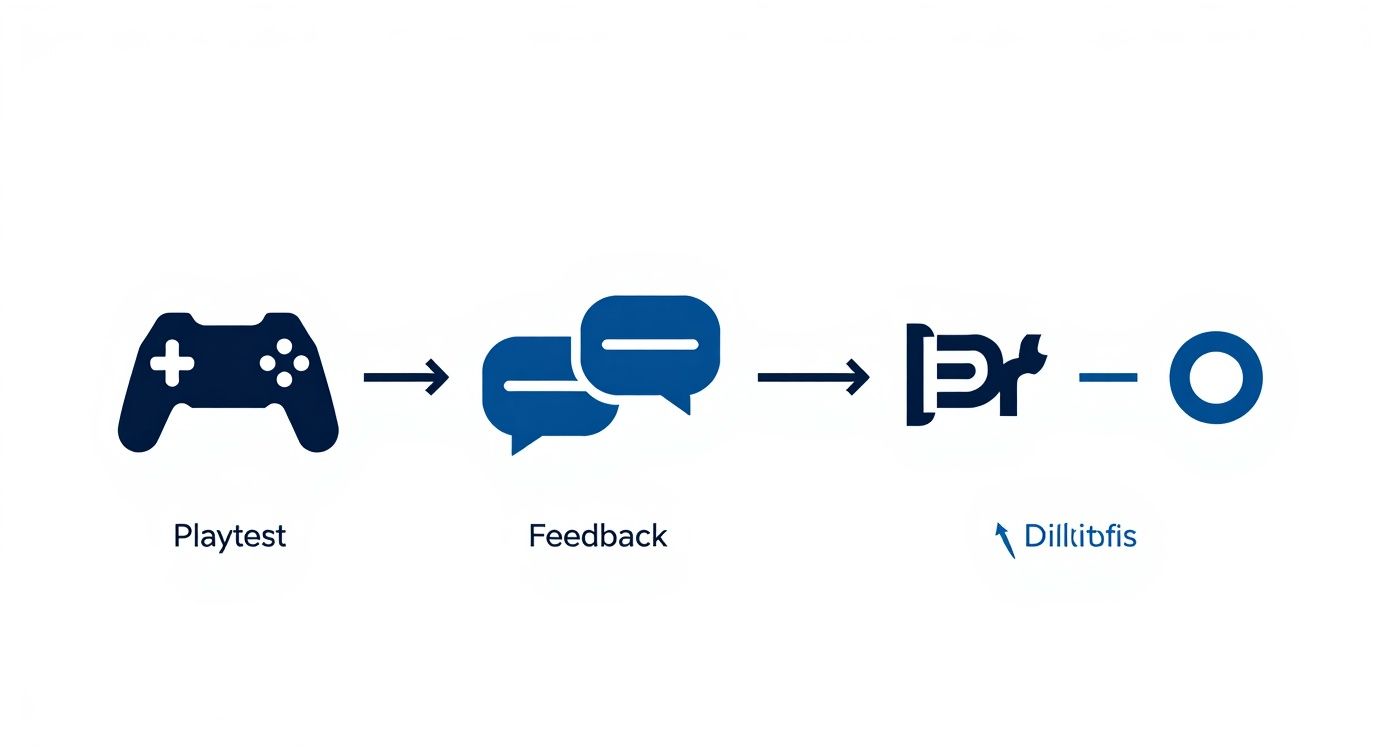
The Playtesting Workflow
You can't just hand your story to a few friends and ask them to "try it out." That won't get you anywhere. To make real improvements, you need specific, actionable feedback. This is where a solid playtesting checklist becomes your most valuable tool.
Make sure your checklist zeroes in on the most critical areas:
- Narrative Coherence: Does the story actually hold together across different paths? Keep an eye out for plot holes that only pop up when a player makes a very specific sequence of choices.
- Character Consistency: Does the AI character stay in character? You need to flag every single instance where the AI "hallucinates" or does something that betrays its core personality. This is almost always a sign that your main prompt needs tweaking.
- Emotional Impact: Are the tense scenes actually creating tension? Do the big emotional payoffs actually land? Ask your testers to point out the parts they found most and least engaging.
- Boundary Testing: What happens when a player tries to break the game? You need to see how the AI handles absurd inputs. Does it gracefully steer the conversation back on track, or does it fall apart? This is a direct test of the safety guardrails you built.
The real breakthrough comes when you start analyzing the feedback. Look for patterns. If three separate testers say a certain choice feels pointless, it probably is. If everyone gets lost in the second act, you haven't left enough narrative breadcrumbs.
This kind of back-and-forth design process is standard for any kind of interactive story. We’ve seen a massive boom in this space, with platforms like Choice of Games and Twine hitting millions of downloads. A huge chunk of that audience is adults—Choice of Games alone has put out over 200 titles aimed at a mature readership. With the market expected to grow at a CAGR of over 10% through 2025, there's a real hunger for polished, well-tested interactive fiction. You can dig deeper into the growth of interactive fiction in this market analysis.
Iterating Based on Feedback
Once the data is in, it's time to roll up your sleeves. The feedback should point you directly to the parts of your story or AI that are broken. Don't be precious about your work—be ready to make big changes.
Tools like Twine are fantastic for this because they give you a visual map of your entire story structure, which makes finding and fixing broken branches much easier.
This kind of visual layout lets you see exactly where the story forks and where it comes back together. It’s perfect for spotting the illogical paths or dead ends your testers ran into. The big takeaway here is that you can surgically fix the weak spots without having to tear down the whole narrative and start over.
In the end, testing is a loop. You get feedback, you analyze it, you make targeted fixes to your story and AI prompts, and then you send it back out for another round. Each cycle makes your adult choose your own adventure stronger, tighter, and more emotionally resonant, ensuring the final product is a journey worth taking.
You've built it. The branching paths are a tangled, beautiful mess, the AI characters feel like they could walk right off the screen, and you've got your safety guardrails firmly in place. Now for the exciting part: getting your adult choose-your-own-adventure into the hands of players. A brilliant story that no one plays is just a well-kept secret. It's time to shout it from the rooftops.
Your first big decision is where your story will live. You don't need a huge publisher or a massive budget to find your people. Communities like itch.io are fantastic starting points, full of players actively looking for unique and indie interactive fiction. If you're more technically inclined, spinning up your own simple web app gives you complete control over the experience and a direct relationship with your audience.
Monetizing Your Narrative
Okay, let's talk about getting paid. Once you've picked a home for your story, you need a plan to make it financially viable. I've seen a few models work really well in this space.
- One-Time Purchase: This is the classic, straightforward approach. Players pay once, they get the whole story. Clean, simple, and no surprises for anyone.
- Episodic Releases: Think of your story like a TV series. Releasing it in chapters builds suspense and can generate a steady, predictable income stream. It also keeps players coming back for more.
- Freemium with In-App Purchases: This is a great way to get people hooked. Give away the first chapter for free. If they love it, they can buy subsequent chapters, extra scenes, or even cosmetic tweaks. It lowers the barrier to entry and can attract a much larger initial player base.
Finding Your Tribe
Marketing an interactive story isn't about casting a wide net; it's about finding the right people. Your most powerful tool here is a killer demo. Slice off a piece of your story that showcases its absolute best—a gut-wrenching decision, a shocking plot twist, or a truly memorable character moment. Let them taste what you've created.
Then, go where your audience already is. Dive into subreddits, Discord servers, and forums that are all about interactive fiction, visual novels, or the specific genre you're writing in. These places are gold mines for finding early adopters who will champion your work.
Another pro-tip? Reach out to streamers and influencers who specialize in narrative games. A single, authentic playthrough from the right personality can put your story in front of thousands of potential fans overnight.
Remember, launch day isn't the finish line. It's the beginning of a conversation. The feedback you get from real players is what will help you iterate, refine, and make your next story even better.
Got Questions? We've Got Answers
Diving into the world of AI-driven adult choose your own adventure stories can feel like a lot at first. It’s natural to have questions pop up, especially when you're just getting your bearings. Let's tackle some of the most common ones I hear from creators.
Do I Really Need to Be a Coding Whiz to Build an AI Story?
Honestly, no. That's one of the biggest misconceptions. While knowing how to code certainly opens up more advanced possibilities, it's far from a requirement these days.
Tools like Twine offer visual editors that let you map out your story without writing a single line of code. And when it comes to the AI part, most APIs are designed to be accessible. You’ll often just be working with simple code snippets you can find in any good tutorial. The real magic isn't in complex code; it's in your storytelling and how cleverly you write your prompts.
My AI Characters Keep Forgetting Things. How Do I Keep Them Consistent?
This is a classic problem, but it’s solvable. The trick is a two-pronged attack: a rock-solid character bible and a basic memory system.
First, your initial prompt is everything. Think of it as your character's DNA—it needs to spell out their personality, motivations, backstory, and even their speaking style in detail.
Second, you need to give the AI a little nudge to remember recent events. You can do this by programmatically sending a brief summary of the last few interactions back into the context window with each new prompt. It’s like whispering in the AI's ear, "Hey, remember this just happened," before it decides what to say next.
Pro Tip: A detailed core prompt defines who the character is, while a memory summary reminds them of where they are in the story. Nailing both is the secret to a believable, consistent character over a long and winding narrative.
How Do I Keep My Story From Becoming an Unmanageable Tangle of Branches?
It's tempting to create a new branch for every single choice, but that's a fast track to chaos. Don't do it. Instead, think like a screenwriter and map out only the major, story-altering decision points—the ones that lead to fundamentally different outcomes. A visual tool is your best friend here.
For all the smaller choices in between, lean on a 'state-tracking' system. It works like this:
- A player's choice doesn't create a new branch. Instead, it changes a variable, like a character's trust level from +1 to +2.
- Later, at a major plot point, the story checks that variable. A high trust score might unlock a special dialogue option, while a low one could lead to betrayal.
This method gives smaller choices real weight without making your story map look like a plate of spaghetti. It's efficient, powerful, and so much easier to manage.
Ready to bring your own unforgettable characters and worlds to life? With Luvr AI, you have the tools to design incredibly lifelike AI companions and build the kind of immersive stories you've always wanted to create. Start building your dream adventure today.