


Create Your Own AI Girlfriend 😈
Chat with AI Luvr's today or make your own! Receive images, audio messages, and much more! 🔥
4.5 stars


Ever played a choose-your-own-adventure book? An AI text adventure is like that, but supercharged. It’s an interactive story where every choice you make genuinely matters, all powered by an AI that creates the world, characters, and consequences right on the fly. It's not a pre-written path; it's a dynamic world that reacts to you.
Your Gateway to Unforgettable Interactive Storytelling
If you've ever wanted to build your own interactive world, you’re in the right place. This guide is your complete roadmap for creating AI text adventures on Luvr AI that feel alive. We're not just talking about generic stories here—we're getting into the nuts and bolts of crafting narratives that truly grip players and developing characters with real, believable personalities.
The goal isn't just to write a story. It's to build an entire experience where your audience feels seen, understood, and totally lost in the world you’ve built.
We're going to walk through everything you need to know:
- How to dream up and design compelling stories, whether you're into fantasy epics, steamy romance, or futuristic sci-fi.
- The art of crafting characters that feel real, including how to handle NSFW themes creatively and responsibly.
- Mastering the prompts that create dynamic, branching paths, making the story feel like it’s responding to a player's every whim.
And people are hungry for this kind of thing. The market for AI text generators—the tech that makes this all possible—is exploding. It shot up from $335.1 million in 2021 to an estimated $534.78 million in 2024. Projections show it could hit a staggering $2,214.07 million soon. This isn't just a niche hobby; it's a rapidly growing industry, as detailed in market insights from SkyQuest.

Why Luvr AI is Your Ultimate Creative Playground
Platforms like Luvr AI are giving creators the tools to turn these wild ideas into playable realities. It’s built specifically for this kind of interactive storytelling, and we'll show you exactly how to use its features to get your first adventure off the ground.
Whether you're an experienced writer or just someone with a cool idea, this guide will give you practical, actionable advice to build something that really connects with people.
The real magic of an AI text adventure lies in its ability to surprise both the creator and the player. You're not just telling a story; you're setting a stage for infinite stories to unfold based on genuine, unscripted interaction.
Think of this guide as the framework. Your imagination is what will truly bring it to life.
Laying the Groundwork for Your Story and World
Every truly great text adventure, the kind that sticks with you long after you've logged off, starts with a single, killer idea. This is the soul of your story. Before you get lost in the weeds of prompt engineering or character design, you need a rock-solid vision for the world you're about to build.
Think of yourself as an architect. You wouldn’t just start throwing up walls and hope a house appears, right? You need a blueprint. The same goes for crafting a compelling narrative. Start by just riffing on themes that get you excited. Are you thinking of a sprawling fantasy epic? A gritty cyberpunk mystery? Or maybe something more intimate, like a slow-burn romance in a forgotten, magical city?

Defining Your Core Concept and Conflict
Once you've landed on a theme, it's time to sharpen it. "A space adventure" is okay, but it’s flimsy. It doesn't give you, or the player, anything to grab onto. Now, try this: "A rogue trader must choose between betraying their smuggling crew to a corrupt galactic federation or risking it all on a high-stakes heist." See the difference? That's a concept with immediate tension. It has stakes.
This core conflict is the engine that will drive your entire story. It shapes every character's motivations, every plot twist, and every single choice the player agonizes over. To make it hit hard, make sure it’s a real dilemma with no easy "correct" answer.
- Internal Conflict: Is your main character wrestling with a personal demon, a dark secret, or a moral crossroads? This is the secret sauce for deeply personal, character-driven stories.
- External Conflict: Are they up against a monolithic corporation, a terrifying monster, or just the brutal reality of a post-apocalyptic wasteland?
The best adventures, I’ve found, weave these two together. A knight fighting a dragon (external) is far more interesting if they’re also battling their own crippling fear (internal). That layering is what creates a truly rich experience.
The most memorable AI text adventure worlds feel grounded because they have established rules and clear stakes. When players understand what's possible and what's at risk, their choices gain weight and significance.
Structuring the Narrative Arc
With your conflict locked in, you can start sketching out the journey. Even in a wildly branching story, a classic three-act structure is an incredibly reliable roadmap. It gives your adventure a satisfying rhythm.
- The Setup: Introduce your world and the key players. You're establishing the "normal" before you shatter it. This is where the player gets their bearings.
- The Confrontation: Now, you crank up the heat. The challenges get harder, new allies and enemies emerge, and the player is forced to make decisions that have real consequences. This is the meaty, exciting part of your adventure.
- The Resolution: Everything comes to a head. The central conflict is confronted head-on, and the player’s choices culminate in one of several possible endings.
Try to pinpoint the major turning points in your story. What's the catalyst that kicks everything off? Is there a midpoint twist that completely flips the script? Having these key moments mapped out helps you keep the momentum going, no matter which path a player decides to take.
Keeping Your Scope Realistic
It’s so easy to dream up a massive, sprawling epic with dozens of characters and a web of infinite branching paths. I’ve been there. But trust me on this: the single biggest enemy of a finished project is an unmanageable scope.
A smaller, polished, and complete AI text adventure is infinitely better than an ambitious masterpiece that never sees the light of day.
Start with something focused. One primary location, a handful of well-developed characters, and a clear main questline is the perfect starting point. You can always build on it and expand the world later. Once you get a feel for the tools and the process, you can start thinking bigger.
And while the story is king, don't forget that powerful visuals can make your world feel real. As you work on the narrative, think about the art that will accompany it. For some great ideas on creating imagery that matches your story's tone, check out our guide on generating high-quality AI character images.
Breathing Life into Your AI Characters
Your story and world might be the stage, but the characters? They're the very soul of your AI text adventure. A player can forget a minor plot point, but they’ll always remember a character who made them feel something real. Crafting these personas isn't about just listing traits; it's about weaving a complex tapestry of desires, flaws, and secrets.
Forget the one-dimensional hero or the cartoonishly evil villain. The characters that truly stick with us are a study in contradictions. Think about a hardened mercenary who secretly writes poetry, or a charming aristocrat hiding a ruthless ambition behind a disarming smile. It's these layers that make them feel unpredictable and, most importantly, human.
Beyond the Character Sheet
To really get started, you have to push past simple descriptions like "brave knight" or "witty rogue." You need to dig into the questions that truly define a person, whether they're made of code or flesh and blood.
- What's their core motivation? Are they driven by love, revenge, or a quest for power? Or is it something more subtle, like a desperate need for acceptance?
- What are they terrified of? Fear is an incredible driver of action. A character's greatest fear often points directly to their greatest vulnerability.
- What secret are they hiding? Everyone has secrets. A hidden past, a forbidden love, or a shameful act can inject fantastic tension into your narrative.
This process transforms a character from a simple game piece into a living, breathing entity. Their backstory informs their present, their fears shape their decisions, and their secrets create golden opportunities for surprise and discovery.
The real goal here is to create characters that feel like they have a life beyond the player's immediate view. They should have routines, relationships, and opinions that exist whether the player is there to see them or not. That's what makes the world feel truly alive.
This kind of depth is exactly what separates a basic chatbot from a genuine virtual companion. The entire game changed when ChatGPT hit 100 million monthly users just two months after its 2022 launch, completely resetting user expectations. People now crave authentic connection. It's no surprise that an incredible 88% of people interacted with chatbots last year, showing a massive appetite for the kind of immersive role-play that platforms like Luvr AI deliver. You can dig into more of these astounding AI growth statistics yourself.
Crafting Nuance and Flaws
Let's be honest: perfection is boring. A character's flaws are what make them relatable and interesting. A flawless hero is just an archetype, but a hero who is brilliant yet struggles with crippling arrogance? That’s a personality. Don't ever be afraid to give your characters real weaknesses.
Think about how these traits come through in their dialogue. A character's speech pattern is a direct window into their soul.
- A nervous scholar might use overly complex words and stutter when flustered.
- A confident commander probably speaks in short, direct, authoritative sentences.
- A whimsical fae creature could speak entirely in riddles and metaphors.
When building a character on a platform like Luvr AI, you can actually build these personality quirks right into their core programming. The AI character chat features let you define not just what they say, but how they say it, keeping every interaction consistent and authentic.
To truly build a compelling AI persona, it helps to break down their traits into core elements and the subtle details that bring them to life.
Essential Character Trait Development
| Trait Category | Core Element Example | Nuanced Detail Example |
|---|---|---|
| Personality | Confident and Outgoing | Secretly insecure, overcompensates with bravado. |
| Backstory | Orphaned as a child | Resents happy families but pretends not to care. |
| Motivation | Seeks justice | Motivated by a past injustice against their family. |
| Flaws | Impulsive | Tends to make rash decisions when their loyalty is questioned. |
| Speech | Eloquent and formal | Switches to coarse, simple language when angry. |
By layering these core and nuanced details, your character starts to feel less like a script and more like a person with a history.
Handling NSFW Character Development
For a lot of creators, exploring adult themes is a crucial part of their storytelling. When approaching NSFW character development, the key is to be intentional. It shouldn't be there just for shock value; it should serve the character's arc or the plot.
An NSFW scene can be a powerful tool to reveal vulnerability, deepen a bond between characters, or show the consequences of someone's deep-seated desires or flaws. As you design these aspects, always focus on consent and context. The character's personality has to dictate their behavior. A shy, reserved character's approach to intimacy will be worlds apart from a bold, confident one's. On Luvr AI, you can define these boundaries and preferences, ensuring the AI responds in a way that’s true to the character you’ve so carefully built. This thoughtful approach makes the experience far more meaningful and respectful for everyone involved.
Mastering the Art of Prompt Engineering
If your character is the soul of your story, then prompt engineering is what teaches it how to dance. This is where the magic really happens in your ai text adventure. It's the technical craft that turns a static narrative into a dynamic world that twists and turns with every single choice the player makes. This is how you create the branching paths and reactive scenes that make interactive fiction so damn addictive.
You have to stop thinking of prompts as simple commands. Think of them more like a director giving notes to an actor. You aren't just telling the AI what to say; you're guiding how it should feel, what it should focus on, and how it needs to pivot when a player does something you never saw coming. A well-written prompt is the difference between an adventure that feels like it’s on rails and one that feels truly alive.
The whole process builds on itself. The better you define your character's core, persona, and unique quirks, the more material you have to fuel your prompts.
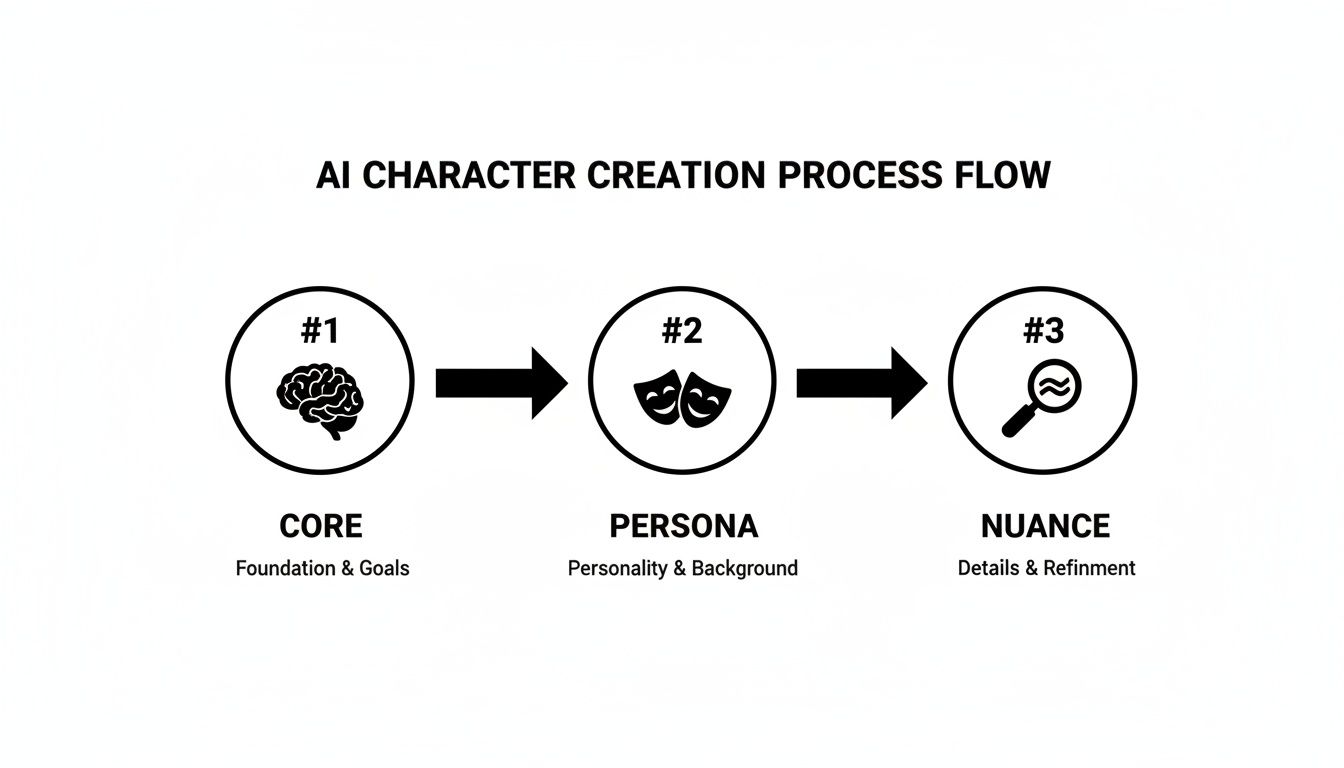
As you can see, great prompts don't come from nowhere—they’re born from a deep understanding of who the AI is supposed to be in that moment.
The Anatomy of a Powerful Prompt
A truly effective prompt does more than just ask the AI to describe a room. It weaves together layers of instructions, context, and creative guardrails to shape the final output with surgical precision. It’s like building with LEGOs; every little piece is an instruction that adds to the bigger picture.
Most of my strongest prompts include a few key ingredients:
- Role and Persona: First, tell the AI who it is. Is it the all-knowing narrator? A snarky goblin? A seductive vampire? This sets the entire tone.
- Context and State: Give it a "Previously on..." recap. Where is the player? What just happened? This anchors the AI in the story's present.
- Objectives and Goals: What's the point of this scene? Does a character need to drop a cryptic hint? Does the forest need to suddenly feel more menacing? Be specific.
- Constraints and Rules: This is where you really take control. You have to tell the AI what not to do. Things like, "Do not reveal she's the traitor yet," or "Keep the dialogue flirty but evasive."
When you combine these elements, you give the AI a solid framework to build from, but with enough creative wiggle room to surprise you. Getting this right is absolutely essential. The market for AI-generated content hit $12.88 billion in 2024 and is expected to rocket to $53.79 billion by 2033. That explosive growth is all about creating sophisticated, believable interactions. You can dig into the rise of AI-generated content on Grand View Research to see just how big this is getting.
From Theory to Practice: Good vs. Bad Prompts
Let’s make this real. Picture a player in a dusty crypt, trying to pick the lock on an old treasure chest.
A 'Bad' Prompt:The player tries to open the chest. Describe what happens.
This is lazy. It’s a total gamble. The AI might just spit out, "The chest opens," instantly killing the mood. There’s no direction, no tension, no personality.
A 'Good' Prompt:**Persona:** You are the ancient, mischievous spirit guarding this crypt. **Context:** The player, a clumsy but determined adventurer, is fumbling with the lock on your treasure chest. **Objective:** Build tension. Describe their attempt as difficult, highlighting the intricate, rusty lock. Hint that there's a magical trap without saying it outright. **Constraint:** Do not let them succeed on the first try. Make them feel the chill of the crypt and your ghostly presence watching them.
See the difference? This one is packed with flavor. It gives the AI a personality to embody, a clear goal for the scene, and hard rules to follow. The result is going to be a far more memorable and engaging moment for the player.
Your prompt is a conversation with the AI. The more detail, context, and personality you provide, the more nuanced and compelling its response will be. Treat the AI as a creative partner, not just a content machine.
Implementing Branching Mechanics in Luvr AI
This is where you bring it all together inside the Luvr AI scenario builder. The platform is designed specifically to help you manage these complex, branching interactions without needing to write a single line of code.
When you present a player with choices, you're really just setting up different prompt pathways for the AI to follow.
For every choice, you’ll write a custom prompt that dictates the consequence.
- Choice A leads to Consequence A: The player chooses to "threaten the guard." Your next prompt for the guard character should be loaded with a personality that reacts badly to intimidation—maybe he gets aggressive, calls for backup, or just shuts down completely.
- Choice B leads to Consequence B: The player decides to "bribe the guard" instead. Now, the prompt should trigger the guard’s pre-defined greed (or, perhaps, his unwavering loyalty), leading to a totally different outcome.
This structure is what makes player decisions feel like they actually matter. By handcrafting a unique prompt for every possible branch, you're not just writing a story; you're building a web of possibilities. It’s what makes an ai text adventure so replayable and keeps players coming back to see what they missed.
Bringing Your Adventure to Life on Luvr AI
You've done the hard work. You’ve built a world from scratch, crafted unforgettable characters, and woven a narrative that’s ready to be explored. Now for the fun part: sharing it. Launching your ai text adventure on Luvr AI is where your project stops being a file on your computer and becomes a living experience for others to discover. This is your chance to make a first impression that sticks.
Think of your adventure's profile page as its book cover and back-blurb all in one. It has to be compelling enough to make someone stop scrolling. A killer title and a sharp, intriguing description are your best friends here.
Don't just summarize the plot. Hook them with a question or a tantalizing glimpse of the world. Instead of "A cyberpunk mystery game," try something like, "In the rain-slicked streets of Neo-Veridia, a conspiracy is brewing. Can you expose the truth before you become another ghost in the machine?" You're not just describing a story; you're selling an experience.
Setting the Stage for Success
Getting your adventure set up on Luvr AI is straightforward, but the details are what separate the hits from the misses. Your goal is to create a profile that perfectly captures the tone and content of your story so you attract the right kind of players from the get-go.
This is where tags become absolutely essential. They’re like signposts guiding players directly to your creation. Be specific.
- Genre Tags: Don't just settle for "Fantasy." Are we talking "Dark Fantasy," "Epic Quest," or maybe a "Magical Romance"? The more precise you are, the better.
- Theme Tags: What’s the emotional core of your story? Use tags like "Slow Burn," "Betrayal," "Found Family," or "Psychological Thriller" to connect with players looking for that specific vibe.
- NSFW Tags: If your adventure leans into adult themes, tag it correctly. This isn't just about rules; it's about respect for player choice and finding an audience that genuinely wants what you've created.
The adventures that truly take off are the ones that find their tribe. A well-crafted profile with accurate tags doesn't just get you more players—it gets you the right players, the ones who will become your biggest fans.
With your profile looking sharp, it's time for the most crucial pre-launch step: testing. You’re too close to the project to see its flaws. You need fresh eyes. Find a few trusted friends to act as beta testers and tell them their job is to try and break everything.
Give them a clear mission. Ask them to hunt for:
- Narrative Dead-Ends: Any choices that lead to a brick wall or an unsatisfying, abrupt ending?
- Logic Breaks: Does a character suddenly forget who the player is or contradict something they said five minutes ago?
- Typos & Grammar: Little errors can shatter immersion in a second.
- Confusing Choices: Are there options where the outcome feels completely random or disconnected from the prompt?
This feedback is pure gold. It gives you the chance to patch the holes and smooth out the rough spots before the public ever sees it, ensuring a polished experience for your first real players.
From Launch to Living World
Going live isn't the finish line; it’s the starting gun. Your launch begins a conversation with your players, and Luvr AI's community tools are your direct line to that audience.
Set up a space, maybe a Discord channel, to talk about your adventure. Jump in, chat with players, and actually listen to what they have to say. Their feedback is the most powerful tool you have for making your story even better. They’ll tell you which characters they love, which plot points are confusing, and what they’re dying to see next.
Use these insights to iterate. Maybe you add a new branching path based on a popular request or expand the backstory of a fan-favorite character. This is how a static project becomes a living, breathing world. Over time, you can even explore monetization options on the platform, turning a passion project into something more. It all begins with a solid launch and a real commitment to the community you build around your story.
Ready to see how it all works? You can jump right in and start playing with the creation suite using the Luvr AI adventure builder.
Got Questions About Your AI Text Adventure? We've Got Answers.
Jumping into the world of AI-powered storytelling can feel a little daunting. You've got this incredible idea, but a ton of questions are probably swirling around. How much control do you really have? What are the boundaries? Let's tackle some of the most common things creators wonder about when they start building their first AI text adventure.
Think of this as less of a technical deep dive and more of a guide to the creative sandbox you're about to jump into. Getting these fundamentals down from the start will give you the confidence to build something truly memorable.
Can I Make My AI Text Adventure Totally Private?
Absolutely. One of the biggest myths is that anything you create has to be for public consumption. On Luvr AI, privacy isn't just an option; it's baked into the core of the platform. You have 100% control over who sees your work.
When you're building out a new character or a fresh scenario, you can simply set its status to private. That means it’s for your eyes only, accessible just to your account. This is perfect for a few key situations:
- Freely experimenting with wild or off-the-wall story concepts without any judgment.
- Exploring personal fantasies or narratives that are just for you.
- Working on a big project behind the scenes before you're ready for the grand reveal.
Your private adventures are exactly that—private. They aren't indexed, they aren't shared, and no one else will ever see them unless you make the conscious choice to hit that publish button.
What's the Deal with Creating NSFW Content?
Let's be direct: Luvr AI is a platform built for an adult (18+) audience, and we fully permit the creation of NSFW content. You have the freedom to design characters and build scenarios with explicit romantic, intimate, or otherwise mature themes. We're big believers in creative expression.
But that freedom comes with a very clear responsibility to create ethically. All content must be legal and built on a foundation of consent. That means:
- Your stories can't depict or endorse any illegal acts.
- Hate speech, harassment, and non-consensual themes are strictly forbidden and will not be tolerated.
The platform gives you robust tools to tag your content as mature, which is a crucial step. It ensures your adventure finds its intended audience while letting other users filter their experience. The whole idea is to give you a space to be expressive and creative, but always within clear, respectful boundaries.
How Do I Make My Branching Story Feel Less... Robotic?
The secret sauce to a natural-feeling narrative is focusing on character motivation, not just a checklist of plot points. A story feels stiff and scripted when it hinges on rigid, mechanical choices. To break free from that, you need to give the AI a soul to inhabit, not just a list of commands.
Forget prompts like, "If the user chooses to fight, then begin the battle." Instead, dig into the character's identity.
For instance, a core prompt for a character could be: "You are Kael, a disgraced knight haunted by your past. You're fiercely protective of the innocent, but you live in constant fear of leading others to their doom again."
This simple directive is gold. It empowers the AI to react dynamically. If the player proposes a reckless plan, Kael won't just trigger a pre-written scene; he’ll respond with hesitation, caution, or maybe even outright defiance, all stemming from his defined personality. When you use Luvr AI's character builder to flesh out backstories, fears, and desires, you're giving the AI the raw material it needs to make your AI text adventure feel unscripted and alive.
What if I'm Not a "Good Writer"?
You absolutely do not need to be the next Tolkien to create a captivating adventure. Honestly, the most important skill isn't crafting perfect prose; it’s having a strong, creative vision for your world and the people in it.
Think of the AI as your co-pilot. Luvr AI's generative engine can handle a lot of the heavy lifting with descriptive language and dialogue flow. Your real job is to be the director, focusing on the big picture:
- Dream up an interesting concept that hooks you.
- Create compelling characters with clear goals and flaws.
- Design meaningful choices that actually have consequences.
So many of the most loved text adventures are successful because of a brilliant core idea, not because every sentence is a literary masterpiece. Start small with a focused story to get a feel for the tools. And don't forget—the community is an amazing place to get feedback, find inspiration, and get a little help when you need it.
Ready to answer your own creative calling? Stop wondering and start building. With Luvr AI, you have everything you need to create the interactive stories you’ve always dreamed of. Dive into our intuitive builder and bring your world to life today.