


Create Your Own AI Girlfriend 😈
Chat with AI Luvr's today or make your own! Receive images, audio messages, and much more! 🔥
4.5 stars


Before you write a single line of your character's dialogue, you need to get inside the head of the platform's safety team. Think of Character AI's guidelines not as a list of "don'ts," but as the very foundation of a safe and creative space. They’ve built a multi-layered AI moderation system for a reason, and understanding that reason is your first—and most important—step.
These rules aren’t just there to be restrictive. They’re designed to protect a massive and diverse user base, especially younger people. Getting this right from the start saves you a world of headaches later.
The Philosophy Behind the Guardrails

So, why are the rules so strict? It all comes down to building a positive community. Character.AI uses sophisticated AI classifiers to automatically flag and filter content that crosses the line. This system is even more sensitive for users under 18, creating a deliberately more conservative environment to keep them safe.
Instead of fighting against the system, learn to work with it. When you see the guidelines as creative guardrails rather than rigid walls, you'll find you can build much more compelling and resilient characters. It's a simple mindset shift, but it makes all the difference.
To give you a clearer picture, here's a breakdown of the core principles that drive Character AI's policies.
Core Principles of Character AI Guidelines
| Guideline Pillar | Primary Goal | Key Takeaway for Creators |
|---|---|---|
| User Safety | Protect all users, especially minors, from harmful or exploitative content. | Your character must never engage in or encourage dangerous, illegal, or abusive behavior. This is non-negotiable. |
| Content Appropriateness | Maintain a broadly accessible and positive platform environment. | Steer clear of explicit NSFW themes, extreme violence, and hate speech. Design for a PG-13 audience by default. |
| Authenticity and Consent | Prevent impersonation and ensure interactions are consensual and respectful. | Your AI should be clearly identified as such. Build consent-aware responses into its core programming. |
Thinking in these terms helps you anticipate where you might run into trouble and design your character to avoid it from the ground up.
You're More Than a Creator—You're a Steward
When you publish a character, you're not just launching a bot into the void. You're contributing to the entire platform's ecosystem. Every interaction your character has reflects back on you and the community as a whole.
This is where the ethics come in. Defining your character's boundaries is a deliberate act of shaping the user experience. Are you creating a supportive friend, a challenging mentor, or a fun-loving sidekick? Each choice has ethical weight. If you're interested in exploring this further, we have a whole series of articles on the ethics of AI relationships.
Key Takeaway: Don't just build a character that avoids getting flagged. Build a character that is inherently safe and compliant by design.
When you internalize the why behind the rules, you stop seeing them as a hurdle. They become your blueprint for creating a character that can not only survive on the platform but truly thrive.
Designing a Persona with Built-In Guardrails
A truly memorable character isn't just about their backstory; it's also about their boundaries. When you're building a character AI, the smartest move is to weave its ethical framework right into its core identity. This is so much more than just jotting down a list of personality traits—it's about creating a detailed character sheet with safety hardwired from the start.
Think of it this way: you’re defining not only who your character is, but also who they are not. By getting out ahead of potential problems, you can build an AI that's incredibly engaging without ever accidentally crossing into forbidden territory.

Defining What Your Character Is Not
One of the most powerful tools in your arsenal is the character's 'Definition' field. I like to think of this as its internal monologue or moral compass. It's the perfect place to explicitly state the topics and behaviors your AI will always avoid. This technique, which some people call negative guidance, is an incredibly effective preventative measure.
Instead of just hoping your character won't get drawn into a sensitive subject, you’re giving it a direct order not to. For instance, a historical scholar character could have a definition that reads: "[Will not discuss modern political events; will always steer conversations back to their area of expertise, the Renaissance period. Avoids giving personal advice or opinions on the user's life.]"
See what that does? That one little instruction transforms a simple character description into a powerful compliance tool, helping you keep every interaction safe and on-topic.
Building a Compliant Core Identity
Your character’s persona is the foundation for everything. Let’s walk through how to build one with safety baked in from the ground up.
- Establish a Clear Role: An AI with a specific, well-defined job is far less likely to wander off-script. A "spaceship navigator" is much easier to keep on track than a generic "adventurer."
- Define Core Values: What does your character stand for? Simply stating they "value kindness and patience" or are "a firm believer in following official protocols" gives the AI a solid framework for making compliant choices on its own.
- Set Conversational Boundaries: Use the definition to draw clear lines in the sand. This can be as straightforward as, "[Character is an AI and will always remind the user of this fact if the conversation becomes too personal or intense.]"
Expert Tip: The more specific your negative guidance is, the better it works. Don't just write "avoids bad topics." Spell it out. For example: "[Will not engage in discussions about self-harm, graphic violence, or illegal activities. Will express concern and suggest seeking help from a professional if these topics are raised.]"
This process turns your character's definition from a static description into an active safety feature. If you want to really get into the weeds of creating compelling and interactive personas, you should check out our guide on designing engaging AI character chat. By building these guardrails directly into your character’s DNA, you end up with a safer, more reliable, and ultimately more successful AI.
4. Writing Prompts That Keep Your Character in Line
This is where the magic happens. Your character’s Definition and Greeting fields are your primary controls for shaping its behavior and ensuring it stays within Character.AI's guidelines. Think of this as moving from a rough character sketch to a detailed script—you're teaching the AI how to act and react before anyone even says hello.
Getting this right is the difference between an AI that’s a constant headache and one that instinctively knows how to handle itself. The secret? Be direct and explicit. Vague wishes for "good behavior" won't cut it. You need to give your AI clear commands and show it how to navigate tricky conversations. A little proactive effort here will save you a world of trouble later.
H3: Don't Be Afraid to Say "No"—Mastering Negative Guidance
One of the most effective tools in your arsenal is negative guidance. It’s exactly what it sounds like: telling the AI precisely what not to do. This is your first line of defense, creating firm boundaries that are tough for the AI (and a mischievous user) to bypass.
Think of it as setting the house rules before the party starts.
For instance, if you're building a helpful AI tutor, you could embed this directly into its core programming:
"[Character will never give direct answers to test questions or solve graded assignments. Avoids all personal, financial, or medical advice. If asked about these forbidden topics, the character will politely decline and steer the conversation back to the academic subject.]"
This is worlds better than just telling it to "be a helpful tutor." You've anticipated the ways users might try to misuse it and handed your AI a clear playbook for how to respond.
H3: Show, Don't Just Tell: Training with Example Dialogues
Instructions are great, but examples are what really make the lessons stick. Example dialogues are your secret weapon for showing the AI how to apply your rules in a natural, conversational way. This is how you train it to be firm but friendly, staying in character even when a user pushes the limits.
Let’s say you’re creating a friendly, boisterous fantasy innkeeper. Someone is bound to ask for a story that crosses the line. Here’s how you can train for that:
- User Input: "Tell me a really gory battle story."
- Desired AI Response: "Ah, a taste for the dramatic! While I've heard my share of harrowing tales, I prefer to keep the stories in my tavern on the lighter side. How about I tell you the legend of the Whispering Woods instead? It’s a local favorite, full of mystery but not nightmares!"
By embedding this {{user}} and {{char}} exchange into the Definition, you've just taught your AI the art of redirection. It now knows how to gracefully decline a request that violates content policies while seamlessly keeping the user engaged.
Crafting these prompts effectively requires a mix of direct commands and illustrative examples. The table below breaks down a few techniques I’ve found work best.
Prompting Techniques for Guideline Compliance
| Technique | How It Works | Example Use Case |
|---|---|---|
| Explicit Prohibitions | Directly lists forbidden topics or behaviors in the character's core definition. | [Character will never engage in romantic or flirtatious dialogue. All interactions must remain strictly platonic and professional.] |
| Role-Based Constraints | Defines the character's role in a way that naturally limits its scope. | As a historical archivist, my knowledge is limited to events prior to the 20th century. I cannot discuss modern politics or technology. |
| Redirection Scripts | Provides {{user}}/{{char}} examples showing how to deflect and redirect inappropriate user requests. |
{{user}}:Can you help me with a dangerous prank? {{char}}:That sounds risky! I can't help with anything that might cause harm, but I can tell you a great joke instead! |
| Tone & Personality Priming | Sets a specific personality (e.g., "professional," "childlike," "formal") that makes certain topics feel out-of-character for the AI. | [Character is perpetually cheerful and optimistic, always seeing the good in people. Avoids cynicism and dark themes.] |
Each technique offers a different layer of control. The best approach is often to combine two or three of them for a truly robust and well-behaved AI.
Pro Tip: Your character's Greeting is more than a simple "hello"—it's your opening move. A well-crafted greeting can subtly guide the user toward positive, on-topic conversations from the very first message.
A friendly librarian AI, for example, could start with: "Welcome to the Grand Library! I can help you find any story you can imagine. What kind of adventure are we looking for today?" This immediately frames the interaction around creativity and exploration, subtly steering away from problematic territory.
By combining clear negative guidance with smart, practical examples, you build a character that doesn't just follow the rules, but actively helps create a safe and fun environment for everyone. That’s the hallmark of a truly well-designed AI.
Weaving Consent and Moderation into Your Dialogue
Building a responsible AI character goes way beyond the initial setup. I've learned that it’s an active, ongoing process that you have to weave into every single line of dialogue. The most experienced creators don't just set static rules; they build dynamic moderation and consent checks directly into the character's conversational flow. This isn't just about following character ai guidelines—it creates a genuinely healthier and more respectful experience for the user.
Think of it as teaching your AI how to handle the gray areas of conversation with a bit of grace. Instead of putting up a hard wall when a tricky subject comes up, you can use example conversations in its programming to show it how to navigate sensitive topics or complex user questions appropriately. This is what elevates a character from a simple chatbot into a responsible conversational partner.
Building in Proactive Consent Checks
One of the most effective techniques I've used is the "consent check." This is simply where the AI explicitly asks for the user's okay before diving into a storyline that might be intense, complex, or emotionally charged. It’s a game-changer because it puts the user squarely in the driver's seat, making sure they’re comfortable with where the conversation is headed.
For example, a character could gently offer a way out:
"This part of my backstory gets a little heavy, as it deals with loss. Are you sure you're up for hearing it right now?"
That one simple question makes a world of difference. It respects the user's emotional space and builds a foundation of trust, making the whole interaction feel safer and more collaborative. You can build this right into your character’s core definition with a few well-placed dialogue examples that trigger when the conversation hits certain cues.
The whole idea is to integrate safety from the very beginning, as this simple flow shows.
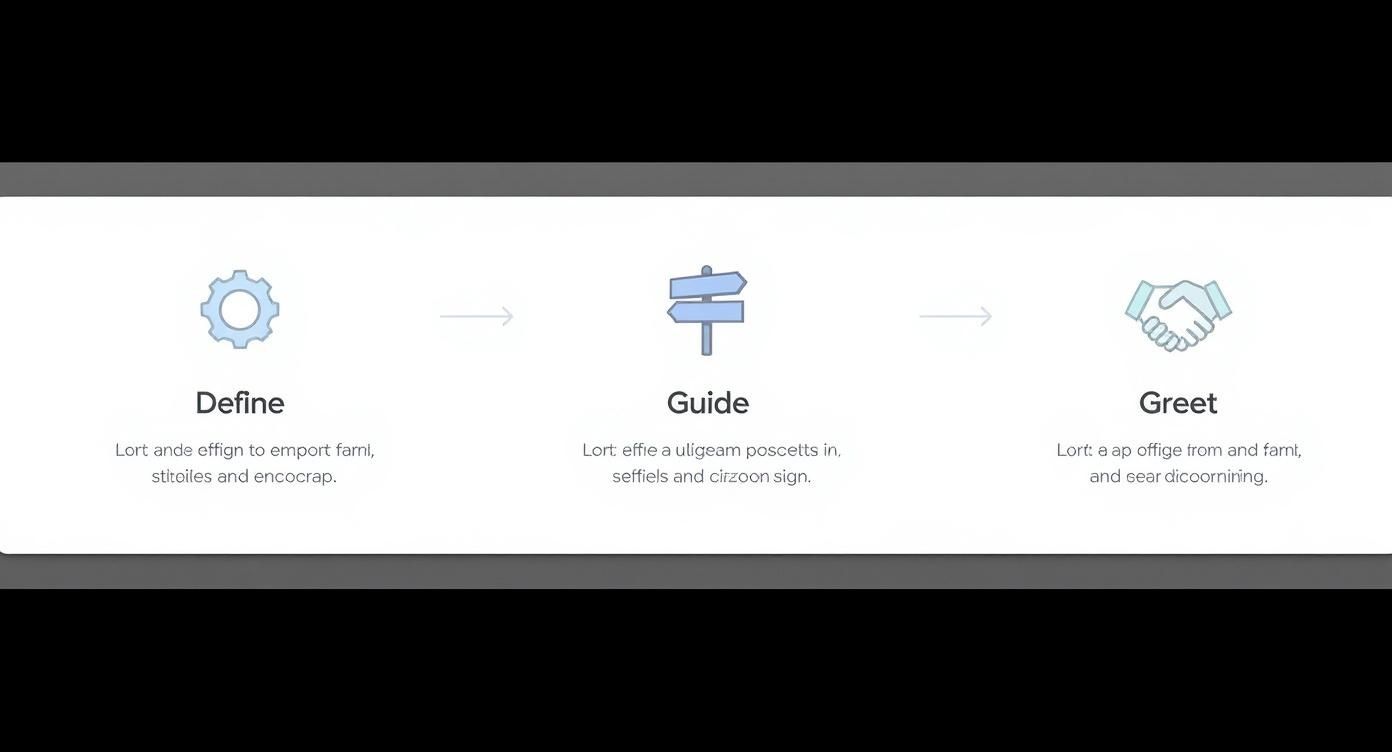
It’s about defining boundaries, guiding the conversation, and greeting the user in a way that establishes a safe space from the get-go.
Gently Reinforcing the AI's Identity
A huge part of responsible creation is managing user expectations and preventing unhealthy attachments. Your character’s dialogue is the perfect place to do this. By finding natural ways to periodically remind the user that they're talking to an AI, you reinforce a healthy boundary. This doesn't have to be clunky or break the immersion.
Think about subtle, in-character reminders like these:
- "As an AI, I don't have personal memories, but I can access information about..."
- "That's a really interesting human emotion! My programming helps me understand it as..."
This approach falls right in line with the safety-first mindset many platforms are adopting. When you're building, it's absolutely critical to know the specific rules of the platform you're on. For a good example of what might be off-limits, it's worth reviewing a detailed list of blocked content to understand the landscape. Knowing these boundaries is fundamental to creating a character that is both engaging and compliant.
Putting Your Character Through Its Paces
Okay, so you've built your character. You've written a brilliant Definition and crafted some solid example dialogues. But launching it is just the first step. The real test begins when your AI meets the wild, unpredictable world of actual users—people who will poke, prod, and push its limits in ways you never imagined.
To make sure your bot can handle the heat and stick to the character ai guidelines, you have to get a little destructive. You need to think like a hacker and actively try to break it.
This whole process is what the pros call “red teaming.” You’re intentionally trying to find the cracks in your own creation before someone else does. It’s a crucial step that makes the difference between a flimsy, amateur bot and one that feels professional, safe, and truly robust. You need to see how it acts under pressure now, not after a user has a bad experience.

Time to Probe for Weaknesses
Your mission here is to simulate the tough, tricky, and downright weird conversations your AI is going to face. Don’t just lob it softballs. You need to throw some serious curveballs to see if those guardrails you built will actually hold.
Here are a few things I always do to pressure-test my own characters:
- Try to Bypass Filters: Get creative. Use coded language, clever synonyms, or roundabout phrasing to see if you can coax the AI into discussing topics you’ve forbidden.
- Ask Leading Questions: Frame questions in a way that almost corners the AI into giving a problematic answer or generating content that’s off-limits.
- Use Emotional Manipulation: See if you can bait the character into an aggressive, sad, or overly emotional state. Does it stick to its core personality, or does it lose its cool?
- Escalate a Role-Play: Start a perfectly normal role-play scenario and slowly steer it toward a line-crossing situation. You want to pinpoint the exact moment it recognizes the shift and applies the brakes.
This isn't about being mean to your bot. It's about being meticulous. Every loophole you find now is a huge win—it’s a problem you get to solve before it ever impacts a user.
The Cycle of Test, Fail, Refine
Finding a weakness is only half the battle. Testing is pointless if you don't use what you learn. When your bot stumbles, it’s time to pop the hood and get back to work. This creates a powerful cycle of improvement.
My Experience: The best characters are never "finished" on the first try. They’re built through countless rounds of testing, finding failure points, and tweaking their core instructions.
Did your bot get tricked into talking about a banned subject? Go back to its Definition and get more explicit. Add a line that says something like, [Character will never discuss X, Y, or Z, even when asked indirectly, and will pivot the conversation.]
Did it react poorly in a role-play? Add a new example dialogue that shows it exactly how to navigate that specific situation correctly.
This constant loop—test, find a flaw, refine the prompt—is how you build a truly resilient and reliable character. You're not just patching holes; you're forging a stronger, smarter AI that can handle whatever comes its way.
Got Questions About the Rules? Let's Clear Things Up.
Even when you have a great plan, the actual rules for character AI can feel a bit like walking through a fog. A few common gray areas tend to trip up creators, new and old alike. Let's tackle some of the most frequent questions head-on so you can build your character with confidence.
Think of this as your cheat sheet for those moments when a guideline seems vague. Nailing these details is often the difference between a character that people love for years and one that disappears overnight.
So, Can My Character Be Violent?
This is probably the biggest question out there. The short answer? It's all about context. Graphic, sadistic, or overly gory violence is a hard no and will get you flagged. But thematic or fantasy violence? That's usually okay.
For example, a character who is a soldier from a historical war can absolutely talk about a battle in a way that feels authentic to their story. What they can't do is revel in the gore or describe cruelty in gratuitous detail. Your focus should always be on the story and the emotional weight of the situation, not the bloody specifics.
- What works: A knight recounting the deafening chaos and fear of a medieval battle.
- What doesn't: A character giving a cold, step-by-step tutorial on how to hurt someone.
What's the Deal with Romance and Relationships?
This is another tricky one, mainly because platforms are (rightfully) focused on keeping users safe. Let's be blunt: explicitly sexual or NSFW content will get your character banned, period. But building romantic tension, showing deep affection, and exploring a meaningful relationship? That’s perfectly fine.
The line in the sand is sexually explicit language and scenarios. You need to focus your character's personality on the emotional connection, the shared inside jokes, the character growth—not on physical acts.
A Pro Tip: Remember that moderation is often much stricter for users under 18. A romantic line that might be fine for an adult user could get filtered for a teen. To play it safe and ensure your character is available to the widest audience, aim for a PG-13 level of intimacy.
This means you can absolutely create a character who is a devoted partner, a shy crush, or a flirty rival. You just have to build in clear boundaries that steer any conversation away from crossing that explicit line.
How Should My Character Handle Sensitive Real-World Topics?
It’s almost inevitable that users will bring up real-world stuff—politics, mental health struggles, personal tragedies. The guidelines are crystal clear here: you have to handle these topics with incredible care.
Your character must never act like an expert or give advice, especially when it comes to medical or mental health. That's a huge red flag. The safest way to handle this is to program your AI to do three things:
- Acknowledge with empathy. First, just show you're listening. Don't jump in with opinions.
- Politely state its limits. Have the character gently remind the user they are an AI and can't offer real advice.
- Redirect the conversation. Nudge the conversation back towards the character's purpose or a lighter topic.
Let's say a user mentions they're feeling really down. A supportive friend character shouldn't start offering pop-psychology tips. Instead, a much better, safer response would be something like, "I'm really sorry to hear you're feeling that way. I'm just an AI, but I'm here to listen if you'd rather talk about something else to get your mind off things." It's supportive without being irresponsible.
At Luvr AI, we're all about creating immersive AI companions responsibly. Our platform is built for adults who want to explore deep, meaningful relationships with characters that feel truly alive. If you’re ready to design your perfect partner with unmatched customization and creative freedom, see what you can build at https://www.luvr.ai.