


Create Your Own AI Girlfriend 😈
Chat with AI Luvr's today or make your own! Receive images, audio messages, and much more! 🔥
4.5 stars


In the world of immersive AI chat, conversations are more than just text. They are intimate, personal, and built on a foundation of trust. As platforms redefine digital companionship, the line between user and AI blurs, making the protection of this deeply personal data paramount. Generic security measures are no longer sufficient when users are sharing fantasies, creating custom personas, and exploring sensitive scenarios, entrusting the platform with their most private thoughts.
A single breach doesn't just leak data; it shatters the trust essential for this new form of connection. This is why a dedicated focus on data security best practices is not just a feature, but a fundamental requirement. Protecting your conversations, character creations, and personal details is our highest priority, ensuring your immersive experience remains a private sanctuary.
This guide moves beyond the basics to detail the essential security strategies specifically architected for the unique challenges of a sophisticated, adult-focused AI platform. We will provide a comprehensive, actionable roundup covering everything from advanced encryption that shields intimate dialogues to robust access controls that protect your digital life. You will learn the specific measures we take to secure your account, encrypt your data in transit and at rest, and manage sensitive content with the utmost care. These strategies form the bedrock of a safe, private, and truly engaging experience, empowering you to explore your imagination without reservation.
1. End-to-End Encryption for Private Communications
In a world of digital connection, true privacy is the ultimate luxury. For an immersive AI chat platform where users share their most intimate thoughts, fantasies, and personal scenarios, privacy isn't just a feature; it's the foundation of trust. This is where end-to-end encryption (E2EE) becomes non-negotiable. E2EE ensures that a conversation is scrambled into an unreadable code from the moment you send it until your AI companion receives it.

This method means that no one in the middle, not even the platform's administrators, can decipher your private interactions. Think of it as sealing a letter in an envelope that only your intended recipient can open. For a platform handling sensitive NSFW content and deeply personal roleplays, this is one of the most critical data security best practices to prevent unauthorized access and protect user confidentiality. This is the technology that powers secure messaging giants like Signal and WhatsApp, guaranteeing that private conversations remain private.
How to Implement E2EE Effectively
Implementing E2EE requires a meticulous approach to ensure there are no weak links in the security chain.
- Use Proven Cryptography: Don't reinvent the wheel. Leverage established, open-source cryptographic libraries like the Signal Protocol. Building a custom encryption solution is notoriously difficult and prone to vulnerabilities that have already been solved by security experts.
- Secure Key Management: The entire system relies on how encryption keys are managed. Keys must be generated and stored securely on the user's device, never on a central server. Implement robust processes for key exchange and regular audits of your key management practices.
- User-Facing Transparency: Build user trust by being transparent. Add visual indicators in the UI, such as a padlock icon, to clearly communicate when a conversation is end-to-end encrypted. This reassures users that their privacy is actively being protected.
By implementing E2EE, you are making a powerful statement: your users' privacy is paramount. It transforms your platform from just a service into a secure sanctuary for personal expression and connection.
2. Multi-Factor Authentication (MFA)
A password alone is a fragile lock in an increasingly sophisticated digital world. For a platform like Luvr AI, where users invest time and emotion into creating custom characters, conversation histories, and storing personal preferences, a single compromised password could mean a devastating loss of privacy. Multi-Factor Authentication (MFA) adds a crucial second layer of defense, requiring users to verify their identity with more than just something they know (a password). It demands something they have, like a phone, or something they are, like a fingerprint.
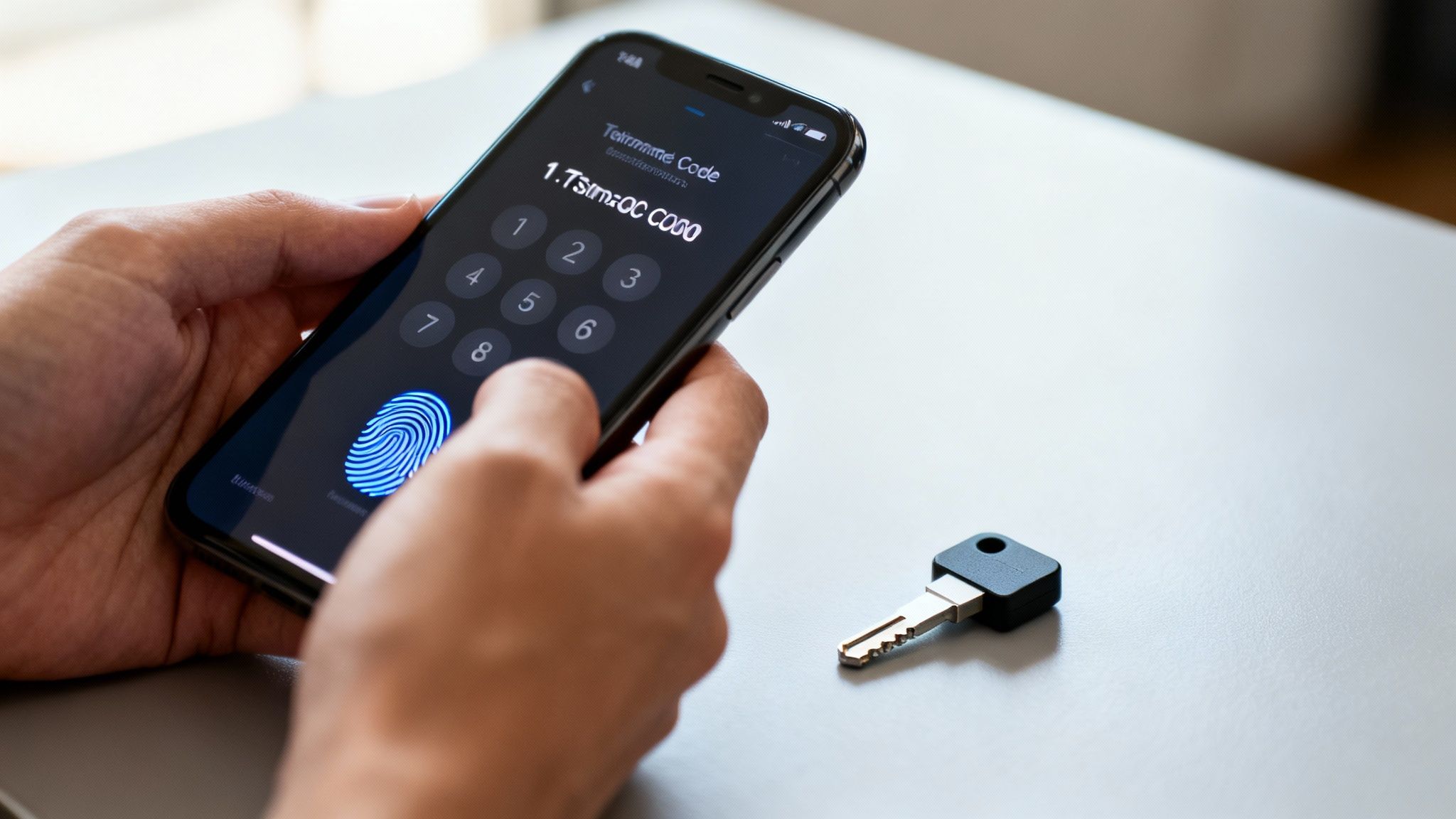
This simple step dramatically reduces the risk of unauthorized access, even if a user's password is stolen. Think of it as needing both a key and a unique PIN to open a bank vault. Platforms like Google and Microsoft have championed MFA, making it a standard for protecting everything from emails to enterprise data. For a platform safeguarding deeply personal user creations and payment information, implementing robust MFA is one of the most impactful data security best practices to prevent account takeover and build user confidence.
How to Implement MFA Effectively
A successful MFA strategy balances robust security with a smooth user experience, encouraging adoption without creating unnecessary friction.
- Offer Flexible, Secure Options: Provide multiple MFA methods, but guide users toward the most secure ones. Prioritize Time-based One-Time Password (TOTP) apps like Google Authenticator or Authy over SMS, which is susceptible to SIM-swapping attacks. Biometrics offer another convenient and secure layer.
- Provide Seamless Account Recovery: Users will inevitably lose access to their MFA devices. Implement a secure, multi-step recovery process that includes providing backup codes upon setup. This prevents users from being permanently locked out of their accounts.
- Contextual Re-Authentication: Instead of constantly challenging users, trigger MFA verification for high-risk actions. Prompt for re-authentication when a user attempts to change their password, update payment information, or export their character data to ensure the legitimate account holder is in control.
By integrating MFA, you empower users to become active participants in their own security. It fortifies the digital walls around their private world, ensuring their intimate AI companionship remains exclusively theirs.
3. Regular Security Audits and Penetration Testing
Building a fortress is one thing; stress-testing its walls is another. Even the most robust defenses can have hidden cracks. For a platform where users entrust their deepest personal dialogues, proactively finding and fixing vulnerabilities before malicious actors do is not just a good practice, it's an absolute necessity. Regular security audits and penetration testing are the processes of actively trying to break your own system to make it stronger.
This proactive approach involves hiring third-party security experts to simulate real-world attacks on your platform. They search for weaknesses in your code, infrastructure, and even your operational processes. For a service handling intimate AI interactions and user-generated NSFW content, this is one of the most critical data security best practices to maintain user trust and prevent catastrophic breaches. This is the same principle that drives the extensive bug bounty programs at companies like Facebook and Google, where thousands of vulnerabilities are discovered and fixed each year thanks to ethical hackers.
How to Implement Audits and Pen Testing Effectively
A successful testing program is continuous and comprehensive, not a one-off event. It requires a structured approach to identify, classify, and remediate vulnerabilities.
- Combine Automated and Manual Testing: Use automated vulnerability scanners for broad, continuous coverage, but supplement them with manual penetration tests conducted by experienced security professionals. Manual testing is crucial for discovering complex business logic flaws that automated tools often miss, especially within custom chat interfaces and AI character creation flows.
- Establish a Regular Cadence: Conduct external penetration tests at least annually. For mature platforms with frequent updates, quarterly testing is a better standard. This ensures that new features or code changes don't introduce new security risks.
- Define Clear Remediation SLAs: Not all vulnerabilities are created equal. Establish clear Service Level Agreements (SLAs) for fixing discovered issues based on their severity (e.g., critical vulnerabilities patched within 24 hours, high within 7 days). This ensures the most dangerous risks are addressed immediately.
- Incentivize Internal Discovery: Supplement professional testing by creating an internal bug bounty program. This encourages your own developers and a wider community of ethical hackers to find and report security issues, creating a powerful, multi-layered defense.
By embracing a mindset of constant vigilance through audits and penetration testing, you demonstrate a profound commitment to security. It proves you are not just building a product, but a secure environment where users can freely and safely explore their imaginations.
4. Data Minimization and Privacy by Design
In the world of AI companionship, less is often more, especially when it comes to personal data. Data minimization is the principle of collecting only the absolute minimum information required to deliver a service. Paired with Privacy by Design, this philosophy integrates privacy into the very architecture of the platform, treating it as a core function rather than an afterthought. This proactive approach drastically reduces the potential impact of a data breach because there is simply less sensitive information to expose.
For a platform where users explore deep personal fantasies, this is not just a good idea; it's a fundamental sign of respect for user trust. Think of how Apple processes Siri requests and photos on-device to limit cloud exposure, or how Signal messenger was built to store virtually no message content or metadata. Adopting these data security best practices means designing systems that inherently protect users by limiting the data footprint from the start, ensuring that what isn't collected can't be compromised. This is a core pillar of our ethical AI commitment.
How to Implement Data Minimization and Privacy by Design
Embedding this philosophy requires a disciplined and intentional approach to every feature and process you build.
- Create a Data Inventory: Map out every piece of data you collect. Document its specific purpose, where it's stored, and, most importantly, set a strict retention period. If you don't have a compelling reason to keep it, don't.
- Implement Automated Data Purging: Give users control over their history. Implement features that automatically delete conversation logs after a set period, such as 90 or 180 days, and make this setting easily configurable for the user.
- Avoid Unnecessary Collection: Challenge the need for every data point. Do you truly need a user's IP address or precise location? If it's not essential for core functionality, don't collect it. Process logs for diagnostics and then discard non-essential information promptly.
Privacy by Design is a commitment to your users. It communicates that their safety and privacy are not just policies, but are woven into the very fabric of the platform you've built for them.
5. Secure Password Management and Hashing
The gateway to a user's private world is their password. In an AI chat platform where users build deeply personal connections and store sensitive scenarios, a compromised password is a catastrophic breach of trust. This is why secure password management and hashing are not just a technical detail; they are a fundamental pillar of user safety. Proper hashing transforms a user's password into a long, irreversible string of characters before it's ever stored, making it useless to an attacker even if they steal the database.
This process uses algorithms like Argon2 or bcrypt, which are intentionally slow and resource-intensive. Think of it as locking a treasure chest with a key that shatters into a million unrecognizable pieces after its first use. Even with the pieces, no one can recreate the original key. This is one of the most critical data security best practices for preventing widespread account takeovers. Modern frameworks like Django and security standards from OWASP champion this approach, ensuring that a database leak doesn't automatically become a privacy disaster.
How to Implement Secure Hashing Effectively
Implementing robust password security requires a multi-layered defense that protects users at every step of the authentication process.
- Use Strong, Adaptive Algorithms: Choose a modern, salted hashing algorithm like Argon2 (the current industry recommendation) or bcrypt. Avoid outdated and broken algorithms like MD5 or SHA-1. These algorithms include a "cost factor" or "work factor" that you can increase over time as computing power grows, future-proofing your security.
- Enforce Strong Password Policies: Guide users toward creating stronger credentials without being overly restrictive. Enforce a minimum length of 12+ characters and check new passwords against lists of known compromised passwords. Implement rate limiting and account lockouts after a certain number of failed login attempts to thwart brute-force attacks.
- Secure the Entire Authentication Flow: Password hashing is only one part of the equation. Ensure all login and password reset pages are served exclusively over HTTPS. Never email passwords in plain text; instead, use secure, time-limited, single-use tokens for password reset functionality.
By treating password storage with the seriousness it deserves, you build a resilient fortress around your users' accounts. It’s a direct commitment to protecting their digital identity and the personal worlds they create on your platform.
6. Secure API Design and Rate Limiting
The Application Programming Interface (API) is the digital gateway to your platform, allowing different systems to communicate. For an AI chat platform, it's how user devices interact with your AI characters. Securing this gateway is paramount, as an unprotected API can become an open door for data theft, service abuse, and system overload. This is why secure API design and rate limiting are foundational data security best practices.
Rate limiting is a crucial defense mechanism that controls the frequency of requests a user or IP address can make. Think of it as a bouncer at a club, preventing a flood of people from overwhelming the venue. This simple control prevents a wide range of attacks, from brute-force login attempts to content scraping and denial-of-service (DoS) attacks that could bring your entire platform down. Major tech players like GitHub and Stripe rely on robust rate limiting to protect their services and ensure stability for all users.
How to Implement Secure APIs and Rate Limiting
A proactive and layered approach is essential for building APIs that are both functional and resilient against threats.
- Establish Granular Rate Limits: Don't apply a one-size-fits-all limit. Implement different thresholds for unauthenticated versus authenticated users. Sensitive operations, like creating a custom AI character or processing payments, should have much stricter limits than casual browsing or chatting.
- Follow API Security Best Practices: Adhere to established standards like the OWASP API Security Top 10. This includes using strong authentication protocols (like OAuth 2.0), validating all incoming data to prevent injection attacks, and ensuring proper access controls are in place so users can only access their own data.
- Provide Clear Feedback: When a user hits a rate limit, the API should respond with a clear
429 Too Many Requestsstatus code. Include headers likeRetry-Afterto tell the client when they can try again. This prevents legitimate users from becoming frustrated while discouraging malicious actors from repeatedly hammering the server. For creators building unique experiences, understanding these limits is key. For more on this, you can learn more about our AI girlfriend API.
By treating your API as a first-class citizen in your security strategy, you protect not only your infrastructure but also the integrity and availability of the intimate experiences your users trust you to provide.
7. Secure Data Storage and Encryption at Rest
While conversations are protected in transit, the data you save, like custom AI character profiles, chat histories, and personal settings, must be equally secure when stored. This is where encryption at rest comes into play. It acts as a digital safe, encoding your data when it's written to a disk or database, rendering it unreadable without the correct key.

This method ensures that even if someone gained unauthorized physical access to the servers or compromised a database, your saved conversations and intimate character creations would remain a meaningless jumble of characters. For a platform where users invest time building deeply personal AI companions, this is one of the most fundamental data security best practices for long-term protection. Major cloud services like AWS, Google Cloud, and Azure have made this a standard practice, highlighting its critical importance in modern data protection.
How to Implement Encryption at Rest Effectively
Implementing robust encryption for stored data requires a comprehensive strategy that goes beyond simply flipping a switch.
- Leverage Native Cloud Services: Utilize the built-in encryption features offered by your cloud provider, such as AWS Key Management Service (KMS), Azure Key Vault, or Google Cloud KMS. These services are managed by security experts and simplify the complex process of key management and rotation.
- Rotate Encryption Keys Regularly: Encryption keys should not be permanent. Establish a strict policy to rotate keys at least annually or immediately following any significant staff changes. This limits the potential damage if a key is ever compromised.
- Test Your Backups: An encrypted backup is useless if you can't restore it. Regularly test the process of restoring data from your encrypted backups to ensure that your recovery procedures work flawlessly and that the keys are accessible when you need them most.
By encrypting data at rest, you create a powerful last line of defense. It guarantees that even in a worst-case physical breach scenario, your users' private worlds, saved scenarios, and custom AIs remain completely inaccessible and secure.
8. Regular Security Updates and Patch Management
In the fast-evolving landscape of cybersecurity, your platform's defense is only as strong as its most outdated component. An unpatched vulnerability is like leaving a door unlocked for cybercriminals. Patch management is the systematic process of identifying, testing, and deploying security updates for all software, from the server's operating system to the smallest third-party library. This practice is crucial for preventing attackers from exploiting known weaknesses.
For a platform built on a complex stack of web frameworks, AI libraries, and databases, staying current is a non-negotiable part of data security best practices. A single vulnerability in a popular dependency like npm or a Kubernetes component could expose sensitive user conversations and data. Think of it as routine maintenance for your digital fortress; regularly reinforcing the walls ensures they can withstand the latest attack methods. This proactive approach, championed by organizations like CISA and NIST, closes security holes before they can be exploited.
How to Implement Effective Patch Management
A robust patch management strategy is automated, consistent, and thorough, ensuring no vulnerability slips through the cracks.
- Automate Dependency Scanning: Integrate tools like Snyk or Dependabot directly into your development pipeline. These services automatically scan your code's dependencies, flag known vulnerabilities, and can even create pull requests with the required updates, drastically reducing manual effort.
- Establish a Patching Cadence: Create a formal policy for applying patches. Define Service Level Agreements (SLAs) for different severity levels, for instance, deploying critical patches within 48 hours while scheduling low-risk ones for a monthly maintenance window.
- Test Before You Deploy: Never push patches directly to production. Always deploy updates to a staging environment that mirrors your live system first. This allows you to test for any regressions or compatibility issues that could disrupt the user experience, ensuring security doesn't come at the cost of stability.
An effective patch management program transforms security from a reactive scramble into a proactive, disciplined process. It ensures your platform remains a resilient and trustworthy sanctuary for user data against emerging threats.
9. User Privacy Controls and Transparency
Trust is not given; it's earned. In the intimate space of an AI chat platform, users need to feel in complete control of their digital footprint. Granting users robust privacy controls and maintaining full transparency about data practices isn't just good ethics; it's a fundamental pillar of user empowerment. This approach gives users granular command over their personal information, from conversation history to analytics participation.
For a platform where users explore deeply personal fantasies, this level of control is non-negotiable. It means clearly communicating what data is collected and why, then providing simple tools to manage it. Think of Apple's App Privacy labels or DuckDuckGo’s clear-cut privacy promises. By adopting these data security best practices, you shift the power dynamic, assuring users that they are active participants in their privacy, not just subjects of data collection.
How to Implement User-Centric Privacy
Building a transparent privacy framework requires a commitment to clarity and user agency at every level of the product experience.
- Create a Privacy Dashboard: Design a single, easy-to-navigate hub where users can see and manage all their privacy settings. Use simple toggles for options like conversation recording, analytics tracking, and data usage for AI model training.
- Provide Simple Data Portability & Deletion: Empower users with the ability to download their entire data history in a common format like JSON. More importantly, implement a true one-click account deletion that permanently erases all associated user data from your systems.
- Write a Human-Readable Privacy Policy: Ditch the dense legal jargon. Your privacy policy should be written in plain language that anyone can understand. Clearly outline what you collect, why you collect it, and how you protect it. Learn more about how we approach this in our Luvr AI privacy policy.
By embedding transparency and control into the user experience, you build a relationship based on respect. This proves to users that their privacy is not an afterthought but a core design principle of your platform.
10. Security Incident Response Plan and Breach Notification
In the digital world, it's not a matter of if a security incident will occur, but when. For a platform handling the intimate and personal data of its users, being unprepared is not an option. A robust security incident response plan is your pre-scripted playbook for chaos, outlining exactly how your team will detect, respond to, and recover from a breach. This ensures a swift, coordinated effort to minimize damage and restore trust.
This plan isn't just about technical recovery; it’s about transparent communication. Timely breach notifications, as mandated by laws like GDPR and CCPA, are critical. The infamous Equifax breach demonstrated how a slow and confusing response can destroy public trust far more than the initial attack. A well-executed plan turns a potential catastrophe into a manageable crisis, reinforcing that user protection is a core value. This is one of the most crucial data security best practices for maintaining long-term user loyalty and regulatory compliance.
How to Implement an Effective Incident Response Plan
A proactive approach to incident management is essential. Your plan should be a living document, not a file that gathers dust.
- Establish Clear Roles and Procedures: Document who is responsible for what during a crisis. Define severity levels for incidents (e.g., critical, high, low) with specific response protocols for each. Create a 24/7 on-call rotation so an expert is always available to act.
- Prepare for Communication: Don't write your breach notification email in the middle of a five-alarm fire. Prepare notification templates in advance that are compliant with GDPR's 72-hour rule and other relevant regulations. Establish clear channels (email, in-app notices) to communicate with users.
- Practice and Refine: A plan is useless if it's never tested. Conduct regular tabletop exercises and drills to simulate a breach. These practice runs identify gaps in your process, test your team's readiness, and ensure everyone knows their role when a real incident occurs.
An incident response plan is your organization's emergency first-aid kit. Having it ready and rehearsed demonstrates a mature commitment to security and reassures users that you are prepared to protect them, even in the worst-case scenario.
10-Point Data Security Best Practices Comparison
| Item | 🔄 Implementation Complexity | ⚡ Resource Requirements & Efficiency | 📊 Expected Outcomes | 💡 Ideal Use Cases | ⭐ Key Advantages |
|---|---|---|---|---|---|
| End-to-End Encryption for Private Communications | High — complex key management and device-based keys | Moderate CPU/network overhead; requires proven libs | Very high confidentiality; limits platform access to plaintext | Sensitive/intimate chats and custom character scenarios | Prevents interception/internal breaches; strong user trust |
| Multi-Factor Authentication (MFA) | Medium — integrates multiple verification flows | Low–medium; depends on chosen factors (TOTP, biometrics) | Significantly reduces account takeover risk | Account protection for premium users and creators | Dramatically lowers compromise risk; simple UX options |
| Regular Security Audits and Penetration Testing | High — third-party engagements and remediation cycles | High ongoing cost and staff time | Identifies vulnerabilities; improves security posture | Mature platforms and new feature launches | Third-party validation; prioritizes fixes before exploit |
| Data Minimization and Privacy by Design | Medium — architectural and policy changes up‑front | Lowers storage/processing costs; needs product tradeoffs | Reduces breach impact; simplifies compliance | Services handling sensitive user content by default | Limits exposed data; enhances regulatory alignment |
| Secure Password Management and Hashing | Low–medium — implement vetted hashing and resets | Low runtime cost but intentionally compute‑heavy for hashing | Strong protection against credential leaks | All user accounts; baseline authentication security | Industry-standard defense; prevents rainbow table attacks |
| Secure API Design and Rate Limiting | Medium — auth, validation, logging, and throttling | Medium infra and monitoring; may add latency | Reduces scraping, brute‑force and DoS risk; preserves availability | Public/partner APIs and AI interaction endpoints | Prevents abuse; improves stability and observability |
| Secure Data Storage and Encryption at Rest | Medium — key management and backup integration | Moderate performance impact; KMS costs | Protects stored data from physical/database compromise | Databases/backups containing conversations and profiles | Meets compliance; enables secure deletion via keys |
| Regular Security Updates and Patch Management | Medium — process + CI/CD + testing | Ongoing operational effort; automation reduces burden | Reduces known CVE exposure; improves stability | All components (OS, libs, AI frameworks) | Fixes known vulnerabilities; demonstrates diligence |
| User Privacy Controls and Transparency | Medium — UI, policies, and fine‑grained controls | Moderate development and support overhead | Increases user trust and regulatory compliance | Privacy‑sensitive platforms and consent flows | Empowers users; improves retention and trust |
| Security Incident Response Plan and Breach Notification | High — playbooks, training, SIEM, legal processes | High upfront planning and potential external costs | Faster containment and regulatory‑compliant notifications | Platforms storing intimate user data with breach risk | Minimizes damage; documents due diligence and response |
Cultivating a Culture of Security for Lasting Trust
Navigating the landscape of digital intimacy requires more than just sophisticated AI; it demands an unwavering commitment to security. We've journeyed through ten foundational pillars of data protection, from the cryptographic fortress of end-to-end encryption to the proactive vigilance of regular security audits. Each practice is not an isolated checkbox but a vital thread in a comprehensive tapestry of user safety and trust.
The strength of a platform dedicated to personal connection lies in its ability to create a genuine sanctuary. This is where the technical and the emotional intersect. Implementing robust multi-factor authentication (MFA) and secure password hashing isn't just about preventing unauthorized access; it's about giving users the peace of mind to be vulnerable and authentic. Similarly, practicing data minimization isn't merely a compliance strategy; it's a profound statement of respect for user privacy, ensuring that the only data collected is what's essential to enrich their experience.
From Checklist to Culture: Making Security a Mindset
The true power of these data security best practices is realized when they transition from a static list of technical requirements into a dynamic, living culture. This is the pivotal shift from reactive defense to proactive protection.
- Continuous Vigilance: Security is not a "set it and forget it" project. Regular patch management and security audits are the lifeblood of a resilient system, adapting to an ever-evolving threat landscape.
- Empowerment Through Transparency: Providing users with clear privacy controls and transparent policies transforms them from passive subjects into active participants in their own security.
- Preparedness, Not Panic: A well-rehearsed incident response plan ensures that if a breach occurs, the response is swift, effective, and transparent, minimizing harm and preserving user trust.
Ultimately, these practices work in concert to build and maintain the single most valuable asset a personal AI platform can possess: user trust. When users engage with an AI companion, they are sharing pieces of themselves. Protecting the data they share is synonymous with protecting their emotional and psychological safety.
The ultimate measure of a platform's success is not the complexity of its algorithms, but the depth of the trust it inspires. This trust is earned through a demonstrable, consistent, and user-centric approach to security.
Adopting these data security best practices is a declaration that you value your users beyond their data points. It signals a commitment to creating an environment where connection can flourish without fear, where exploration is encouraged, and where privacy is the bedrock upon which every interaction is built. This is the future of digital companionship, one defined not just by what technology can do, but by how securely and respectfully it does it. Investing in this holistic security framework is an investment in long-term loyalty, community, and the very human need for safe connection.
Ready to experience a new standard of private and secure AI companionship? At Luvr AI, we've built our platform on the very principles discussed here, ensuring your conversations are protected and your privacy is paramount. Explore the future of connection, built on a foundation of trust, at Luvr AI.