


Create Your Own AI Girlfriend 😈
Chat with AI Luvr's today or make your own! Receive images, audio messages, and much more! 🔥
4.5 stars


Picture a game where the most powerful graphics card you own is your own imagination. That’s the real magic behind text-based adventure games, a genre that builds entire worlds not with pixels, but with prose. These are experiences that rely on you to bring them to life, turning simple text commands into epic journeys.
Welcome to a World Built from Words
Let's step away from sprawling, photorealistic open worlds for a second. Instead, imagine a simple cursor blinking on a dark screen, patiently waiting for your next move. This is your doorway into the captivating universe of text-based adventure games, or as they're often called, interactive fiction. At their heart, these are stories you don't just read—you actively shape them.
The setup is brilliantly simple. The game describes a scene, perhaps a dusty attic or an alien cockpit, and you type commands to interact with what's around you. Actions like "go north," "examine the strange book," or "talk to the mysterious figure" are your tools for pushing the narrative forward. This back-and-forth creates a powerful sense of agency, making every choice feel personal and loaded with consequence.
The Power of Your Imagination
Modern video games show you everything, leaving little room for interpretation. Text adventures do the opposite. They tell you things and trust your mind to fill in the blanks. When the game describes a "dank, moss-covered cavern," your brain does all the hard work, conjuring an image far more vivid and unique than any pre-rendered graphic ever could. This partnership between the game's words and your imagination is the genre's secret weapon.
The implicit promise of any creative work is that the author had something to say. In text games, that promise is kept by letting you co-author the experience through your own actions, making every playthrough a deeply personal story.
Why This Classic Genre is Still Going Strong
You might be tempted to file these games away as charming relics from the 1980s, but they're enjoying a serious comeback. It's not just nostalgia, either. The reasons for their lasting appeal are pretty clear:
- Unmatched Immersion: By tapping directly into your imagination, these games often create a kind of immersion that’s far more personal and profound than what you get from just watching a screen.
- Storytelling Takes Center Stage: When you don't have to worry about complex graphics, all that creative energy can be poured into what really matters: intricate plots, memorable characters, and genuinely clever puzzles.
- Anyone Can Be a Creator: Modern tools like Twine and Inform 7 have thrown the doors wide open, making it easier than ever for writers and dreamers to build their own interactive worlds.
Today, this classic format is getting a fresh coat of paint with modern technology. New conversational AI is breathing life into these text-based worlds, allowing for dynamic characters who can hold unscripted, believable conversations. This guide will walk you through it all—from the genre's humble beginnings to crafting your own adventure with the latest tools.
The Journey from Zork to Modern AI Storytelling
The story of text-based adventure games starts where you might expect: in the dimly lit computer labs of universities back in the 1970s. Hardware was laughably primitive by today's standards, completely incapable of handling graphics. But that limitation sparked a different kind of magic. Programmers like Will Crowther and Don Woods built Colossal Cave Adventure, a world made not of pixels, but of pure imagination—a twisting cave system described entirely through text, filled with puzzles and peril.
How did you interact? Through a simple text parser. This was the real breakthrough. It understood basic commands like "get lamp" or "go east," giving players a genuine sense of agency for the first time. You could explore this digital space on your own terms, and your decisions actually mattered. The parser was the game's ears, and it was listening.
From Colossal Caves to a Great Underground Empire
Colossal Cave Adventure lit a fire. Inspired by it, a group of MIT students went on to create what would become an icon of the genre: Zork. They founded a company, Infocom, and released it commercially in 1980, dropping players into the legendary "Great Underground Empire." It was a hit, celebrated for its sharp writing, devilishly clever puzzles, and a parser that could handle more complex sentences.
The genius of those early games was how they turned a massive constraint into their greatest strength. With no graphics to lean on, developers had to become masters of prose and world-building. They proved that a few carefully chosen words could ignite the imagination more powerfully than a thousand pictures.
These games kicked off a golden age. For a short time, interactive fiction wasn't just a niche—it was a major player in the home computer market. But as technology marched on and graphics became more sophisticated, the mainstream audience drifted toward games that showed you the world instead of describing it.
The timeline below charts this incredible journey, from the command-line roots of Zork to the AI-powered narratives of tomorrow.
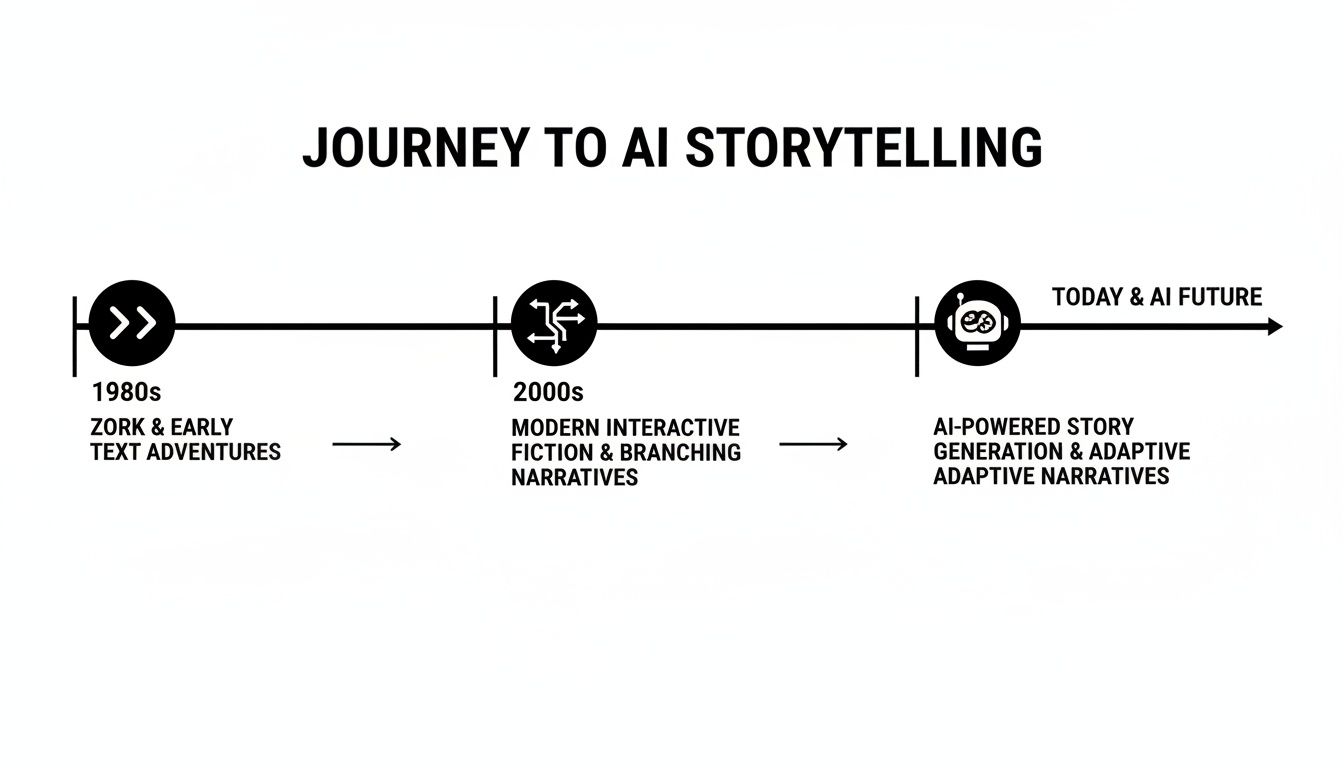
You can see how the core idea evolved from simple verb-noun commands to intricate branching choices. Now, we're standing on the edge of the next big leap, one defined by artificial intelligence.
The Rise of Passionate Communities and New Tools
Even though text adventures stepped out of the mainstream spotlight, they never truly went away. Instead, they nurtured a dedicated, passionate community of players and creators who kept the flame alive. Today, the scene is driven by indie developers who care more about telling a compelling story than chasing commercial success.
You see this reflected on platforms like Steam. A game like 'Text Adventure' by Joey Pawelko Games might only have 27 followers and one review, numbers that would be a disaster in the AAA world. But here, it speaks to the genre’s focused appeal. These games aren't for everyone, and that's the point. They cater to a specific audience that craves the unique experience only text can provide. You can find more of this kind of engagement data over at games-stats.com.
The modern era has also been shaped by incredibly accessible tools like Twine and Inform 7, which empower writers—not just coders—to build their own interactive worlds. This has triggered a creative renaissance, with games tackling deeply personal themes and experimental storytelling.
And now, we’re coming full circle. The genre is beginning to integrate conversational AI, creating characters who don't just spit out pre-written lines but actually listen and react dynamically. It’s the original promise of a living, breathing world made of words, finally on the cusp of being realized.
How Text Based Adventure Games Actually Work

At its heart, a text-based adventure game is a conversation. It's an elegant dance between you and a digital storyteller. But how does a simple screen of text manage to build a responsive, living world from your typed commands? The magic is all happening behind the curtain, powered by a few clever mechanics working in concert.
Think of the game engine as a digital Dungeon Master. This DM knows the entire map, where every item is hidden, how every puzzle works, and the secrets each character holds. Your job is to talk to it, and your primary tool for doing that is the text parser.
The parser is the game's ears. When you type a command like "take the silver key," the parser gets to work, breaking that sentence down into parts it can understand. It sees "take" as a verb (an action to perform) and "silver key" as a noun (the object of that action). If the key is actually in the room and it's something you can pick up, the DM updates its internal notes. You are now holding the silver key. This simple, back-and-forth interaction is the bedrock of every classic text adventure.
The Two Main Flavors of Interaction
While the end goal is always telling a story, how you interact with it usually falls into one of two main camps. Each one creates a completely different feel, appealing to different kinds of players.
To get a clearer picture, let's compare them side-by-side.
Parser Based vs Choice Based Game Mechanics
| Mechanic | Parser-Based Games (e.g., Zork) | Choice-Based Games (e.g., Twine games) |
|---|---|---|
| Player Input | Type commands freely using natural language (e.g., "go north," "get lamp"). | Click on hyperlinks or select from a numbered list of pre-written options. |
| Freedom | High. Offers a sense of total control and encourages creative, out-of-the-box thinking. | Limited. Guides the player down curated narrative paths. |
| Complexity | Can be challenging. Players might struggle to find the exact command the parser understands. | Very accessible. Easy for anyone to pick up and play without a learning curve. |
| Narrative Style | Often focused on exploration, puzzle-solving, and simulating a world. | Primarily focused on branching narratives, character choices, and consequences. |
Ultimately, the choice between these styles shapes the entire experience. Parser games give you a blank page and ask, "What do you want to do?" while choice-based games give you a menu and ask, "Which of these things will you do?"
Building a Living World with States and Flags
So, how does the game remember that you solved that riddle or unlocked that door an hour ago? The secret lies in a simple but powerful system of variables and flags.
Think of a flag as a digital light switch. When you finally defeat the goblin, a flag called is_goblin_defeated might flip from false to true. Now, every time you re-enter that cave, the game first checks the status of that flag. Seeing it’s true, it describes an empty room instead of an angry goblin.
These flags are the game's memory, meticulously tracking your progress and making sure the world reacts logically to everything you do. This is what allows for complex puzzles, evolving character relationships, and stories that genuinely branch based on your actions.
Today, this concept is being pushed to incredible new heights. Instead of just tracking binary on/off flags, developers can now integrate conversational AI to manage the state of non-player characters (NPCs). With sophisticated AI character chat, an NPC can actually remember your past conversations, form opinions about you, and generate new dialogue on the fly.
This creates a far more dynamic and believable world where interactions feel less like triggering a script and more like having a real conversation. It's the ultimate evolution of that digital DM—one that can improvise, react, and remember with stunning realism.
Why Text Adventures Still Have a Hold on Us
In a world overflowing with hyper-realistic graphics and jaw-dropping visual effects, the quiet, persistent appeal of text-based adventure games can feel like a contradiction. Why would anyone trade a lush, digital landscape for a simple, blinking cursor?
The answer is simple, yet profound. These games tap into the most powerful graphics card ever created: the human imagination.
When a game describes a "creaking, salt-stained door on a derelict starship," it doesn't just show you an image—it hands you a paintbrush. The scene that materializes in your mind is uniquely yours, colored by your own memories, fears, and experiences. This act of co-creation forges a personal connection to the world that pre-rendered graphics, no matter how beautiful, can't quite match. Every shadow is exactly as menacing as you imagine it, making every victory feel earned on a much deeper level.
A Partnership Between the Author and the Player
This special relationship is the heart and soul of the genre. You aren't just a passive observer watching a story unfold; you're an active participant, and the narrative bends and shifts around your choices and interpretations.
In most video games, you inhabit a character. In a text adventure, it often feels like the character inhabits you. The world adapts to your logic and curiosity, making the whole thing feel less like playing a game and more like living a story.
This deep sense of agency is what creates such a powerful and lasting impact. The worlds feel real because, in a very real sense, you helped build them.
A Sanctuary for Storytellers and a Home for Their Fans
Beyond the magic of imagination, text adventures thrive for very practical reasons. For indie developers and writers, the genre is a creative haven. It completely removes the massive financial and technical hurdles of modern game development, letting creators focus on what truly matters: crafting a great story, designing clever puzzles, and building a believable world. This freedom attracts a different kind of talent—one that values powerful prose over polygons.
And it turns out, there's a dedicated and passionate audience hungry for these experiences. While it might seem niche, the market is surprisingly strong. On Steam alone, there are nearly 5,000 text-based games that have brought in around $22 million in net revenue. A game like 'Text RPG', for example, boasts an 85.2% positive review rating, proving that a well-told interactive story can absolutely find a loyal—and paying—audience. You can dig into more stats on the performance of text-based games on Steam.
The enduring charm of text-based adventure games is really a testament to the timeless power of words. They offer a unique space for players who crave deep narrative immersion and for creators who know that a compelling story is the greatest special effect of all. It’s a genre built on one simple, unshakable truth: the most vivid worlds are the ones we build in our own minds.
So, you've played a few text adventures and now you're getting that creative itch. You’re ready to jump from the audience to the stage. The great news is that building your own interactive world is easier than it's ever been. You don’t need a huge budget or a team of artists—just a killer idea and the right tools to bring your story to life.
Think of this as your launchpad for becoming a creator. The first big decision on your journey is picking an engine. This is the digital canvas where you'll paint with words, and your choice will fundamentally shape how you build your narrative, design your puzzles, and craft your character interactions.
Choosing Your Storytelling Engine
For anyone looking to dip their toes into creating interactive fiction, three modern tools really stand out. Each one caters to a different style and skill level, from totally code-free visual editors to powerful scripting languages for more complex projects.
Twine: If you're a writer first and foremost, start here. Twine gives you a visual, flowchart-style map of your story. You write passages of text in little boxes and then draw lines between them to represent player choices. It requires zero coding to make a complete, branching game, which means you can pour all your energy directly into the story itself.
Inform 7: Ever wanted to build a classic, Zork-style parser adventure? This is your tool. Inform 7 is wild because it uses a natural-language syntax that reads almost like plain English. You might literally write something like, "The Dragon's Lair is a room. A jeweled sword is in the Dragon's Lair." It has a steeper learning curve, for sure, but the depth it offers for simulating a world full of objects and intricate puzzles is incredible.
Ink: Created by inkle, the studio behind the masterpiece 80 Days, Ink is a scripting language built for professional-level interactive storytelling. It’s brilliant at handling incredibly complex, branching narratives that can split apart and weave back together seamlessly. It’s more code-heavy than Twine, but it gives you immense control for massive, tangled stories.

A visual, node-based system like the one pictured above helps you see your entire narrative at a glance. It makes tracking all those complex branches so much easier and ensures your story actually makes sense from start to finish.
Breathing Life into Characters with AI
Think about the non-player characters (NPCs) in most games. They’re basically puppets, right? Every line they say, every reaction they have—it's all been pre-scripted by the creator. That works, but it also creates a world that feels finite and, eventually, predictable.
But what if your characters could think for themselves?
This is where conversational AI completely changes the game. By plugging in an AI personality, you can finally break free from those rigid, multiple-choice dialogue trees. You can create NPCs who feel genuinely alive. Instead of picking one of three pre-written questions, a player can just type whatever they want, and the AI character will respond dynamically, all while staying perfectly in character.
An AI-driven character isn't just following a script; it's improvising. It draws from a deep well of personality traits, memories, and backstory that you define, allowing it to hold unscripted conversations that are unique to every single player.
This simple shift transforms the player's experience. It’s no longer a simple Q&A session; it becomes a real conversation, a chance to build a relationship. A character can remember your name, bring up something you talked about an hour ago, form an opinion of you, and even lie or keep secrets based on their own private motivations.
Designing Compelling AI Personalities
The best part? Creating a memorable AI character has very little to do with writing code and everything to do with being an author. Modern platforms are making this process incredibly intuitive. You can easily create your own AI character using simple, descriptive prompts to sculpt a personality, much like you would for a novel.
When you're designing your own AI-powered NPCs, focus on these key ingredients:
Define a Core Personality: Start with a strong, simple concept. Is this person a jaded detective? A cheerful but hopelessly naive shopkeeper? An ancient, cryptic wizard? This core idea is the foundation for every word they'll say.
Give Them a Backstory: Where are they from? What are their biggest regrets and wildest dreams? A rich backstory provides the why behind their actions and gives them real conversational depth.
Establish a Unique Voice: How do they talk? Do they use formal language, drop slang constantly, or speak only in riddles? Their specific conversational style is what makes them feel distinct and memorable.
Set Their Goals and Secrets: What does this character want more than anything? And what are they hiding? Giving them a hidden agenda makes them more than just an info-dump—it makes them an active player in your story.
By building on these narrative pillars, you can craft characters who don’t just move the plot forward; they become the most unforgettable part of the world you’ve built.
The Future of Storytelling is Written in AI
Far from being nostalgic relics, text-based adventure games are becoming the surprising pioneers of a new entertainment frontier. While massive studios chase ever-more-realistic graphics, this classic genre is quietly laying the groundwork for the next real leap in interactive storytelling. And it's all powered by artificial intelligence.
It turns out the very thing that once defined these games—their total reliance on text—is now their greatest strength in an AI-driven world.
We're moving way beyond simple branching narratives. Today's tools let creators build experiences with an astonishing level of depth and replayability. Imagine talking to a character who doesn't just spit out pre-written lines but actually has a genuine, unscripted conversation with you. That's the new reality. AI-driven NPCs can remember what you've done, form opinions about you, and even change their personalities over time. No two playthroughs will ever be the same.
This isn't some far-off dream; it's happening right now. The barrier to entry for creators is crumbling, shifting the focus from complex coding back to the pure art of telling a great story.
Building Worlds That Remember You
The real breakthrough here is in creating characters that feel persistent and dynamic. An AI character isn't just a puppet waiting for you to pull its strings; it's an active participant in the story. They can have their own goals, react with genuine surprise, and keep secrets, making the game world feel truly alive and unpredictable.
This shift promises a kind of personal narrative that was simply impossible before. Your unique interactions directly shape the world and the people in it, forging a story that is profoundly and exclusively yours. You can take a closer look at how these systems work by exploring our articles on AI-powered character development.
The next generation of interactive fiction won't just ask you to make a choice; it will challenge you to build a relationship. The story will be a consequence of who you are and how you treat others within its world.
This emerging market is also showing solid signs of being sustainable. Games in this niche often adopt premium pricing, usually between $1.99 and $2.99, which creates a viable path for indie creators. For example, data for 'The Filmmaker - A Text Adventure' shows it generated about $1.48 per unit sold, which added up to $1,479 in total revenue. These aren't blockbuster numbers, but they prove a dedicated audience is willing to pay for quality, text-driven experiences. You can dig into more financial data for these games on platforms like Sensor Tower.
The adventure is really just beginning. The tools are here, the community is passionate, and the creative possibilities are wide open. Now is the perfect time to explore these next-generation games, experiment with the new creation tools, and maybe even start writing a story of your own.
Frequently Asked Questions
It's only natural to have a few questions after diving into a topic this deep. Let's tackle some of the most common ones that pop up, whether you're about to fire up your first game or are getting ready to build one yourself.
Think of this as the final piece of the puzzle, giving you the clarity and confidence to jump in.
Are Text-Based Adventure Games Still Popular?
You bet they are. While they might not be topping mainstream charts, they have an incredibly loyal and active community that’s always growing. Hop onto marketplaces like Steam or itch.io, and you'll find thousands of them, from old-school parser games to modern, choice-driven narratives that are doing amazing things with storytelling.
Their staying power is simple: they offer deep, imaginative experiences that graphics often can't touch. By making your mind the rendering engine, they create a connection that’s uniquely personal.
And now, new technology is bringing in a fresh wave of players. The idea of adding conversational AI into the mix is getting a lot of people excited to see just how dynamic a story can be when its characters feel truly alive.
This mix of classic appeal and new potential is keeping text adventures as relevant as ever.
What Is the Easiest Way to Create My Own Text Game?
For anyone just starting out, the best answer is almost always Twine. It’s a fantastic tool that uses a visual, map-like editor to help you connect passages of text. You can build out a complex, branching story without writing a single line of code.
It has a gentle learning curve, letting you focus on the writing first. Later on, you can start layering in things like variables to track player stats or choices, but you can build a complete, satisfying game without them.
And for creators who want to build more believable characters, new platforms are making it easier than ever to design rich AI personalities. You can define their history, how they talk, and what drives them—all without being a programmer. It's a surprisingly simple way to bring your cast to life.
How Does AI Change Text-Based Adventure Games?
This is where things get really interesting. AI completely rips up the old rulebook for text-based adventure games by freeing them from pre-written scripts. In a traditional game, every possible thing an NPC could say had to be painstakingly written out by the creator. This meant conversations were always finite and, eventually, predictable.
With conversational AI, characters can generate their own dialogue on the fly. They base their responses on their core personality, memories of past interactions with you, and what’s happening in the moment. The result is conversations that feel fluid, spontaneous, and genuinely surprising.
Instead of picking from three pre-canned dialogue options, you can type whatever you want, and a well-built AI character will react believably. This single shift turns a game from a static story into a deeply personal and endlessly replayable experience.
Ready to meet characters who can actually hold a conversation and remember your name? With Luvr AI, you can jump into interactive stories driven by powerful conversational AI. Create your own companions from scratch or get to know a whole library of unique personalities. Explore Luvr AI now! and see the future of storytelling for yourself.